Clifton Elite Roofing brings more than 20 years of work to roofing in Edgewater, and most of what we are asked to look at here is not a single family’s shingle roof. It is a flat or nearly flat roof over dozens of homes, where the person calling us is usually acting for a board, a managing agent or an owner who answers to tenants. That changes who needs the information, how it should be written down and how the job gets onto the calendar.
Our approach starts with a plain answer. Before replacement is ever on the table, we tell the decision-maker whether the existing roof can be repaired, and why. When it can, the repair is scoped and priced on its own. When it cannot, the estimate breaks the work into separate lines so a board can set our numbers beside another contractor’s and compare them item by item.
What follows explains how we assess these roofs, who typically signs off, how the borough’s permit and container paperwork fits into the schedule, and what a property manager can do to make the first visit useful.
Low-Slope Roofs on River Road’s Larger Buildings
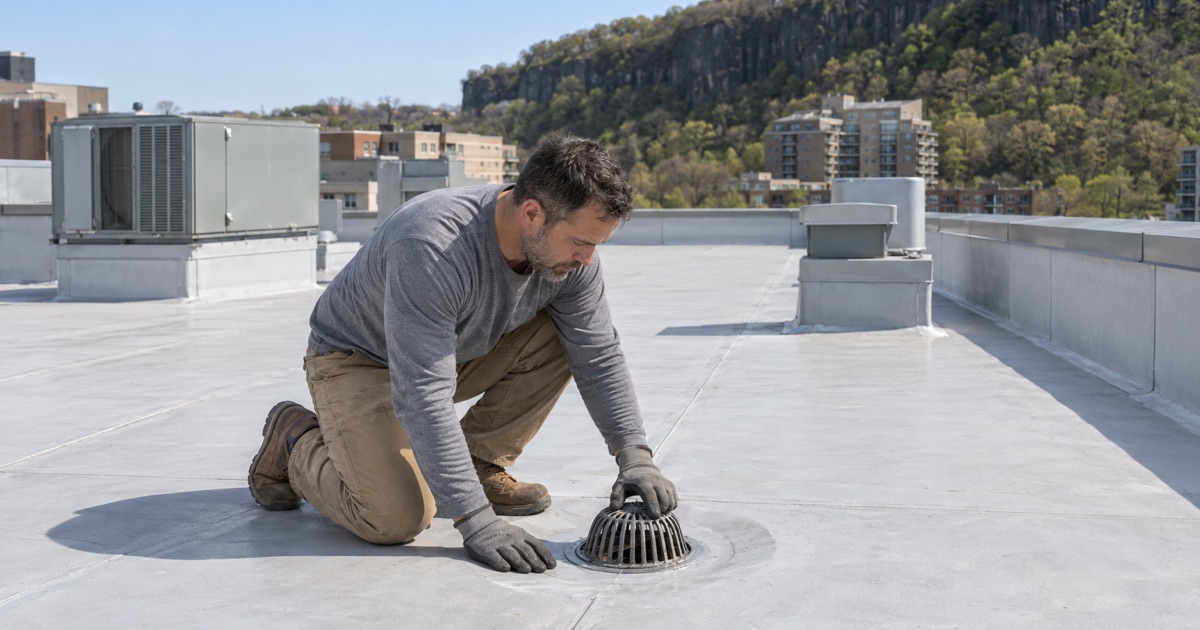
The housing in Edgewater is dominated by big buildings. Census survey figures show 48.2 percent of the borough’s 7,872 housing units sit in buildings of 50 or more units, and 38.7 percent of all units were built in 2000 or later. Detached houses make up a small share of the stock. In practice, most of the roof area along River Road is low-slope roofing on mid-rise and high-rise residential buildings rather than pitched shingle roofs.
What a low-slope roof is made of
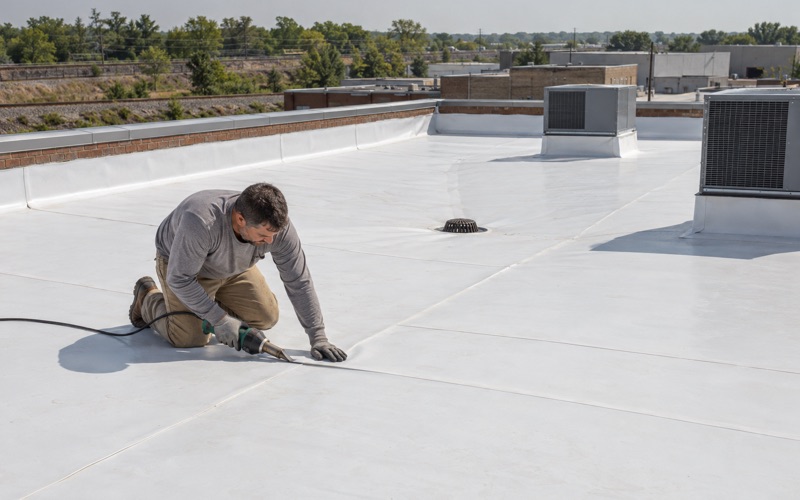
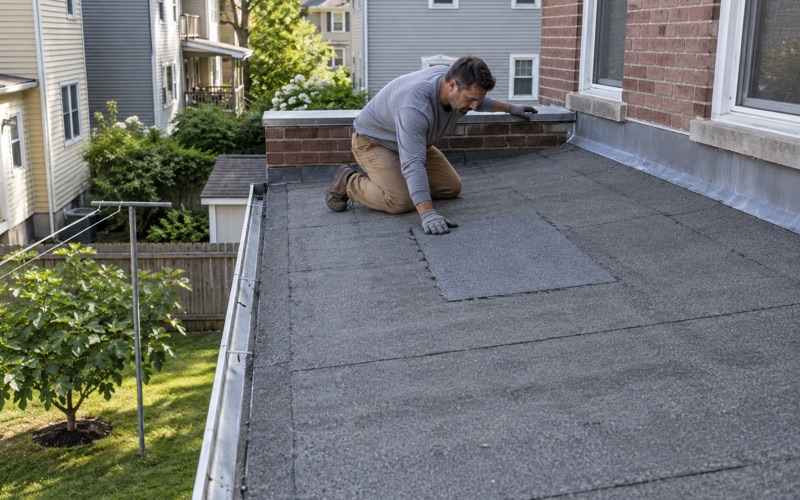
A low-slope roof is typically covered with a membrane rather than shingles. The common systems are single-ply sheets such as TPO, PVC or EPDM rubber, and multi-ply modified bitumen in SBS or APP form. Each one fails in its own way, from opened seams on a single-ply sheet to blistered or cracked laps on modified bitumen, so the first job on any visit is identifying which system is actually up there.
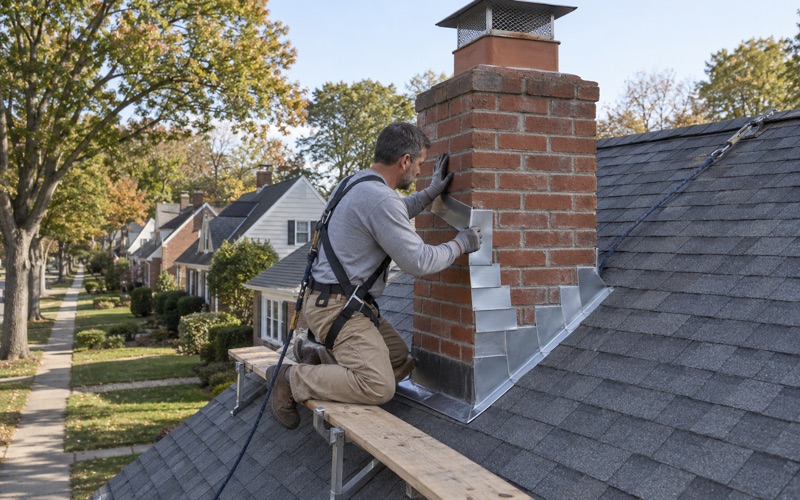
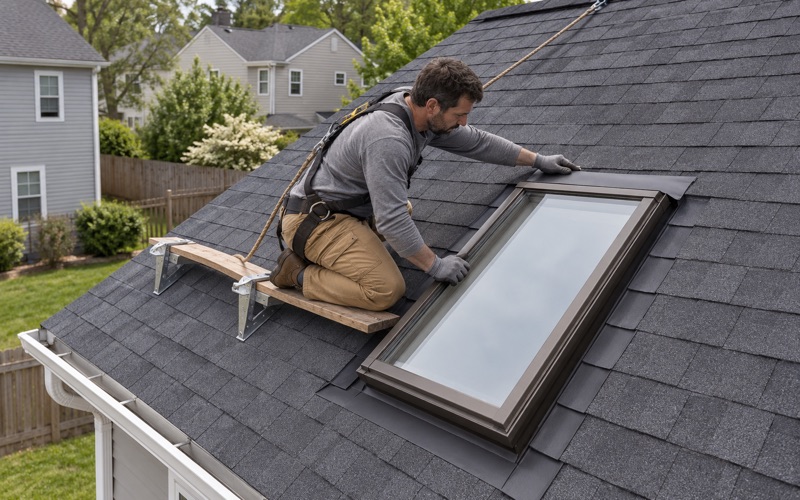
The membrane is only part of the assembly. Below it sit insulation and cover boards, and around it sit the details that cause most leaks: parapet walls, rooftop equipment curbs, pipe penetrations, drains and scuppers. We look at each of those details individually, because a sound field of membrane can still leak at a single poorly sealed curb.
Tracing the water to its source
Water on a flat roof rarely comes through directly above the stain. It travels along the deck, under insulation or down a parapet before it shows up on a top-floor ceiling. On every leak call we check the inside as well as the roof, which in a large building usually means the top-floor unit where the stain appears, a mechanical room or the space under the deck where access allows.
Only after the entry point is found do we price anything. That sequence matters to a board, because paying to patch the wrong spot is how a small leak turns into a second service call and a frustrated resident on the top floor.
Looking for roofing closer to Franklin Lakes? See Roofing Services in Franklin Lakes.
First Membranes and the People Who Approve Them
Because so much of Edgewater went up after 2000, many of these buildings are still on their original roof membrane. A first-generation roof is a different conversation from a third tear-off. The original materials, the installer’s details and whatever has been done since all shape the right next step.
Starting from the building’s own records
Before we scope repair work on an original membrane, we ask to see the manufacturer’s warranty paperwork and the building’s maintenance records. Those documents can set conditions on who may work on the roof and how, and they show which areas have already been patched. We do not assume what any particular building’s warranty says or how old its roof is; we read what the board or agent provides and plan around it.
If no records exist, we say so in writing and document the roof’s current condition with photographs. That gives the association a baseline it did not have before, which is useful whether the next step is a small repair or a reserve conversation.
Boards, managing agents and rental owners
Ownership in Edgewater runs heavily toward shared buildings. Of the borough’s owner-occupied homes, 37.4 percent are apartments in buildings of 50 or more units, and 60.2 percent of occupied units are rented. The person who approves a roof job is therefore usually a condo or co-op board, the managing agent working for that board, or the owner of a rental building, not an individual resident.
We write our scopes with that audience in mind. Tear-off, deck repair, insulation, flashing and drainage work appear as separate lines, so a board treasurer can follow the numbers and a managing agent can present them at a meeting without translating them first. Where New Jersey’s Structural Integrity Law reserve study applies to an association, our written condition notes can be shared with whoever prepares it.
Damaged deck found during the work
On a tear-off, the condition of the deck underneath is not fully known until the old layers come off. When we find damaged decking, we photograph it and show it to the owner’s representative before replacing it, at a per-sheet price already set in the contract. A board then knows in advance what an unexpected deck repair will cost, rather than learning about it on the invoice.
Permits at 55 River Road
New Jersey treats roof re-covering as ordinary maintenance only on detached one- and two-family homes, under N.J.A.C. 5:23-2.7. Edgewater’s mid-rise and high-rise buildings fall outside that item, and so do its attached townhouses and its three- and four-unit buildings. Roof work on those buildings goes through the Edgewater Building Department.
The Building Department and the permit jacket
The department is on the second floor of Borough Hall at 55 River Road, in Room 223, and is open Monday through Friday from 9 a.m. to 5 p.m. Its permit list includes a Construction Permit Jacket, and the borough’s instructions say the jacket must be filled out and returned with each permit application. We prepare the building subcode application and the jacket together so neither one holds up the other.
Building inspections in Edgewater are scheduled Monday through Friday between 10 a.m. and 4 p.m. We plan inspection points into the work sequence so a crew is not standing on a half-finished roof waiting for a slot, and we tell the managing agent ahead of time when an inspector is expected on site.
Paperwork that follows a building
The same department issues certificates of continued occupancy when condo and co-op units are resold or rented. A board with units changing hands benefits from having roof work properly filed and closed out, and we keep a copy of the permit records with the job file so the association has them when an agent or buyer asks.
When rules restrict an overlay
New Jersey’s rehabilitation subcode requires a tear-off rather than another layer when a roof already has two or more layers, or when the covering underneath is slate, wood shake or tile. When that rule applies to a building, we explain the reason before the estimate is written, so the board sees why the scope looks the way it does rather than being surprised by it.
Staging a Tear-Off on River Road
Getting materials up and old roofing down is often the hardest logistical part of a job in Edgewater. Buildings along River Road can sit close to the roadway, which leaves little private space for a debris container.
The container application and the Police Chief’s signature
The borough’s Department of Buildings uses an Application for Placement of Construction Debris Container. It covers dumpsters, receptacles and bins on private or public property, and it asks for the container’s capacity in yards along with placement and removal dates. If the container is going on public property, the Police Chief must sign the application.
The form also asks the applicant to sketch where the container will sit relative to the building, the street and the sidewalk. We complete that diagram with the managing agent or superintendent, because they know the loading areas, the garage entrances and the times residents move in and out. Getting the Police Chief’s signature is part of how we set the tear-off date, not something we chase after the crew is booked.
Working around residents
A large building stays occupied while its roof is replaced. We agree with the board or agent on roof access routes, elevator use, quiet hours and which entrances stay clear, and the agent can pass that schedule on to residents before the first day. Crews working at roof edges follow OSHA fall protection rules.
At the end of each work day, the area around the building is cleaned, including a magnet sweep for roofing nails at the entrance, the walks and any landscaped strip near the container. On a busy street with shared sidewalks, that daily cleanup matters as much to neighbors as it does to residents.
Older buildings in the borough
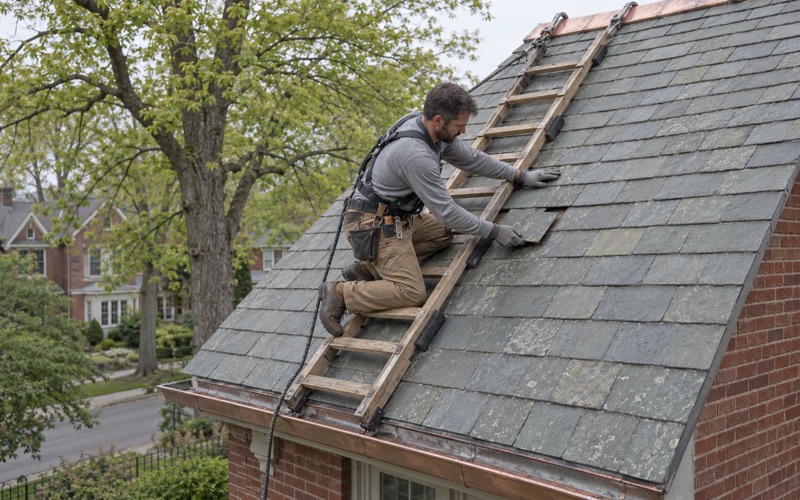
Some of the borough’s housing is much older. About 10.8 percent of the borough’s housing units were built before 1940, and the borough’s own historic Borough Hall received a 2008 New Jersey Historic Trust grant that paid for roof replacement, copper repairs and repointing. On older buildings with copper details or sound slate, we repair with matching material, copper nails and slate hooks rather than tearing off by default, and flashing is replaced along with the roof instead of being reused.
Weather and the river
Edgewater lies along the Hudson River, and tall buildings near open water are exposed in ways a sheltered house is not. That is a general engineering consideration rather than a local measurement, and we plan membrane attachment and edge details with it in mind. A roof keeps rain out of a building; it is not flood protection, and we do not describe it as one.
- 20+ Years on North Jersey Roofs
- Itemized Written Scopes
- Attic-to-Ridge Leak Tracing