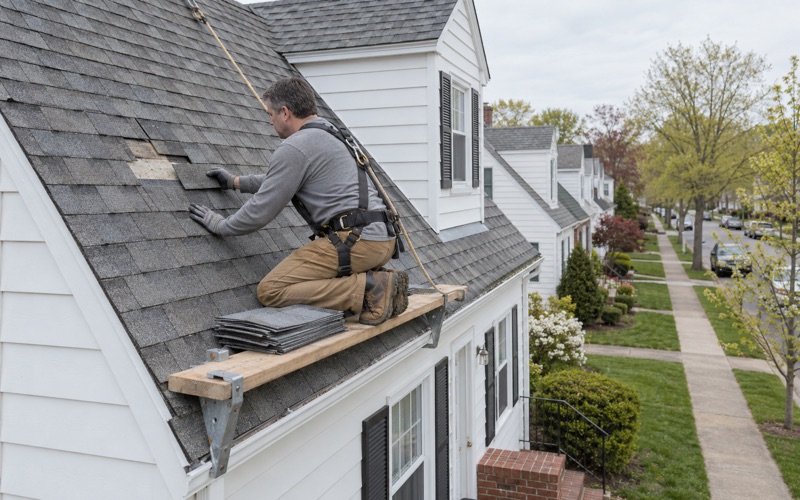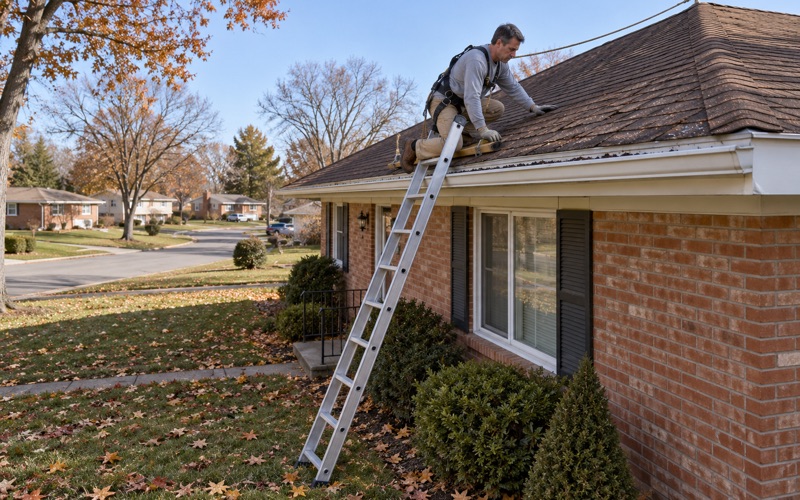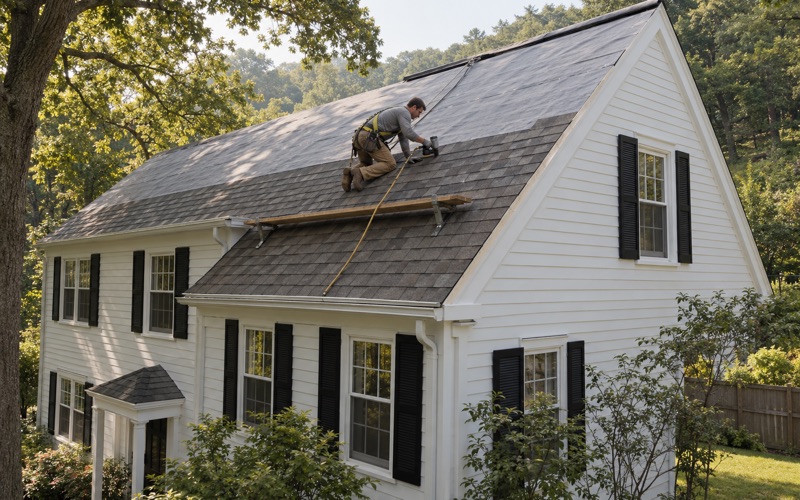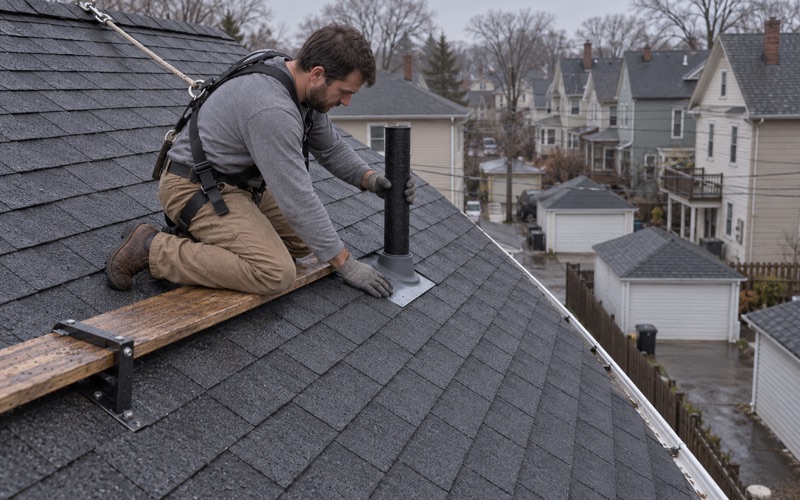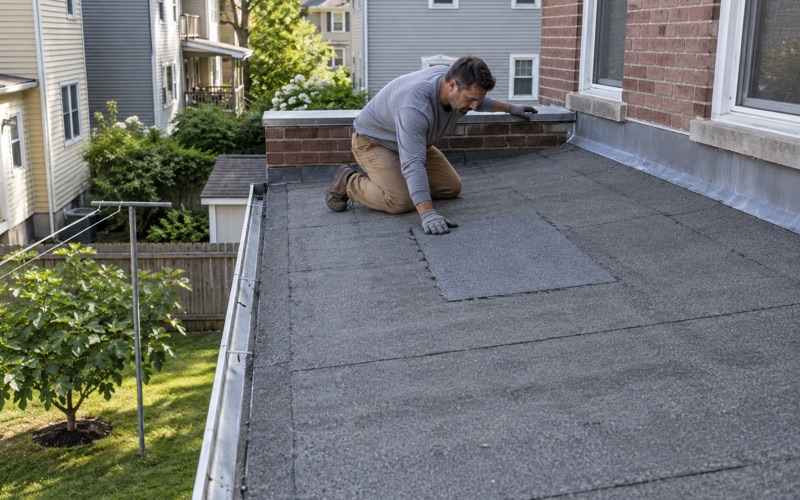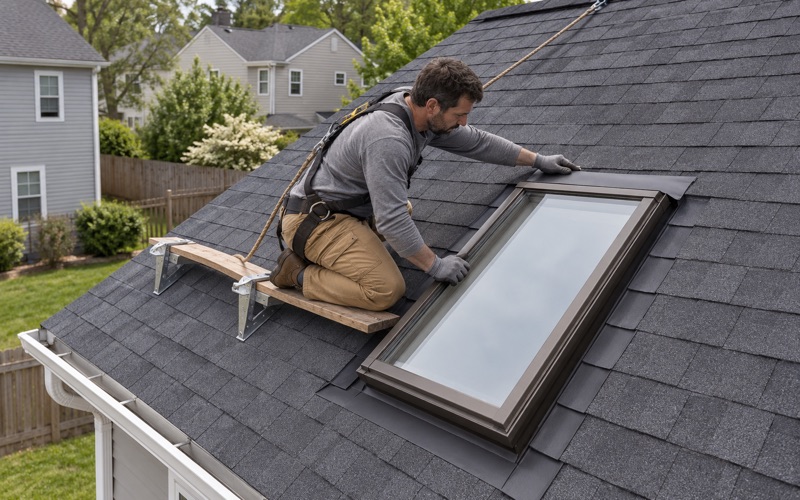
Clifton Elite Roofing has handled roofing in Fairview and the surrounding part of Bergen County for more than 20 years, and the question we settle first on most jobs here is not which shingle to buy. It is whether the work in front of us is a plain re-cover the state treats as routine, or a job that has to be permitted and then closed out with the borough. Getting that answer right before the first bundle lands on the roof is what keeps an owner out of trouble later.
Our visits start the same way whether the call is about a drip in a back bedroom or a full tear-off. We look in the attic as well as on the roof, so the water is traced to where it actually enters, and we tell you honestly whether a repair will hold before replacement comes up at all. If replacement is the right call, the written scope breaks tear-off, decking, underlayment, flashing and ventilation into their own lines, so you can hold our number next to anyone else’s. The rest of this page walks through how that plays out on a Fairview house, from the paperwork side as much as the roofing side.
Fairview’s Two-Family Houses and the Routine Re-Cover
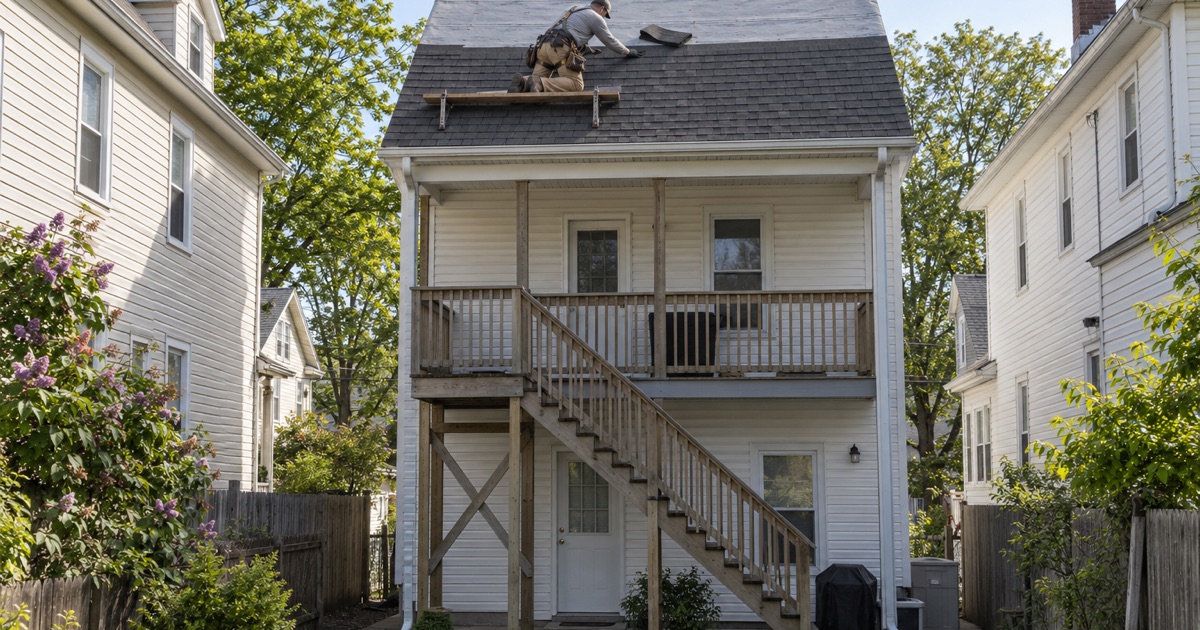
The typical Fairview roof sits over more than one household. Census figures for the borough count 5,566 housing units, and 29.2 percent of them are in two-unit buildings, with another 18.4 percent in three- and four-unit buildings. About two-thirds of occupied homes are rented, so the person who calls us is often an owner who lives on one floor and rents the other. Half the housing stock was built before 1960, and roughly a quarter predates 1940.
What the state calls ordinary maintenance
New Jersey’s construction rules carve out a list of work that needs no permit, no inspection and no notice to the local office. One item on that list, N.J.A.C. 5:23-2.7(c)1x, is the repair or replacement of existing roof covering on a detached one- or two-family dwelling. A detached two-family house in Fairview fits that description, which means a straightforward shingle replacement on it is ordinary maintenance and never enters the borough’s inspection cycle.
The same section also lists exterior gutters and leaders, so swapping seamless aluminum gutters on that house sits in the same category. What the rule does not do is set a layer limit or say anything about the sheathing underneath; it only describes which covering work skips the permit process.
Scheduling around two floors
When both units are occupied, we plan the job with the upstairs tenant in mind as well as the owner. That means telling the second-floor household which day the crew arrives, where we need access to the attic hatch or a rear window, and when the noise of tear-off will start. Owners tell us that a little notice up front saves a lot of awkward phone calls during the week.
At the end of every work day the yard, driveway and gutters are cleaned, and we run a magnet over the lawn and walks for stray roofing nails. On a lot shared by two families and their cars, that daily sweep matters more than it would on a single-family house with one driveway.
Looking for roofing closer to New Milford? See Roofing Services in New Milford.
When a Fairview Roof Job Becomes Permit Work
The ordinary-maintenance exemption is narrow, and several common Fairview situations fall outside it. Knowing which side of the line a job sits on is part of what we explain before an estimate is written, not after the crew is on the roof.
Buildings the exemption does not reach
The rule names detached one- and two-family dwellings and nothing else. A roof covering an attached house, such as one half of a pair sharing a party wall, is not covered by that item. Neither is a three- or four-unit building, and Fairview has more than a thousand units in buildings of that size. Re-roofing any of those is work that goes to the Fairview Building Department at 59 Anderson Avenue.
That is not a penalty for owning a bigger building; it is simply how the state code draws the line. We tell owners at the first visit which category their house falls into, and the written scope says so.
Decking, framing and other structural repairs
Even on a detached two-family house, a job can grow past the covering itself. Rotted rafters, a sagging ridge board, or framing that has to be sistered or replaced are structural work, not a re-cover. When we find that kind of damage, we stop and explain how it changes the paperwork before anything structural is touched.
Decking is handled the same careful way on every roof. Damaged sheets found once the old shingles are off are photographed and shown to the owner before they are replaced, at the per-sheet price written into the contract. Nobody learns about a decking charge for the first time on the final invoice.
Overlays and layer counts
The state’s rehabilitation subcode, N.J.A.C. 5:23-6, calls for tear-off when a roof already carries two or more layers, or when the existing covering is slate, wood shake or tile. If an overlay is off the table for one of those reasons, we tell you why before the estimate rather than quietly pricing the tear-off. Many older Fairview houses have been re-covered more than once, so we count layers at the eave before we quote anything.
Closing Out a Permit: The Final Inspection at 59 Anderson Avenue
Fairview’s Building Department publishes a rule many homeowners have never seen spelled out so plainly: “Final inspections are required for all work or penalties will be issued.” For a roof job that was permitted, that sentence is the whole point of this section. Pulling a permit is only half of the obligation, and the job is not finished in the borough’s eyes until the final inspection is passed and recorded.
Who runs the office
The department sits on the third floor of the Municipal Building at 59 Anderson Avenue. Richard Bolan serves as Construction Official, Zoning Officer and Building Subcode Official, so the same office that reviews the construction side also handles zoning questions. Manny Fernandez is the Electrical and Plumbing Subcode Official, and Roy Riggitano handles the fire subcode.
The office is open Monday through Friday from 8:30 a.m. to 1:00 p.m. and again from 2:00 to 4:30 p.m., and its phone number is 201-943-5485. It takes payment in cash with exact change, by check or by money order, and it does not accept credit cards, which is worth knowing before anyone drives over to pay a fee.
How we plan for the close-out
On permitted work, we treat the final inspection as a scheduled step in the job rather than an afterthought once the dumpster is gone. That means keeping the flashing, ventilation and any structural repairs visible and documented until they have been seen, and making sure the owner knows the inspection date. If the inspector asks for a correction, we come back and make it so the permit can close.
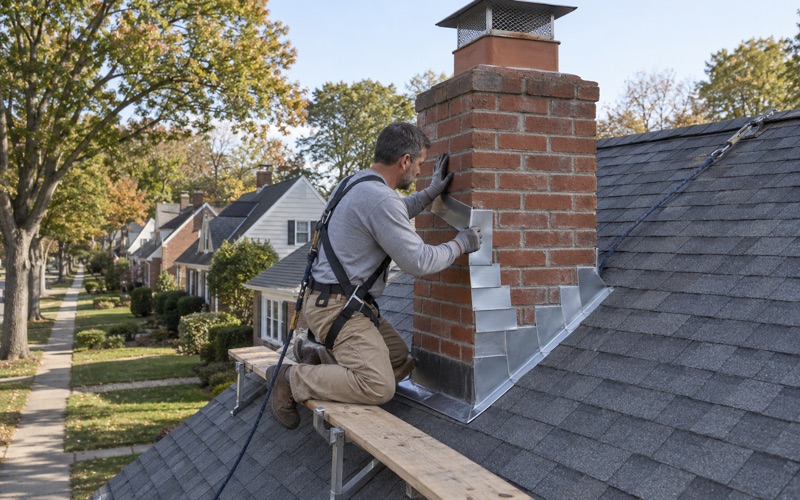
We will never promise that a job will pass inspection; that decision belongs to the borough’s inspector, not to us. What we can promise is work done to the scope on paper, with step, counter and chimney flashing replaced rather than reused under new shingles, and ventilation balanced between soffit intake and ridge exhaust.
Open Violations, Dumpsters and Planning the Week
The reason a final inspection deserves attention in Fairview is the enforcement language that sits next to it. The Building Department’s page states that penalties “start at $2,000 with an additional $2,000 to be added on each week the violation remains open.” That is the borough’s published rule, and it is why we talk about closing out permitted work at the first meeting rather than at the last.
Why the weekly figure matters to an owner-landlord
A penalty that grows each week rewards whoever keeps track of the calendar. An owner who rents out the second floor and works full time may not notice that a permit is still open months after the roofers left. On permitted jobs we tell the owner where the permit stands at the end of the work, so an open item does not sit unnoticed.
None of this applies to the routine re-cover of a detached one- or two-family house, which never opens a permit to begin with. The weekly penalty concerns work that should have closed out with the borough and did not.
The street dumpster window
Fairview’s density shapes the logistics of a tear-off. The borough covers about 0.85 square miles with close to 17,800 people per square mile, so many lots have no room for a container in the driveway. The Building Department requires a permit only when the dumpster goes on the street; one parked in a driveway needs none.
The street permit costs $50 for the first three days and $25 for each additional day, up to a maximum of seven days. A roof planned around a street container therefore has a hard seven-day window, and we build the schedule to fit inside it, with material deliveries and tear-off sequenced so the container is not sitting idle while days run out.
Other things we fold into the schedule
Some Fairview roofs carry solar panels, and we put the panel removal and reinstall into the schedule from the start rather than discovering them on the morning of tear-off. Contracts follow New Jersey’s home improvement rules, including the three-business-day cancellation right on contracts over $500, so you have time to read the scope after you sign.
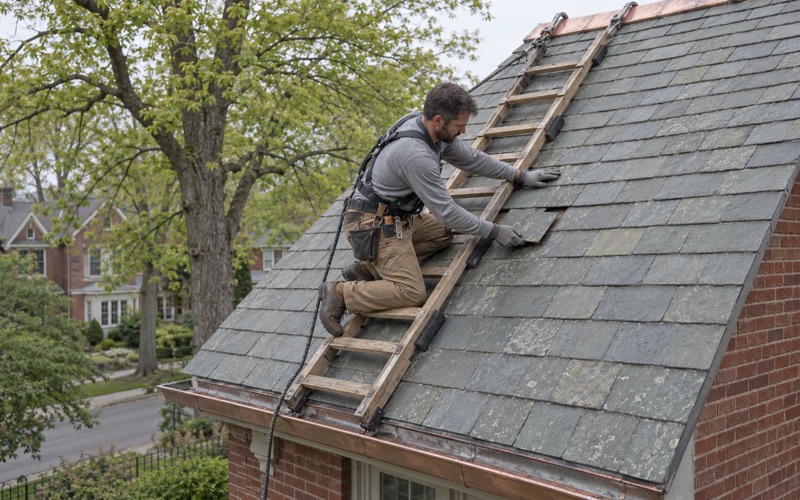
If a storm leaves damage, we photograph it and write it up for your own claim, and the crew will meet your insurance adjuster on site when you ask. On older houses with sound slate, we repair it with matching slate, copper nails and slate hooks instead of tearing it off by default. Whatever the job, the first thing you get from us is a straight answer about what the roof needs and how the borough’s rules apply to it.
- 20+ Years on North Jersey Roofs
- Itemized Written Scopes
- Attic-to-Ridge Leak Tracing