Clifton Elite Roofing handles flat roof repair in Clifton, NJ, serving surrounding cities including Woodland Park, Wallington, Wood-Ridge, Rutherford and Totowa. Over more than 20 years we have repaired flat and low-slope roofs on front porches, rear kitchen additions, sunrooms, garages, two-family back sections and small commercial buildings.
Flat roofs fail for different reasons than shingle roofs. Water sits instead of running off, seams and flashings carry the whole load, and a small opening can soak insulation over a wide area before a stain appears inside. We repair the actual failure point and replace wet material rather than coating over it, because a patch sealed over a wet roof only traps the problem.
Repairs by Membrane Type
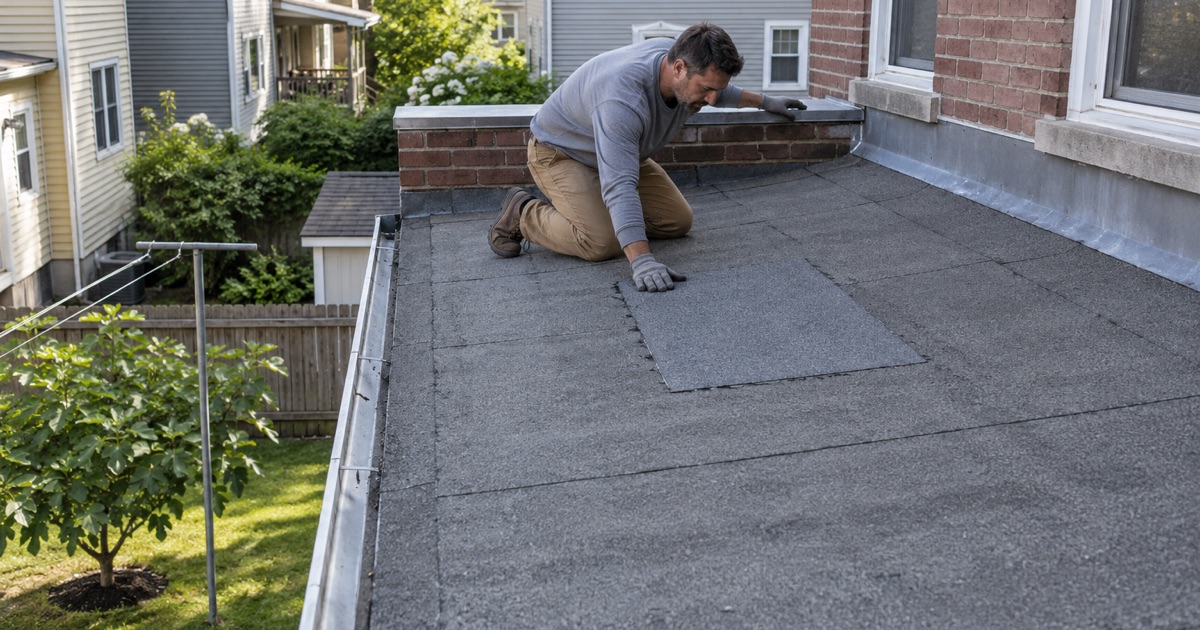
EPDM Rubber Roof Repair
Rubber roofs usually fail at their seams, at the perimeter where the membrane has shrunk and pulled at the flashing, and around penetrations. We clean and prime the rubber, install compatible seam tape and cover strips, and reflash edges and curbs with uncured EPDM where the shape calls for it.
Punctures from dropped tools, fallen branches or foot traffic are patched with cured EPDM over a primed area large enough to give the adhesive a full bond. A dab of caulk over a rubber puncture rarely survives a single winter.
TPO and PVC Repair
TPO and PVC seams are welded with hot air, so a proper repair welds new membrane onto a cleaned, prepared surface rather than gluing over it. Older TPO can become difficult to weld as it ages, and we test a sample weld before committing to a repair approach.
Where a weld will not take, an adhered cover strip or a patch with a compatible primer can still give a reliable repair. We explain which method we are using and why, because the right answer on a ten-year-old TPO roof is not always the same as on a new one.
Modified Bitumen and Built-Up Roof Repair
SBS and APP modified bitumen and older built-up tar-and-gravel roofs blister, crack and lose granules as they age. We cut out blisters and damaged sections, dry the area, and torch or adhere new cap sheet with well-lapped edges, or rebuild plies on built-up roofs, so the repair bonds to the layers around it.
A web of fine surface cracks, often called alligator cracking, means the top layer has dried out and lost flexibility. We assess how deep it goes before deciding between a targeted repair, a restoration over sound plies, or replacement.
Where Flat Roofs Leak
Seams, Edges and Wall Flashing
The joints between sheets and the edges where a flat roof meets a parapet, a house wall or a pitched roof carry most of the risk. We check seam adhesion along the full length, rebuild base and counter flashing at walls, and replace loose or rusted edge metal that lets wind lift the membrane.
Drains, Scuppers and Ponding
Water still standing 48 hours after rain is ponding, and it ages any membrane faster. We clear and reflash drains and scuppers, check that edge metal is not damming water, and look for sagging decking that creates low spots. Where the roof simply lacks slope, we explain options such as tapered insulation at the next replacement.
Skylights, Vents and Rooftop Equipment
Curb-mounted skylights, plumbing vents, exhaust fans and air conditioning units all puncture the membrane. We reflash curbs and install proper pipe flashings, and check where service technicians have walked or set equipment down, since that damage often goes unnoticed until it leaks.
Air conditioning condensate lines that drip onto the roof are another quiet source of wear. We reroute or extend them to a drain or a protected spot, so a steady trickle does not erode the membrane or keep one patch of the roof permanently wet.
Flat Roofs on North Jersey Houses
Two-Family Houses With a Flat Rear Section
Many two-family houses in this area pair a pitched front roof with a flat roof over the rear kitchens or back stairs. The flat section often wears out first, and the joint where it meets the pitched roof is a frequent leak point. We repair or rebuild that transition with flashing that carries water off the pitch and over the membrane, not under it.
Porch Roofs and Rear Additions
Low porch roofs and one-story additions are often too flat for shingles, yet some have been shingled anyway, which leads to slow leaks at every seam. We repair the existing roof where it is sound, and when it is not, explain the membrane or low-slope metal options that suit the pitch.
Wet Insulation and Decking
When water has been getting under a membrane for a while, the insulation and decking beneath it hold moisture. We probe around the leak to find the extent of the wet area, cut it out and replace it, then close the membrane over dry material, so the repair does not trap moisture against the deck.
Repair Versus Replacement
When Repairs Make Sense
A roof with localized damage, sound seams elsewhere and dry insulation is a good repair candidate, and repairs can buy many more years of service. We document what we found with photos and give you a straight assessment of how much life the rest of the membrane has.
When It Is Time for a New Flat Roof
Widespread cracking, saturated insulation, repeated failures in new places and severe ponding all point toward replacement. On a house, replacing the roof covering is ordinary maintenance in New Jersey and needs no permit, and on commercial and larger multifamily buildings we handle the work through the construction office.
- 20+ Years on North Jersey Roofs
- Itemized Written Scopes
- Attic-to-Ridge Leak Tracing