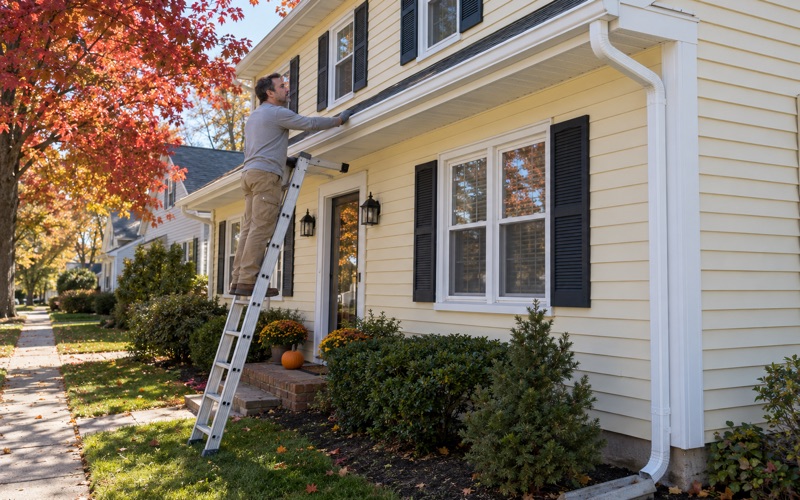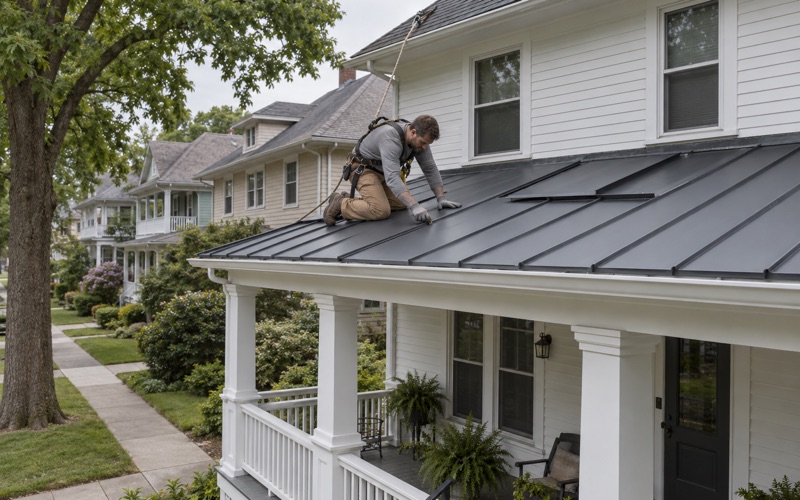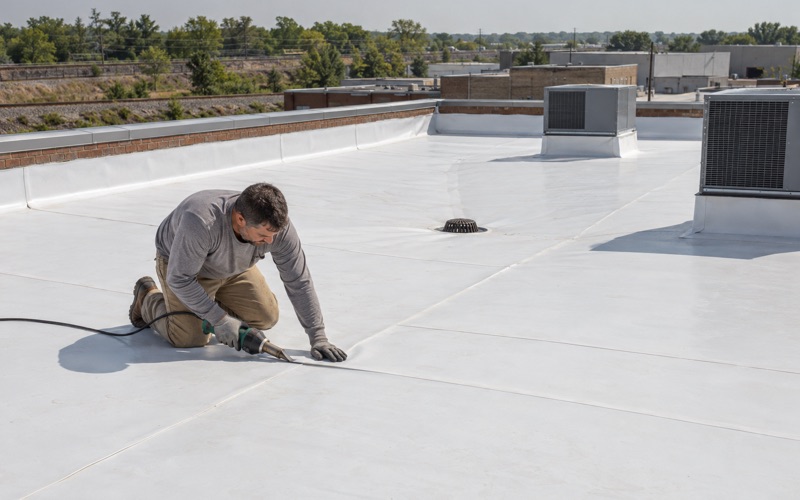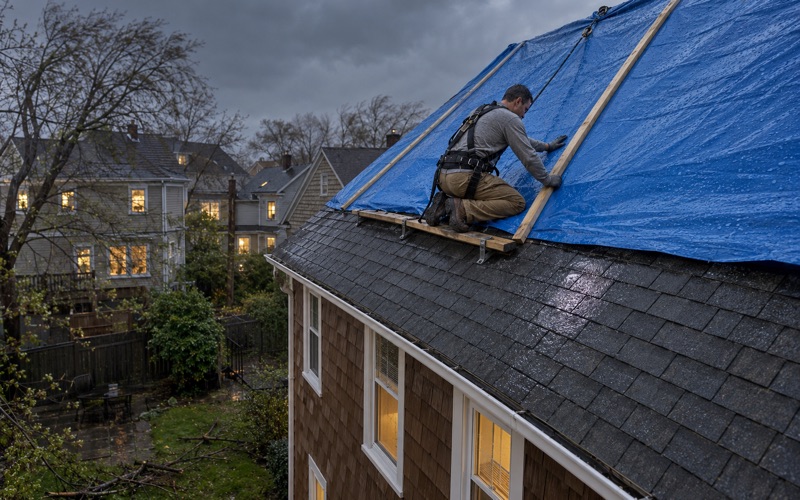
Clifton Elite Roofing has spent 20+ years on roofing in Franklin Lakes and across this part of Bergen County, and the question we hear most here is not about shingle color. It is about scope: which parts of a big roof job are plain re-shingling, and which parts cross into work the borough wants on paper first. We answer that on the first visit, before a number is written down.
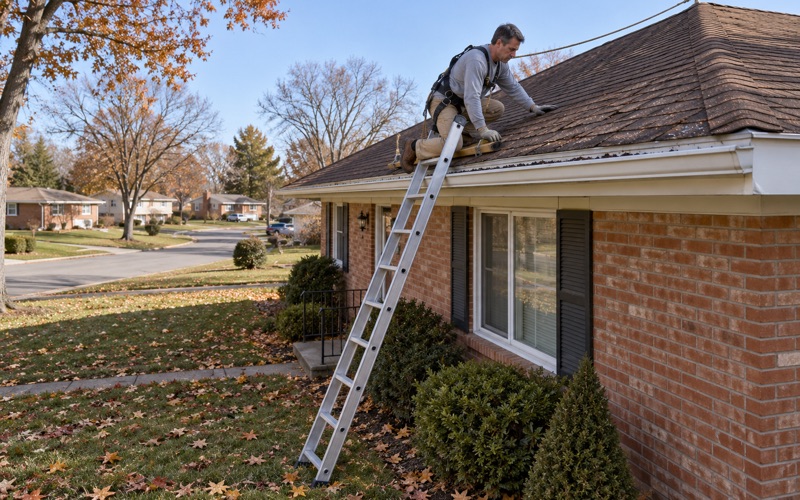
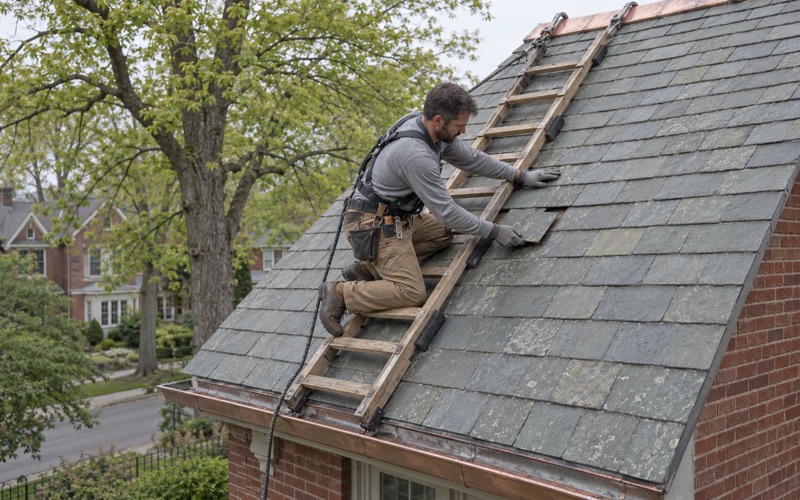
Our first job on any call is to tell you honestly whether the roof can be repaired. Replacement only comes up after that answer, and if a leak brought us out, we go into the attic as well as onto the shingles so the water is traced to the spot where it actually enters.
When a replacement does make sense, the written scope breaks tear-off, decking, underlayment, flashing and ventilation into their own lines. That lets you hold our estimate next to anyone else’s and compare them item by item, which matters on a house where every one of those lines is larger than average.
Ten-Room Houses and the Roofs Over Them
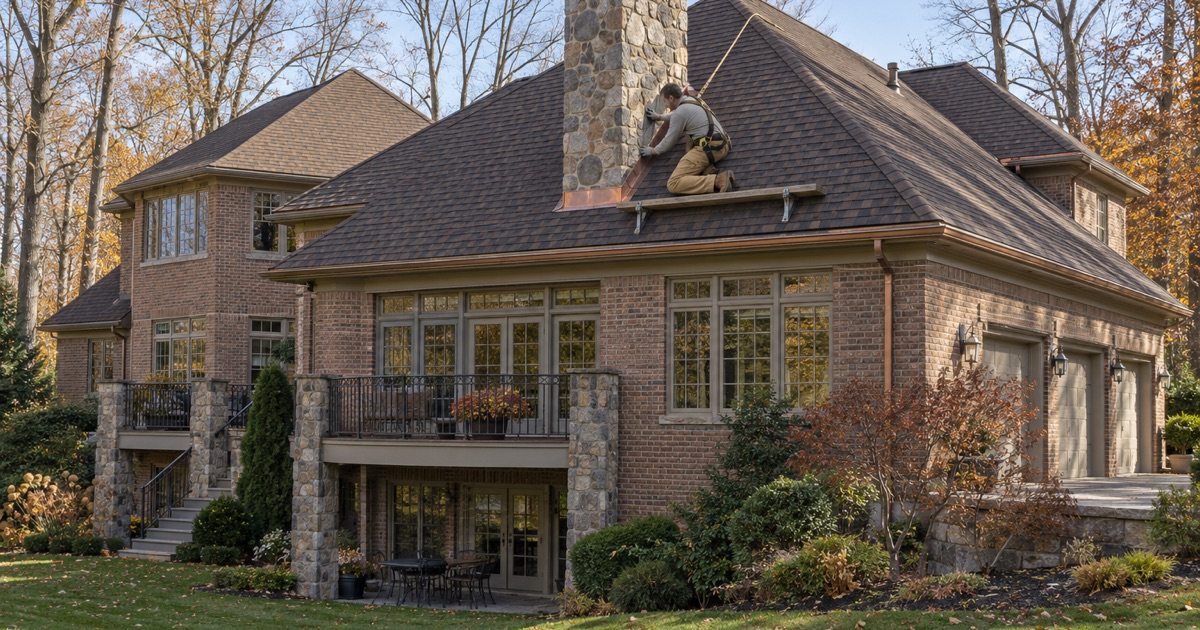
Franklin Lakes housing runs big. The Census Bureau’s 2024 five-year American Community Survey puts the median house in the borough at ten rooms and the median owner-occupied value at $1,264,000, and 87.9% of the 3,878 housing units are detached single-family homes. The median year built is 1982, so many of the roofs we look at sit on post-1960 houses that are well into their second or third covering.
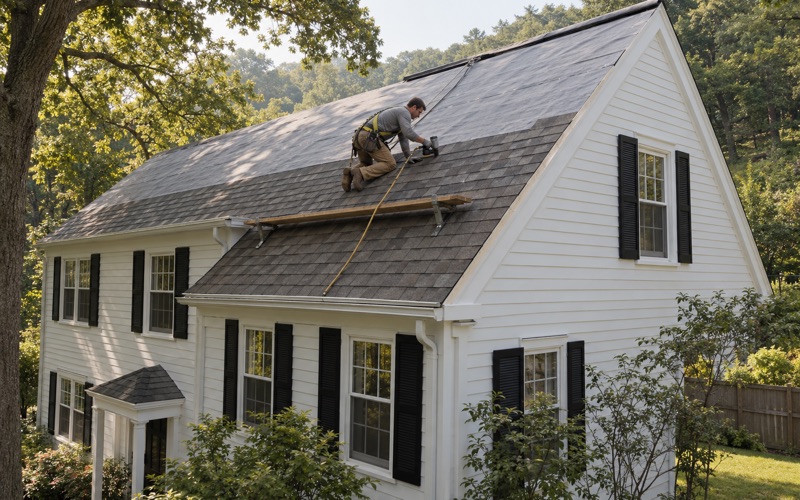
A ten-room footprint rarely sits under one simple gable. It usually means wings, dormers, a garage tied in at an angle and two or three chimneys or vent stacks breaking the plane. Each of those junctions is a place for water to get in, and each one is priced and inspected on its own.
More Planes Mean More Valleys and More Flashing
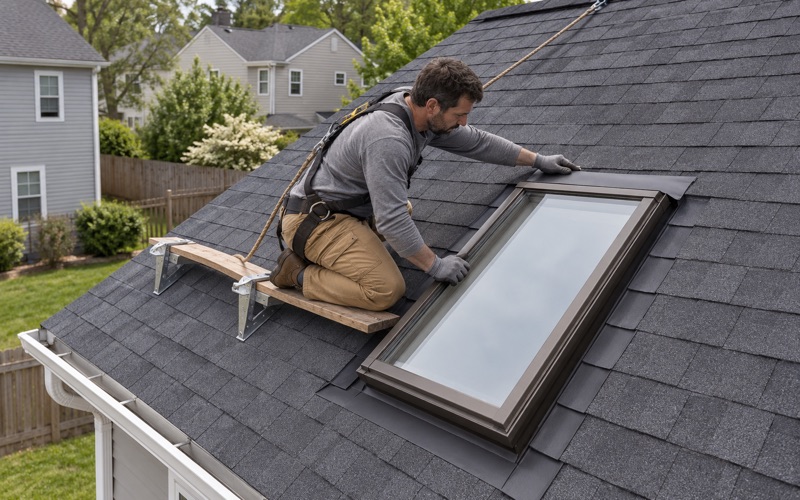
Every wing meeting the main roof creates a valley, and every wall that rises above a lower roof needs step flashing tucked behind the siding with counter flashing over it. On a large house we often count far more linear feet of flashing than on a ranch of the same age, which is why we never treat it as a footnote in the estimate.
We replace step, counter and chimney flashing with the roof instead of nailing new shingles over the old metal. Old metal that has been bent, sealed and resealed rarely lies flat behind a new course of shingles, and on a complicated roof there are simply more places for that to go wrong.
Where a lower roof dies into a sidewall at the eave, we add kick-out flashing so the water is thrown into the gutter instead of down the siding. It is a small piece of metal, but on a house with several wings it is repeated many times, and every one that is missing tends to show up as stained trim or soft sheathing below.
Ventilation Across a Long Ridge
A long, broken-up ridge line can make balanced ventilation harder than it looks from the driveway. Hip sections, short ridges and finished rooms over garages all cut into the exhaust and intake that a straight attic would have. We check ventilation on every replacement and balance soffit intake against ridge exhaust using net free area, rather than adding vents wherever they happen to fit.
Where the attic is broken into separate spaces, we look at each one. A room over the garage with no soffit path can trap heat and moisture even when the main attic is fine, and that difference shows up years later as curled shingles on one wing only.
Looking for roofing closer to Dumont? See Dumont Roofing.
What the Borough’s Permit Matrix Says About Roofs
The Franklin Lakes Construction Department publishes a Permit Application Requirements matrix for residential one- and two-family work. Its ROOF row reads, in full, “No permits on residential if no framing or sheathing.” That is the borough’s own statement, and it lines up with the state’s ordinary maintenance rule in N.J.A.C. 5:23-2.7, which treats replacing roof covering on a detached one- or two-family dwelling as ordinary maintenance.
So a straightforward re-shingle in Franklin Lakes is not a permit job by the borough’s own table. The two words that change that are framing and sheathing, and on large older houses those are exactly where surprises tend to hide.
When Rotted Sheathing Turns a Re-Roof Into a Permit Job
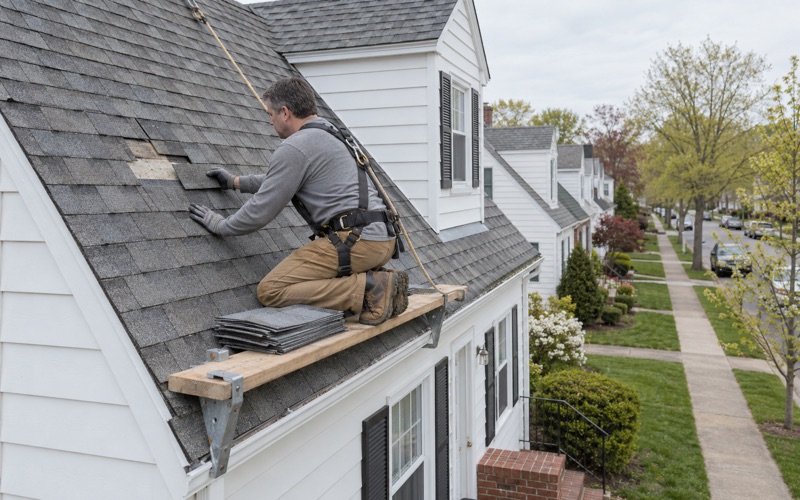
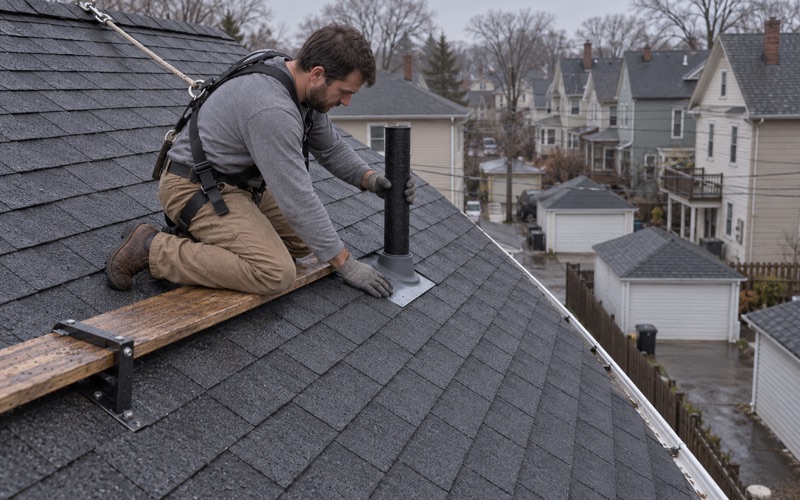
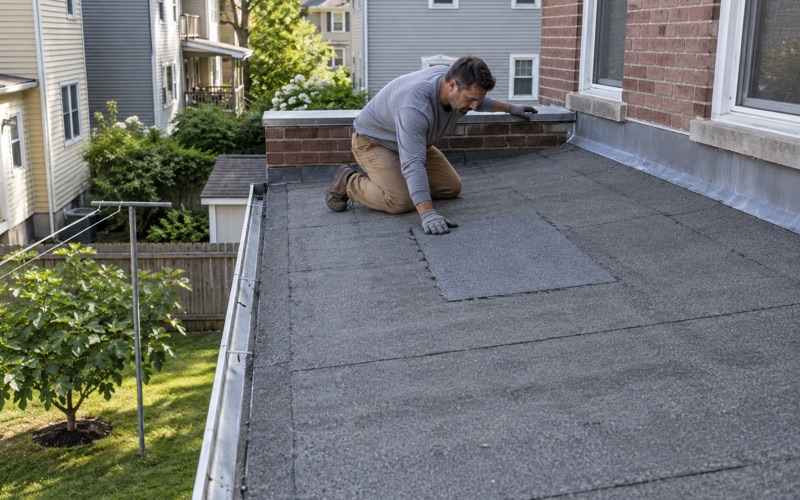
Nobody can see the decking until the old shingles come off. Soft plywood near a valley, rot at an eave where an ice dam sat for years, or delaminated boards under a failed pipe boot all show up on tear-off day, and the matrix language means replacing that sheathing moves the job out of the no-permit row.
When we find damaged decking, we photograph it and show it to you before any of it is replaced, and the price per sheet is already written into the contract. You are not handed a surprise number from the roof. If the amount of sheathing involved means the construction office needs to be involved, we stop and say so instead of quietly carrying on.
We also talk through likely decking condition before the contract is signed. Attic stains around a chimney, daylight at a ridge or a roof that feels soft underfoot near a valley are all clues we look for from inside and out, so a sheathing allowance in the estimate is based on what we saw rather than a guess.
Working With the Construction Office on DeKorte Drive
The Construction Department sits in borough hall at 480 DeKorte Drive and keeps weekday hours, closing early on Fridays. Gary Goodman serves as Construction Official and Building Subcode Official, and inspections are booked only through the SDL Portal, which needs an account.
We plan around that portal schedule when a job needs it, so an inspection does not leave a roof open longer than it has to be. Our contracts are written to New Jersey’s home improvement rules, including the three-business-day cancellation right on contracts over $500, so the paperwork on our side is in order before the borough’s starts.
Chimneys, Flues and the Certification Rule
The same matrix that frees plain re-roofing treats chimneys very differently. The CHIMNEY REPAIR row calls for a building permit with 2 sets of plans and notes “Chimney cert required for flue repair.” The CHIMNEY LINER row requires building and mechanical permits, a chimney certification, and states plainly that a liner “Cannot be done by homeowner.”
On a big Franklin Lakes house, the roof and the chimney are usually one conversation. A tear-off exposes the base of every chimney, and that is when cracked crowns, loose brick and flashing that was once sealed with tar instead of set into a reglet all become visible.
Flashing Work Versus Chimney Repair
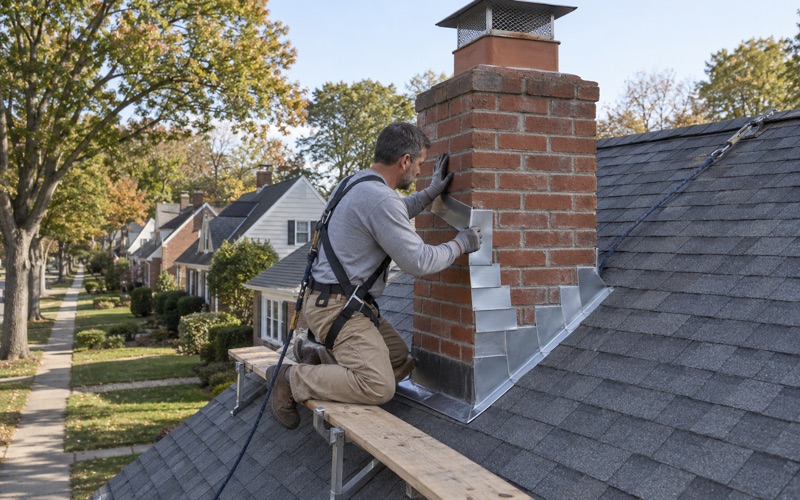
Replacing the step flashing, counter flashing and cricket around a chimney is part of the roof. We cut the counter flashing into a reglet in the mortar joint, build or rebuild a cricket on the uphill side of wide chimneys, and tie everything into new ice and water barrier so the chimney stops sending water into the attic.
Rebuilding brick, a crown or the flue itself is a different category in the borough’s eyes. When the masonry needs that kind of work, we tell you before the estimate is finalized, explain that the borough treats it as a permitted repair, and sequence the roof so the chimney work and the new flashing do not undo each other.
We do not reline flues or certify chimneys ourselves, and we never suggest that a roof crew can sign off on that work. Our part is to make sure the chimney is ready for its own inspection and that the roof around it is finished properly once the masonry and flue work are done.
Why the Order of Work Matters
If the chimney is repointed or rebuilt after the new roof goes on, the new flashing usually has to be pulled back and reset, which risks damage to brand-new shingles. Getting the chimney work done first, or at least scheduled with a clear handoff, keeps the flashing tied in once and correctly.
The same planning applies to rooftop solar, which the matrix routes through zoning and survey review as well as building, electrical and fire permits. When panels are on the roof, we build their removal and reinstall into the schedule from the start rather than discovering it on the day.
On a large house, that also means checking where the panels sit relative to chimneys, valleys and vents. A panel array that crowds a chimney cricket or covers a valley can make both the reinstall and future repairs harder, so we look at the layout with you before the old roof comes off.
Getting Torn-Off Shingles Off a Franklin Lakes Property
A tear-off on a ten-room house produces a lot of material, and Franklin Lakes is specific about where it goes. The borough’s garbage instructions list “shingles, roofing material” as construction debris and state that “Construction materials will not be picked up as regular garbage,” pointing residents to Gaeta Recycling for private pricing.
That means every replacement we quote here includes its own container and hauling. None of the old roof ends up at your curb waiting for a pickup that will not come.
Daily Cleanup on a Large Lot
The yard, driveway and gutters are cleaned at the end of each work day, not just on the last one. That includes a magnet sweep for roofing nails across lawns, beds and the driveway, which matters more when a house has long eaves on every side and shingles come down on several faces at once.
We also clear the gutters of granules and debris before we leave each evening. A gutter packed with tear-off grit can overflow in the first rain after the job, and nobody should find that out the hard way.
Service Drops and Rockland Electric
Franklin Lakes gets its power from Rockland Electric Company, the Orange & Rockland subsidiary, rather than PSE&G. When an overhead service drop crosses a roof plane or lands on the house near where the crew is working, protecting or disconnecting it is coordinated with Rockland Electric ahead of time.
We raise that during the estimate rather than on the morning of the job. A service drop is easy to plan around with notice and a real delay without it, and it is one more item that belongs in the written scope instead of a phone call from the roof.
- 20+ Years on North Jersey Roofs
- Itemized Written Scopes
- Attic-to-Ridge Leak Tracing