Clifton Elite Roofing brings more than 20 years of work to roofing in Guttenberg, and the first thing we settle on any job here is logistics: where the truck stops, where the shingles land and how the old roof leaves the block. In a town this compact, those answers shape the schedule as much as the roof itself does.
When a ceiling stains, we go into the attic as well as onto the roof, because water often enters a few feet from where it shows. Once we know where it gets in, you get a plain answer on whether a repair will hold before anyone mentions a new roof. If replacement is the honest call, the written scope breaks out tear-off, decking, underlayment, flashing and ventilation on separate lines, so you can hold it up against any other estimate and compare it item by item.
The rest of this page covers what is particular to working in Guttenberg: the cliff on its east side, the county roads along it, the town office that reviews permits, and the mix of buildings that sit between Kennedy Boulevard and the Hudson.
A Town on the Edge of the Palisades
Guttenberg sits on top of the Hudson Palisades in the northern part of Hudson County, bordered by North Bergen and West New York. Its land area is 0.19 square miles, and the town is only four blocks wide from north to south. Kennedy Boulevard forms the western border, Bergenline Avenue runs north and south through the middle, and the eastern side drops away to the river.
Boulevard East on top, River Road below
Along the cliff, John F. Kennedy Boulevard East runs across the top and River Road, County Route 505, runs along the bottom. Both are Hudson County roadways rather than town streets. That matters to a roofing job because the county, not the homeowner or the contractor, controls what happens along those curbs and walls.
For a house or small building near the Boulevard East side, we think about the county road the way we would think about a neighbor’s driveway. It is shared, it carries traffic that has nowhere else to go, and anything we put on it has to come off again the same day.
Retaining walls and the 2023 rockfall
Hudson County has put the cliff roads into a Local Concept Development study under the NJTPA program for fiscal year 2026. The study covers repairing or replacing retaining walls and stabilizing slopes along Kennedy Boulevard East, Anthony M. Defino Way and River Road in Weehawken, West New York, Guttenberg and North Bergen. The county describes walls from 1 to 40 feet high and slope and cliff locations that exceed 100 feet in places.
The same county description notes that a 2023 Palisade Cliffs rockfall between Kennedy Boulevard East and River Road left road users with limited access while the road was inspected and repaired. The county does not say exactly where in the four towns that happened, and we do not guess. What it tells us is practical: a cliff road can close or narrow on short notice, and a roof schedule along it should have a fallback for delivery day.
Looking for roofing closer to Edgewater? See Roofing in Edgewater.
Getting Materials Up and Debris Out on a Cliff-Edge Block
On a wide suburban lot, a supplier drops a pallet of shingles in the driveway and a dumpster sits on the lawn for a week. Guttenberg rarely works that way. Most buildings sit tight to the sidewalk and to each other, so staging, hoisting and hauling are planned before the first bundle is ordered.
Planning delivery around county roads
When a building fronts on or near Boulevard East, we plan the material drop around the county roadway rather than assuming curb space will be there. That can mean a smaller delivery timed for early morning, a hoist set from a side street, or splitting the load across two days. Where the work touches the county right of way, we check what the county requires before the truck is booked.
We also keep an eye on any notice of wall or slope work along the cliff roads. If a lane is closed for inspection or repair, the delivery moves, not the crew’s safety margin. Planning for that in advance is cheaper than discovering it with a loaded truck idling on the Boulevard.
Tear-off that leaves the block the way we found it
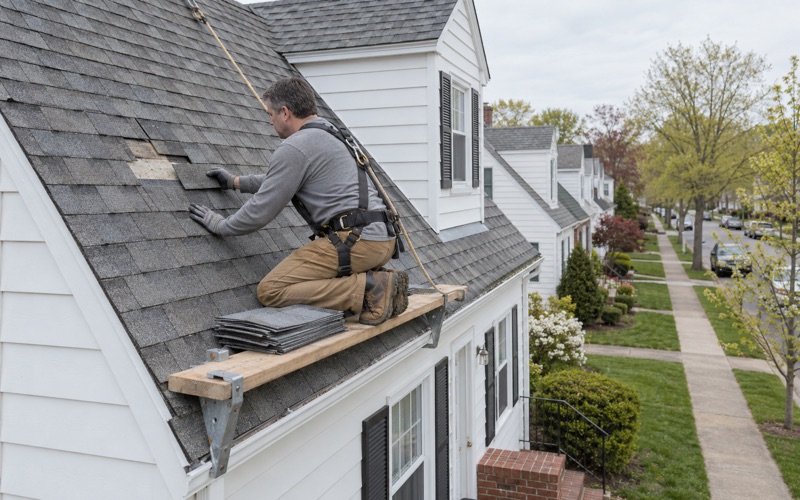
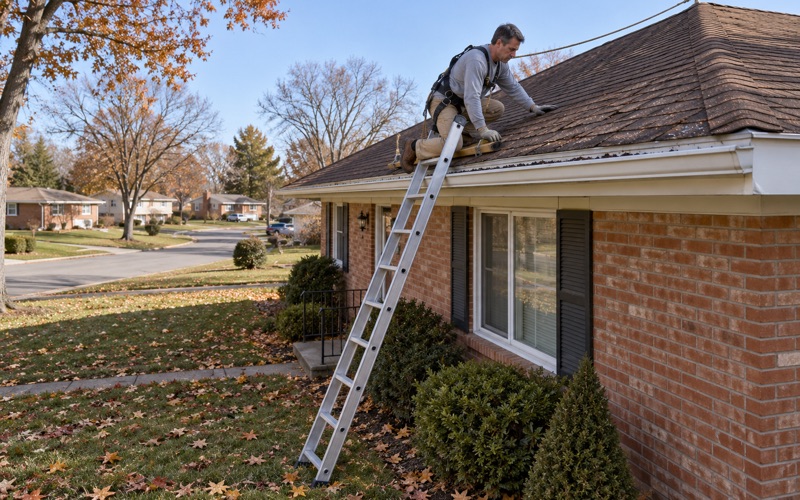
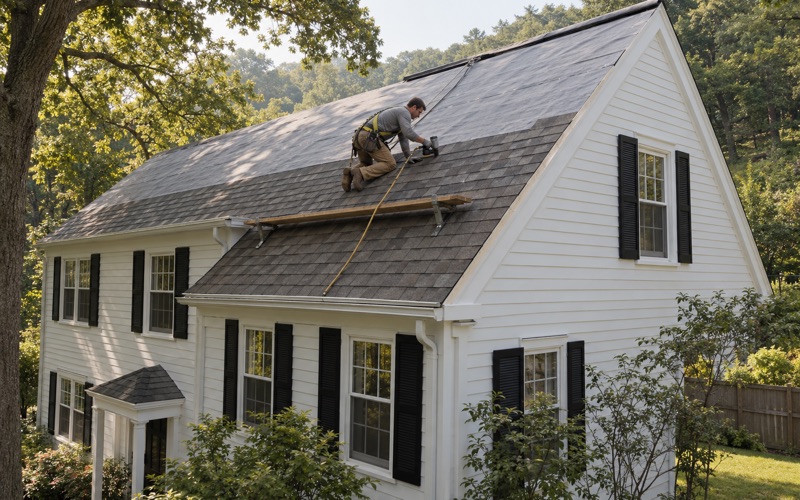
Old shingles and underlayment come off in sections sized to what the container or truck can take that day, rather than piling up on a narrow sidewalk. Every crew member working at the roof edge is tied off under the OSHA fall-protection rule for residential roofing, which applies at 6 feet. On pre-1978 buildings, painted fascia and trim are handled under the EPA lead-safe rule when we have to disturb them.
At the end of each work day we clean the yard, the walk, the gutters and any driveway, and we run a magnet across the ground for roofing nails. On a block where neighbors park inches from the building, that sweep matters as much as anything we do on the roof.
When decking is bad underneath
You rarely see the condition of the roof deck until the old covering is off. If we find soft or rotted sheathing, we photograph it and show you before we replace it, and the price per sheet is already set in the contract. Nothing about the decking is decided for you on the roof.
That same contract follows New Jersey’s home improvement rules, including written notice of the three-business-day right to cancel on contracts over 500 dollars. You have time to read it, ask questions and change your mind.
Guttenberg’s Building Department at 6808 Park Avenue
Guttenberg’s Building Department is the local office that enforces the Uniform Construction Code in town. It works out of Town Hall at 6808 Park Avenue, and a 2025 posting for a department clerk described the office as processing permits and licenses in a high-activity setting. Knowing which roofs go through that office is part of how we set a realistic start date.
Which roofs need a permit here
New Jersey’s ordinary-maintenance list in N.J.A.C. 5:23-2.7 covers the repair or replacement of existing roof covering on detached one- and two-family dwellings. Roof work on an attached house, or on a building with three or more units, is not covered by that item. In Guttenberg, where attached houses and small apartment buildings make up most of the small-building stock, we treat the Building Department as part of the schedule from the first conversation.
We check where your building falls before the estimate is final. If a permit applies, the time it takes goes into the plan, so the crew date we give you is one we can keep.
Overlays, layers and old materials
Under the rehabilitation subcode, a roof that already carries two or more layers, or one that is slate, wood shake or tile underneath, gets a full tear-off rather than another layer. If that rule rules out an overlay on your building, we explain why before we hand you a price, not after.
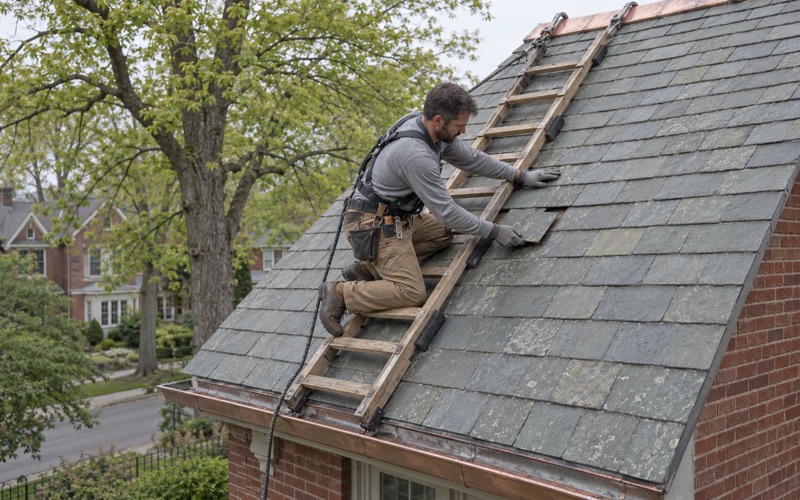
Some of the older buildings in town were built well before 1940. Where we find sound slate, we repair it with matching slate, copper nails and slate hooks instead of tearing it off by default, and we tell you plainly when the slate is past saving.
From Galaxy Towers to the Walk-Ups on Bergenline Avenue
Guttenberg puts two very different kinds of roofs within a few blocks of each other. On the cliff at 7000 Kennedy Boulevard East stands Galaxy Towers, three 44-story towers completed in 1976 and converted to condominiums in 1980. A short walk west, the side streets off Bergenline Avenue are lined with smaller attached buildings, the kind a 1983 description of the town called an old community of two-story row houses.
What the housing numbers say
Census survey figures show how few freestanding houses there are here: only 3.1 percent of homes are detached houses. Two-unit buildings hold 20.8 percent of units and three- and four-unit buildings another 15.8 percent, while buildings of 50 or more units hold 24.7 percent. About 60 percent of occupied homes are rented.
For roofing, that mix means most of the small-building work in town is on attached two-, three- and four-family houses. Large towers like Galaxy Towers are run by their own associations and managers, and that is not the work this page describes. The owner of a row house or a small multifamily building on a side street is.
Attached roofs, parapets and flashing
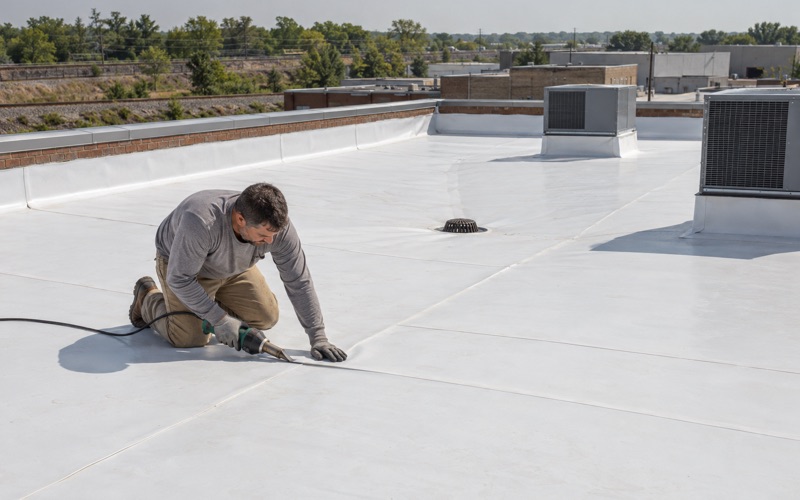
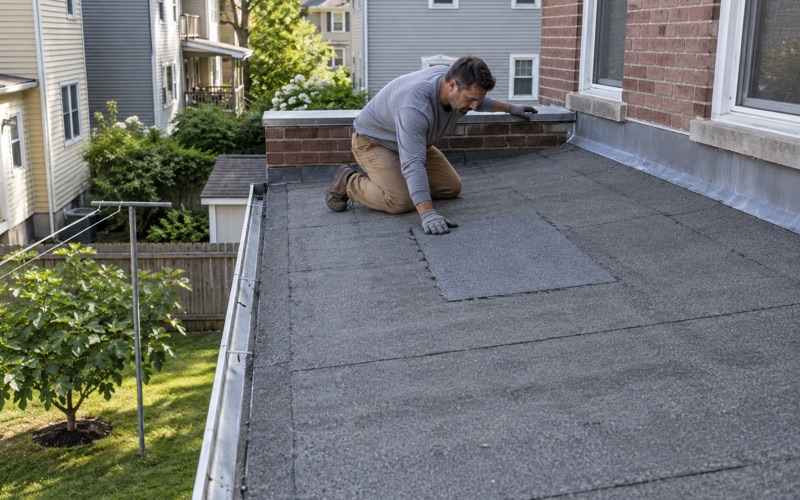
On an attached building, one roof meets the next at a party wall or parapet. A re-roof there includes the tie-in to the neighbor’s roof and the coping or flashing along the shared wall, and we plan that edge before the tear-off starts. Low-slope roofs on these buildings may call for EPDM, TPO or modified bitumen rather than shingles, and we price the option that suits the slope.
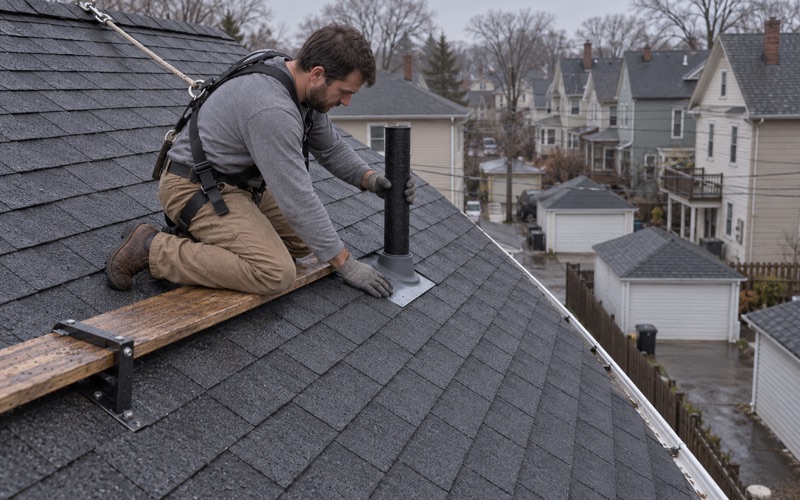
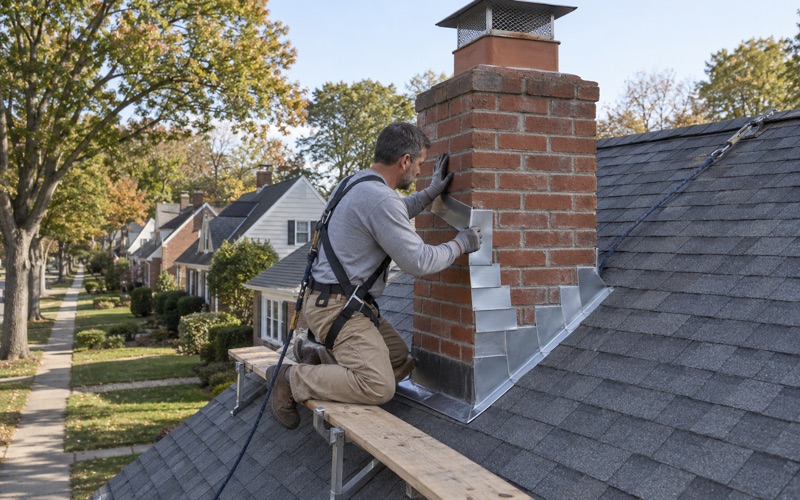
Step, counter and chimney flashing is replaced along with the roof, not bent back and reused under new material. Where a chimney sits on the uphill side, a cricket keeps water from pooling behind it. We also check ventilation on every replacement, balancing intake at the soffit against exhaust at the ridge, or the low-slope equivalent where there is no attic.
Two- and three-family houses with tenants
The town itself recognizes owner-occupied two- and three-family houses as their own category, since they are the only homes eligible for its short-term rental certificate. When the owner lives on one floor and a tenant on another, we schedule with both in mind. The tenant upstairs knows when the crew arrives, how long the noise will last and whether we need access through their unit to reach the roof hatch or attic.
Storms, solar and the insurance claim
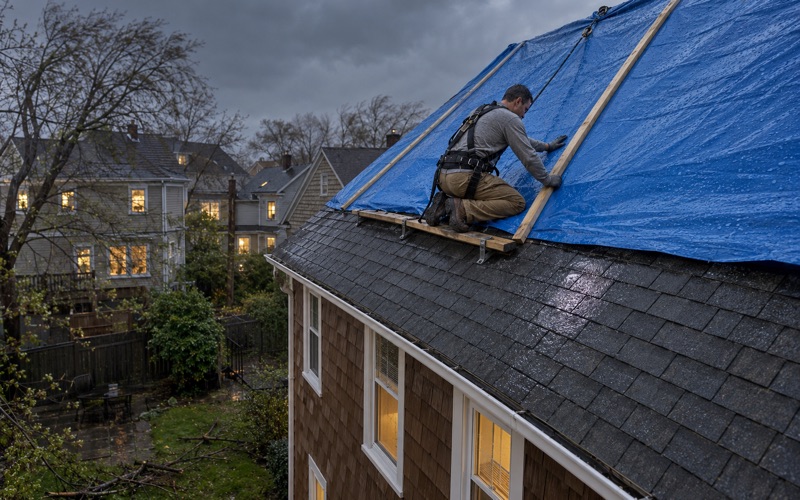
If wind or a fallen limb damages your roof, we photograph the damage and write it up so you have a clear record for your own claim. When you ask, we meet the insurance adjuster on site and walk the roof with them. The claim stays yours.
If panels are mounted on the roof, we plan their removal and reinstall into the schedule from the start rather than discovering them on the morning of the job. That keeps the panel work, the new roof and the reconnection in one sequence, with no gap where the building sits half finished.
- 20+ Years on North Jersey Roofs
- Itemized Written Scopes
- Attic-to-Ridge Leak Tracing