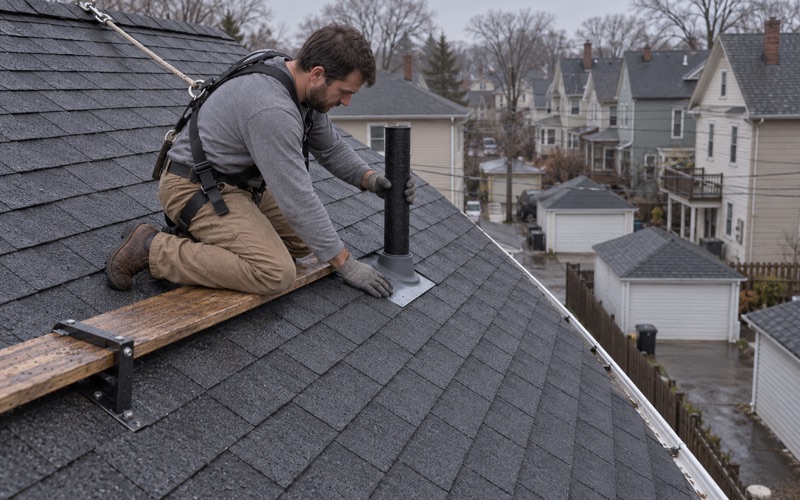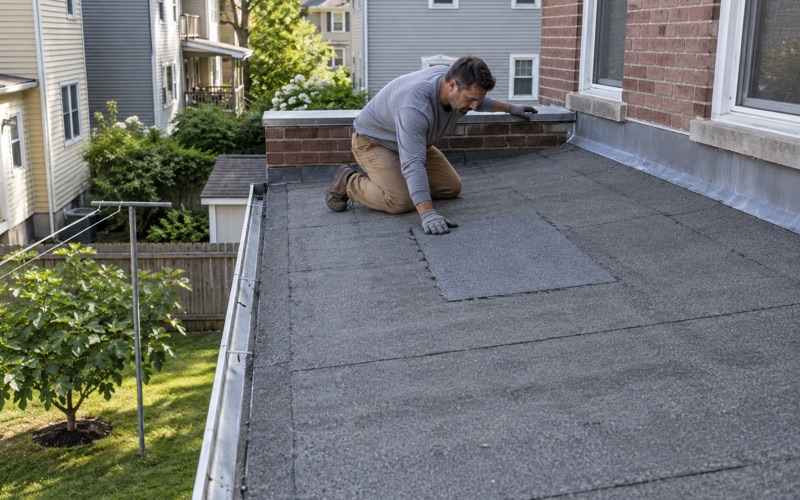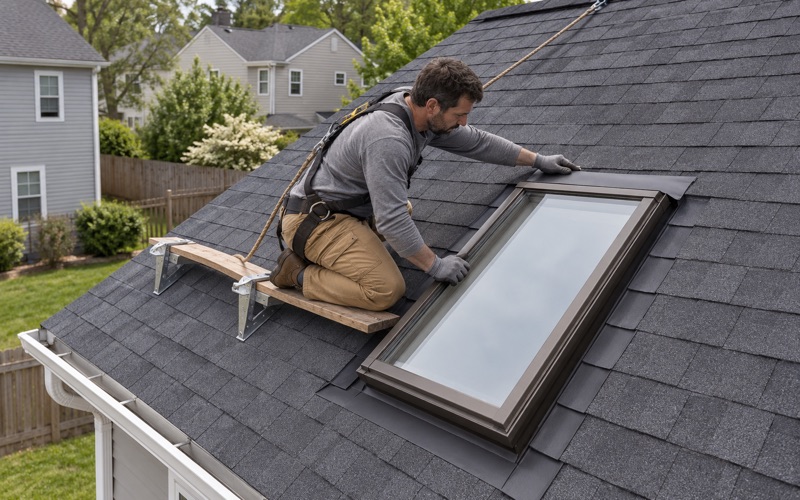
Clifton Elite Roofing has handled roofing in Hasbrouck Heights and across the surrounding part of North Jersey for more than 20 years, from a single cracked pipe boot to a full tear-off down to the deck. Most of what we do here is straightforward residential work, and we say so plainly. Where this borough differs from its neighbors is in one narrow question that only comes up on a minority of jobs: whether a crane we plan to use near Teterboro Airport needs a look under federal notice rules.
Every call starts the same way. We go into the attic as well as onto the roof, follow the water or the damage to where it really begins, and tell you whether the roof can be repaired before anyone mentions replacement. If a new roof is the right answer, the written scope breaks out tear-off, decking, underlayment, flashing and ventilation on separate lines so you can hold our number up against anyone else’s.
The rest of this page covers what that means on a Hasbrouck Heights street: the airport on the eastern border, why the typical re-roof here never involves a crane at all, what the age of the housing tells us before we climb up, and where the state’s rules draw the line between ordinary maintenance and work that needs a filing.
Roofing on Teterboro’s Eastern Edge
Teterboro Airport sits right on the borough’s eastern border, and its own description places part of the field inside Hasbrouck Heights alongside Teterboro and Moonachie. The Port Authority of New York and New Jersey owns it, AFCO AvPORTS operates it, and it runs two runways of 7,000 and 6,013 feet. For residents the airport is mostly a matter of noise, and the borough’s mayor, Ron Kistner, co-chairs the Teterboro Aircraft Noise Abatement Advisory Committee, an advisory body with no say over construction.
For a roof, the airport matters in exactly one concrete way, and it is not the planes overhead. Nothing we have found shows aircraft damaging roofs in the borough, and there is no residential sound-insulation program tied to roofing that we could point you toward. What the airport does change is how we plan the occasional job that calls for lifting material with tall equipment.
The federal rule behind the check
Under 14 CFR 77.9(b)(1), the Federal Aviation Administration requires notice for construction or alteration that rises above an imaginary surface sloping up at 100 to 1, extending out 20,000 feet from the nearest runway of any airport whose longest runway is over 3,200 feet. Teterboro clears that threshold easily. A separate part of the same section, 77.9(a), calls for notice on anything above 200 feet above ground level wherever it stands.
Why a crane counts
The rule speaks to construction and alteration, and a crane boom swung up to set a pallet of shingles or a rooftop unit is temporary construction equipment. That puts it in the same conversation as a building, even though it stands for a few hours. The roof itself, finished and sitting a few feet higher than the old one, is not what raises the question.
Borough ground versus runway ground
The borough sits at about 112 feet of elevation, while the airport field is at 8.4 feet. The sloping surface is measured from the runway, so it starts well below the ground a Hasbrouck Heights house stands on. That gap is exactly why we never assume an answer and instead check the specific lift.
Looking for roofing closer to East Rutherford? See Roofing in East Rutherford.
When a Roofing Crane Needs an FAA Notice Check
We have not run an obstruction calculation for any particular address, and nobody should promise you a blanket answer for the whole borough in either direction. Whether a given crane needs a filing depends on where it stands, how high the boom goes and how far that point is from the nearest runway. The check happens during scheduling, so it is settled before the truck is booked rather than discovered with the crew on the sidewalk.
What we look at before booking a lift
We start with the lift plan: the crane’s position on the street or driveway, the maximum height of the boom and load, and the distance to the closest runway end. Those numbers go against the FAA’s notice criteria, and if they indicate a filing is needed, the job waits on that rather than going ahead on a guess. You get told where things stand, in plain language, before a date is set.
The shielding exception
The same regulation carries an exception at 77.9(e)(1) for objects shielded by existing permanent structures or terrain of equal or greater height in a congested area. A built-up borough can sometimes qualify, but it is a judgment about specific surroundings rather than a general pass. We treat it as one of the criteria to apply, never as a reason to skip the check.
Jobs where a crane actually comes up
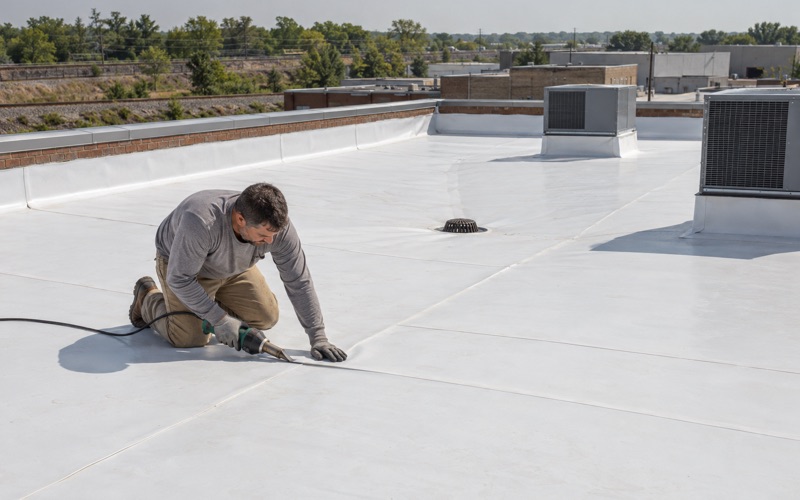
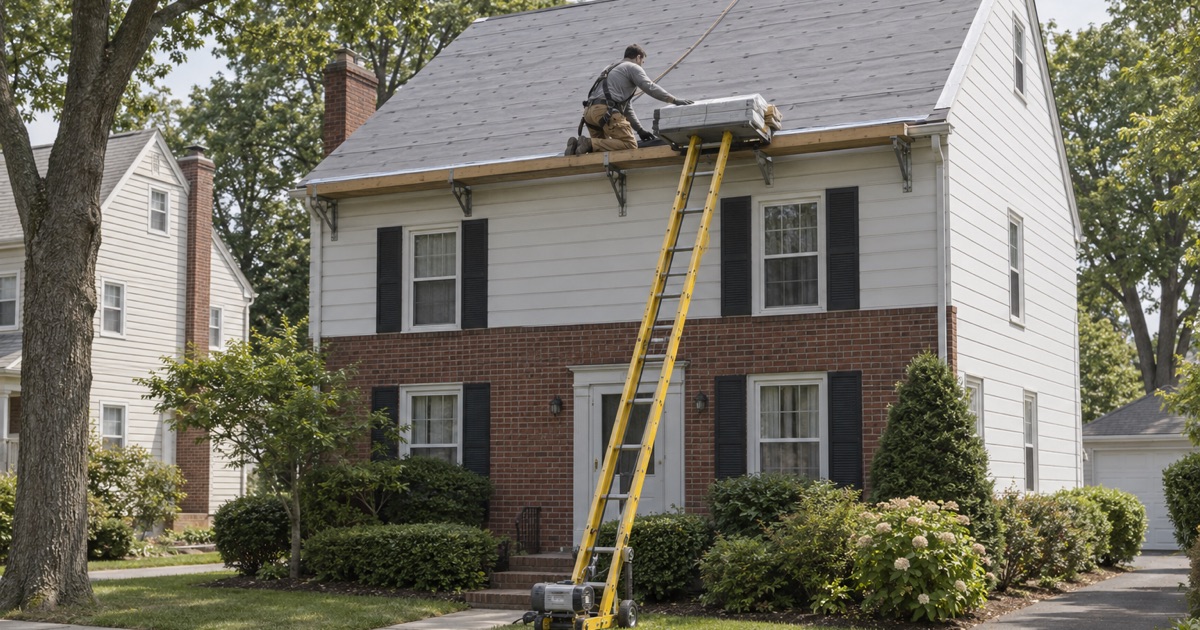
Cranes are the exception on a residential street. They tend to appear when material has to be landed on a roof with no safe ladder access, when heavy units sit on a flat section, or when a solar array has to come down and go back up around the re-roof. Solar jobs are already planned with panel removal and reinstall built into the schedule, so the lift question gets asked at the same time.
Most Hasbrouck Heights Re-Roofs Never Leave the Ladder
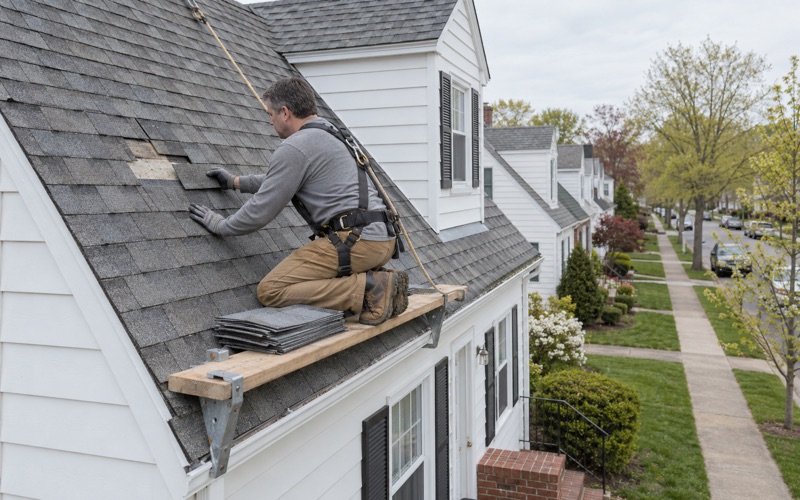
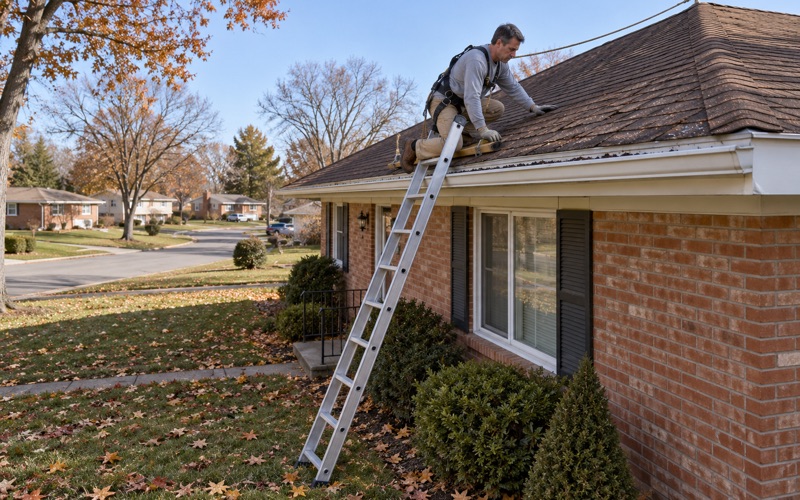
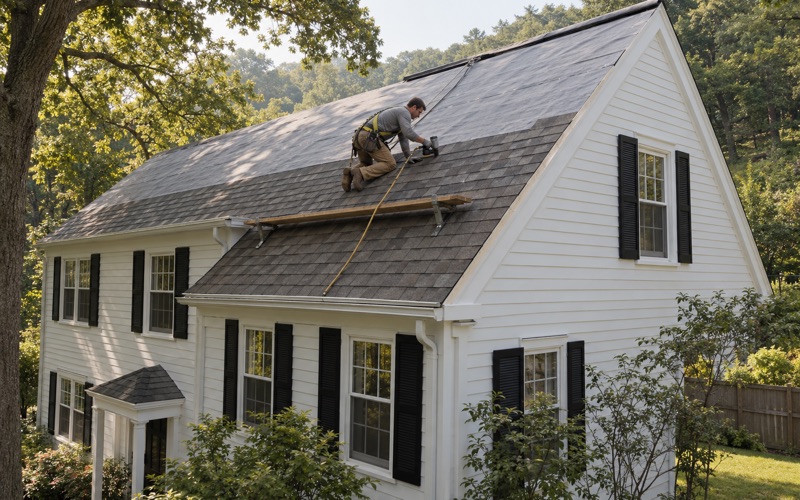
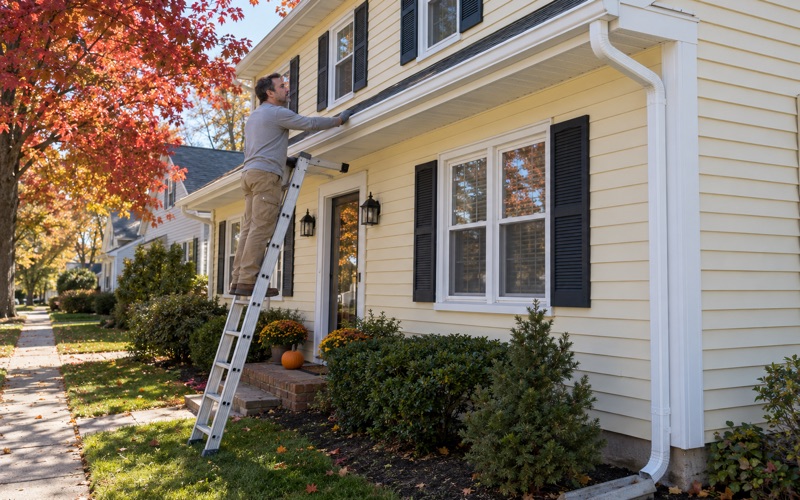
The typical job here is a pitched shingle roof on a detached house, and it is done with ladders, a material hoist and a crew working at the eaves. None of that raises an airspace question, because nothing is being lifted far above the house. If your roof looks like most of the roofs on your block, the airport will likely never enter the conversation.
The postwar housing stock
Census figures from the 2024 American Community Survey five-year estimates show 45.7 percent of the borough’s housing units were built between 1940 and 1959, with 33.8 percent from the 1950s alone. Another 21.1 percent predate 1940, and only 2.5 percent went up in 2010 or later. Roughly 64.9 percent of units are one-unit detached houses and 12.6 percent are two-unit buildings, while 67.7 percent are owner-occupied.
What a 60-to-85-year-old house tells us
On houses of this age, three things usually decide the scope: how many layers are already on the roof, what shape the deck is in, and whether the attic can breathe. Older homes are not automatically a problem, but each of those can change a price, which is why we look before we write anything. A roof with sound decking and one layer is a very different job from one carrying two layers over planks that have taken water.
Decking, flashing and ventilation on the job
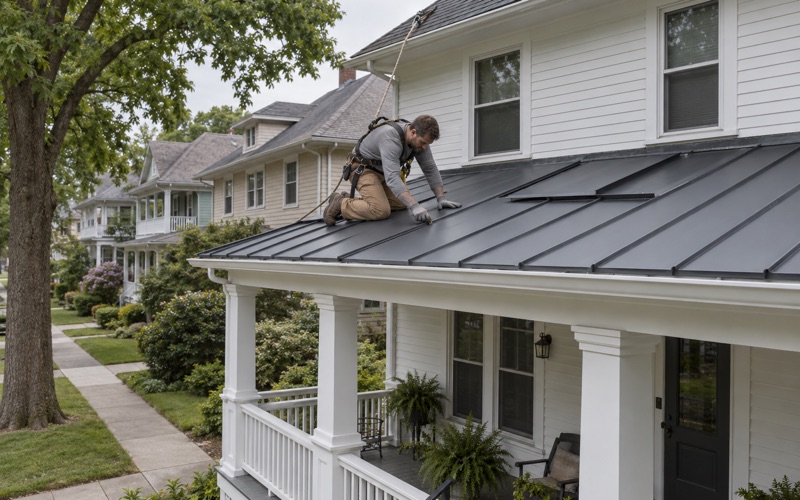
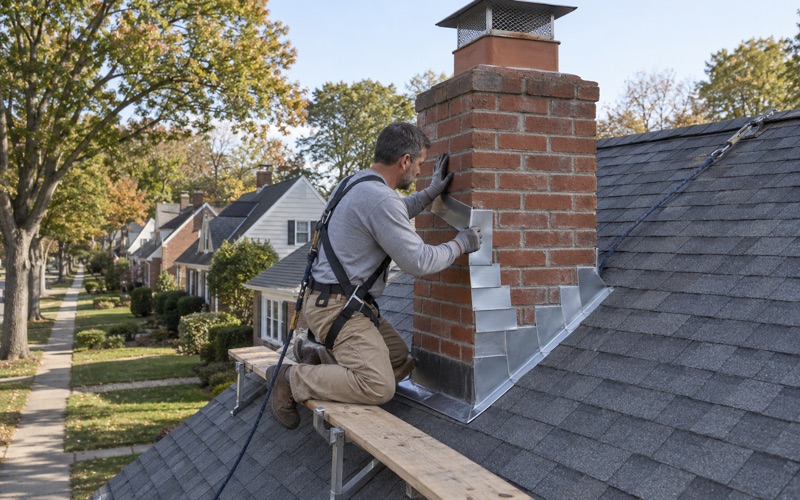
If boards turn out to be rotted once the old roof comes off, we photograph them and show you before replacing anything, at the per-sheet price written into the contract. Step, counter and chimney flashing are replaced along with the shingles rather than reused, and many of these houses need a chimney cricket or new apron flashing where water has been sitting. We also check intake at the soffit against exhaust at a ridge vent, because an attic that cannot move air shortens the life of the new shingles.
Two-family houses on the block
Because two-unit buildings make up a real share of the borough’s housing, we regularly work on houses with a tenant upstairs. Those jobs are scheduled with both floors in mind, so the upstairs household knows when the crew arrives and where we need access. At the end of every work day the yard, driveway and gutters are cleaned, including a magnet sweep for roofing nails.
Ordinary Maintenance, Layers and Paperwork
New Jersey’s Uniform Construction Code treats roof covering on detached one- and two-family dwellings as ordinary maintenance under N.J.A.C. 5:23-2.7. For most of the detached houses in this borough, that is the frame a re-roof starts from. Anything beyond the covering itself, or any question about a particular house, is a matter for the Borough of Hasbrouck Heights Building Department, the local enforcing agency.
When an overlay is off the table
The state’s rehabilitation subcode, N.J.A.C. 5:23-6, calls for a tear-off when a roof already carries two or more layers, or when the existing covering is slate, wood shake or tile. On postwar houses that have been re-covered once or twice, that rule often decides the job before we price it. When an overlay is not allowed, we explain the reason first, so the estimate makes sense when you read it.
Slate and older materials
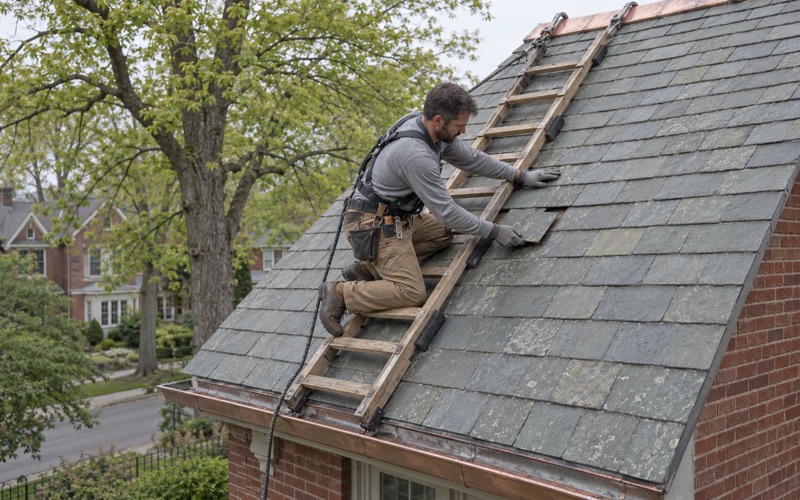
Some of the pre-1940 houses still carry slate, and sound old slate does not have to be torn off by default. We repair it with matching slate, copper nails and slate hooks, and we only recommend replacement when the slate itself has failed. For homes built before 1978, painted fascia and trim fall under the EPA’s lead-safe rule, which shapes how we handle that work.
Your contract and any storm claim
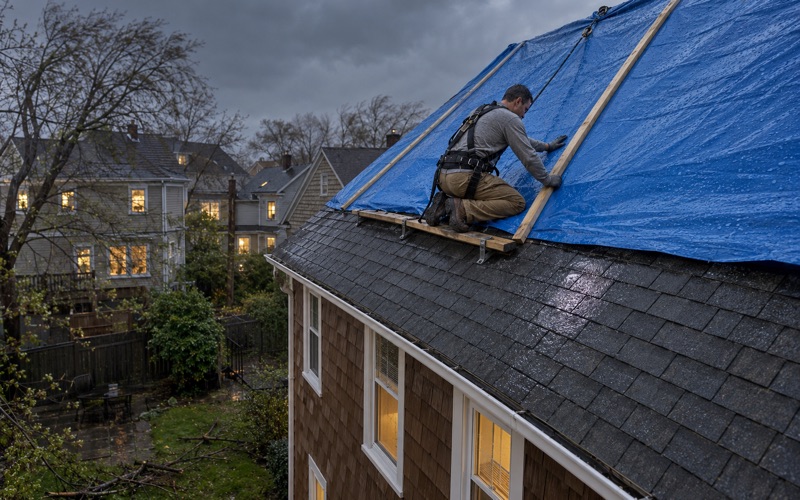
Our contracts follow New Jersey’s home improvement rules, including the three-business-day cancellation right on contracts over $500. If a storm damages your roof, we photograph and write up what we find for your own claim, and we will meet the insurance adjuster on site when you ask. The claim stays yours, and our job is to document the roof accurately and fix it properly.
- 20+ Years on North Jersey Roofs
- Itemized Written Scopes
- Attic-to-Ridge Leak Tracing