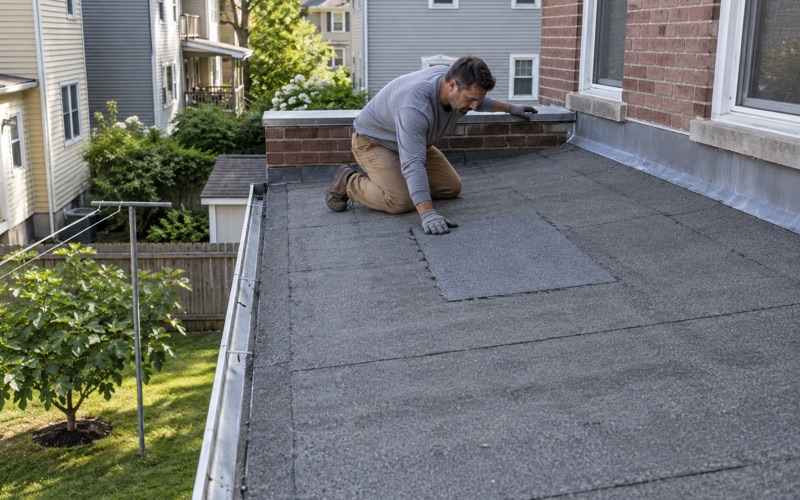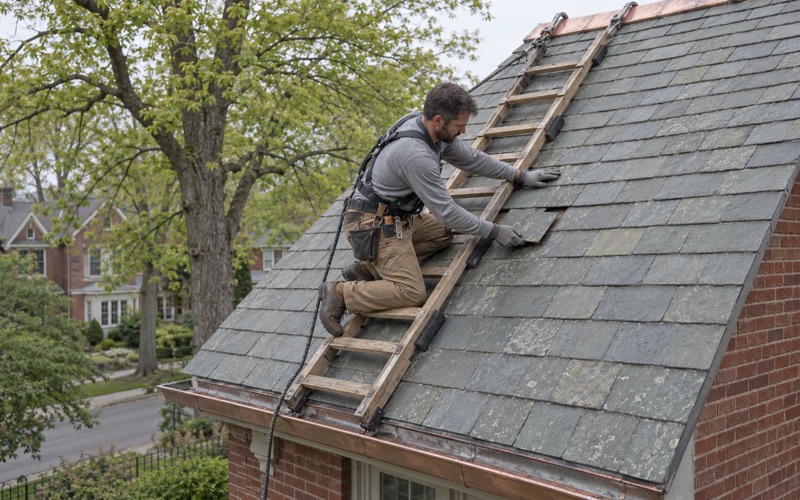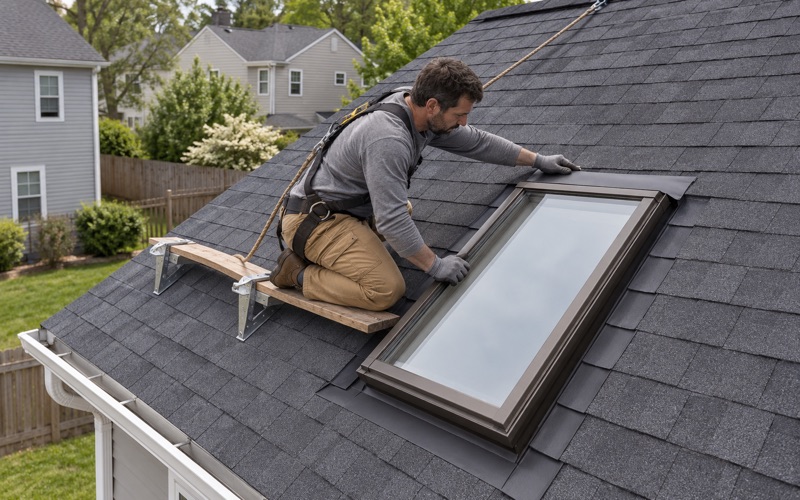
Clifton Elite Roofing has spent more than 20 years on roofing in Kinnelon and the rest of northern New Jersey, and the first thing we settle on any job here is whether the roof can be fixed. You get that answer, with the reasons, before anyone talks about a new roof. When a leak is the complaint, we go into the attic as well as onto the shingles, because water often shows up on a ceiling well away from the spot where it gets in.
When replacement is the right call, our written scope breaks the job into tear-off, decking, underlayment, flashing and ventilation, each on its own line. That lets you hold our number next to another contractor’s and see exactly where they differ. If rotten sheathing turns up once the old roof is off, we photograph it and show you before a single sheet is replaced, at a per-sheet price already fixed in the contract.
Kinnelon roofs come with two local questions that most homeowners have not had to think about: which office handles a permit when one is needed, and who has to approve the tree hanging over the house. This page covers both, along with how the borough’s wooded lots and housing ages shape the work itself.
Who Handles Construction Permits for a Kinnelon Roof
Most residential roof jobs in the borough never touch a permit office at all. Under the state’s ordinary maintenance rule, N.J.A.C. 5:23-2.7, replacing the roof covering on a detached one- or two-family house is maintenance, so a straight shingle replacement proceeds without one. The work changes character when it goes past the covering, and that is where Kinnelon’s arrangement matters.
An office in the next borough over
Kinnelon’s code names its own Building Department as the enforcing agency, but the Borough of Bloomingdale’s building department states that it provides plan review, inspections and code enforcement for Bloomingdale, Butler and Kinnelon. That office sits at 182 Union Avenue in Bloomingdale and is open weekdays from 8:00 a.m. to 4:00 p.m., with Leonard Perre as Construction and Zoning Official. When a Kinnelon roof job does need a permit, this shared-services arrangement is the route it takes.
We treat the split between the two boroughs as something to confirm rather than assume. Before we schedule permitted work, we check with the borough how intake is being handled at that moment, so an application is not filed in the wrong place and a start date does not slip while it is redirected.
Roof work that does go through the office
Structural repairs to rafters or deck framing, solar installations and roofs on attached or multifamily buildings fall outside the ordinary maintenance rule. So does a tear-off the rehabilitation subcode requires, where a roof already carries two layers or has slate, wood shake or tile underneath. If an overlay is off the table for one of those reasons, we tell you why before you see a price, so the estimate already reflects a full tear-off.
Roofs under solar panels get their own step. We put the panel removal and reinstall into the schedule from the start rather than finding out about them on the morning the crew arrives.
A proposed technical assistant in Kinnelon
Kinnelon’s Ordinance No. 18-2025, read in its introduced form, would create a full-time Technical Assistant to the Construction Official. The duties listed include reviewing permit applications, issuing permits on approval and scheduling inspections, with clerical support particularly under the borough’s shared services agreement with another municipality. Whether it has been adopted was not confirmed, so we do not assume the position is filled and we ask the borough who is taking applications when we file.
Looking for roofing closer to Woodland Park? See Roofing in Woodland Park.
Wooded Lake Lots in Smoke Rise and Fayson Lakes
Much of Kinnelon’s housing sits on wooded lots around lakes, and that setting changes how a roof ages and how a crew works. Smoke Rise is a private gated community established in 1946, and its largest lake is Lake Kinnelon. Fayson Lakes was founded in 1925 around three lakes in the borough’s southeastern corner.
What tree cover does to a roof
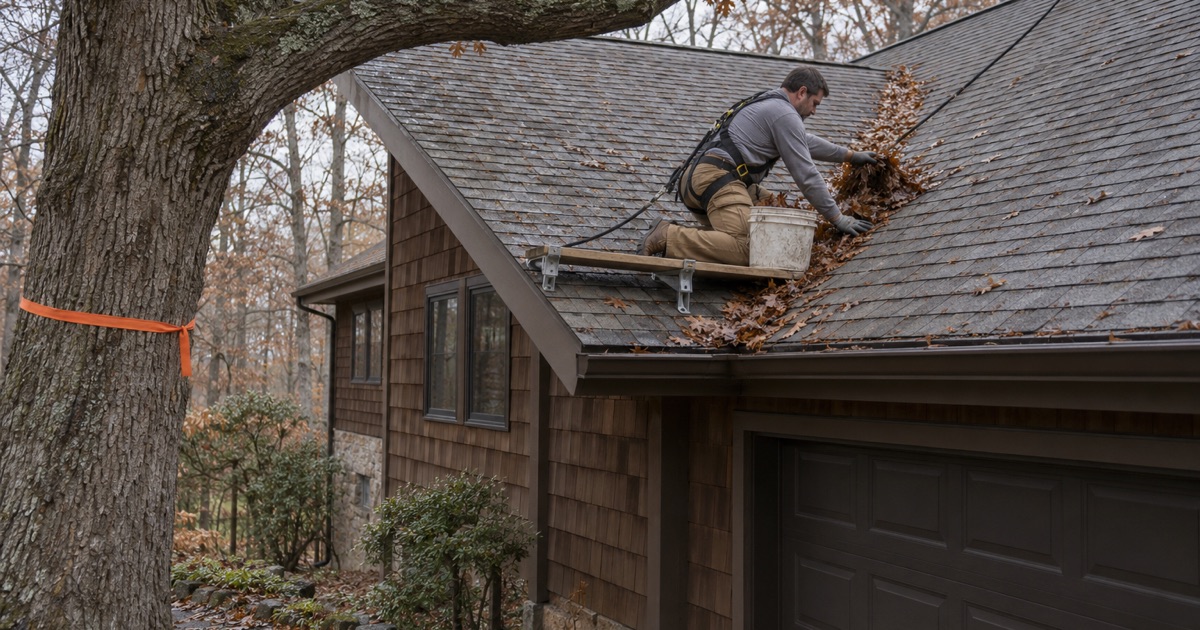
Heavy canopy keeps a roof shaded and slow to dry, and it drops leaves, needles and twigs that pack into valleys and gutters. Packed debris in a valley holds water against the shingles and the valley metal, which is where we often trace a leak that looked like it came from somewhere else. On replacements in this kind of setting, we look closely at open versus closed valley details and at the gutters and leaders that have to carry what the trees shed.
Shade also makes ventilation more important, not less. On every replacement we check that soffit intake is balanced against ridge exhaust, because an attic that cannot move air holds moisture under a roof deck that the sun rarely warms.
Gated roads and tight driveways
A gated community and long, wooded driveways change the logistics of a tear-off. We plan delivery, the dumpster position and crew access with you ahead of the start date, so nothing is left to be sorted out at the gate on the first morning. At the end of every work day we clean the yard, driveway and gutters and run a magnet sweep for nails, which matters on lots where the ground is covered in leaf litter.
Association rules we could not find
We found no published Smoke Rise or Fayson Lakes rule on roof materials or color. That does not mean none exists, so we ask owners in either community to check with their association before materials are ordered, and we build any answer they get into the scope.
Dead and Hazard Trees Need the Borough Forester
In a lot of towns, a dead tree leaning toward the house is something an owner simply has taken down before the roofers arrive. Kinnelon handles it differently, and it is worth knowing before a roof job is scheduled around tree work.
What the introduced ordinance says
Kinnelon’s Chapter 186 governs tree removal, and Ordinance No. 14-2024, read in its introduced form, would replace it. Under that text, an application goes to the Borough Clerk and then to the Borough Forester, who issues or denies it within ten business days. It states that the removal of all living and/or dead trees requires a tree removal permit, and the permit has to be posted where it can be seen from the road for at least ten days; a tree, for this purpose, is a woody plant 6 inches or more in diameter at 4.5 feet.
The introduced text waives the application fee for up to two dead, diseased or hazardous trees, but prior notice and a permit are still required. A tree causing obvious damage to structures counts as a Hazard Tree, as does one a Licensed Tree Expert determines to be a threat. Contractors removing trees register annually for $75 and carry at least $1,000,000 in property damage and bodily injury coverage. Adoption of 14-2024 was not confirmed, so we point owners to the borough for the rules in force on the day they apply.
Planning the roof around the tree
We do not take trees down, but we see what they do to a roof, and we will tell you plainly when a limb or a dead trunk is the reason a section keeps failing. If a tree has to come down before the roof is replaced, the permit is posted and the removal finished first, and only then do we lock in our start date. Otherwise a new roof can end up under the same branch that damaged the old one.
When a storm drops a limb on the house, we photograph the damage and write it up for your own claim, and we will meet the insurance adjuster on site if you ask. The claim itself stays between you and your insurer.
Owner-Occupied Houses From Every Decade Since 1950
Kinnelon is a Morris County borough of 9,966 people at the 2020 census, and its housing is overwhelmingly owner-occupied single-family. Census survey estimates put 91.1 percent of units as one-unit detached houses and 93.1 percent of occupied homes as owner-occupied. Construction is spread fairly evenly from the 1950s through the 2000s, with the 1990s the largest decade at 608 units and only 37 units built since 2010.
Houses from the 1950s and 1960s
The borough has 542 units from the 1950s and 549 from the 1960s. Houses of this age have often been re-roofed more than once, and some still carry two layers of shingles, which rules out another overlay. When we strip a roof this old, we expect to find plank or early plywood decking that needs a close look, and painted trim and fascia on any pre-1978 house are handled under EPA lead-safe practices.
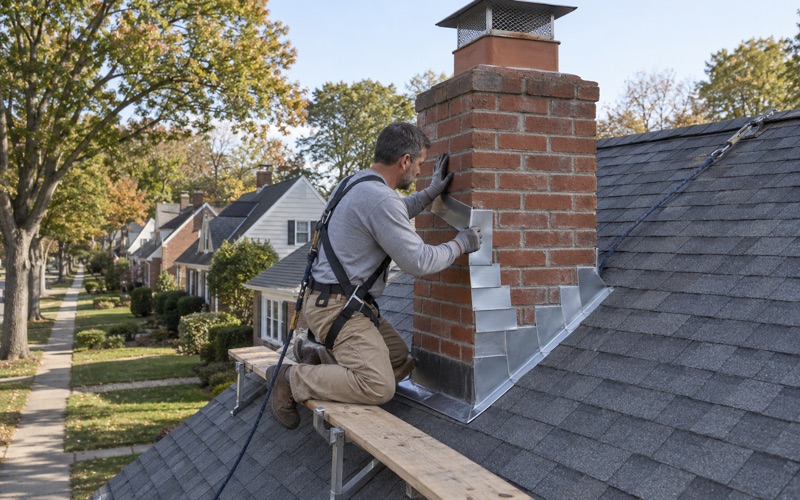
On these roofs we replace step, counter and chimney flashing as part of the job rather than bending the old metal back under new shingles. A chimney wider than the standard size gets a cricket behind it so water does not sit against the masonry.
Houses from the 1970s and 1980s
With 493 units from the 1970s and 449 from the 1980s, this group is often on its second roof, and many were built with ventilation that does not match what the attic needs. A bathroom fan venting into the attic or soffits painted shut can leave the underside of the deck damp for years. We look for both before we write a scope, because a new roof over a wet attic will not last as long as it should.
Houses from the 1990s and 2000s
The 608 units from the 1990s and 427 from 2000 to 2009 are now at or past the age when original asphalt roofs start to give out. Many have larger footprints and more complex rooflines, with several valleys, dormers and roof-to-wall joints where kick-out flashing should be. Those transitions are where we spend extra time, since a missing kick-out can rot a wall long before the shingles look worn.
Whatever the decade, our contracts follow New Jersey’s home improvement rules, including the three-day cancellation notice. If your house is a two-family, we schedule with both floors in mind so the household upstairs knows when the crew arrives and where we need access.
- 20+ Years on North Jersey Roofs
- Itemized Written Scopes
- Attic-to-Ridge Leak Tracing