Clifton Elite Roofing brings more than 20 years of experience to roofing in Lincoln Park, where a good share of the work starts with a question most single-home owners never face: what happens to the roof next door when we work on yours. When a home shares a roof line with its neighbors, the job is part carpentry and part coordination, and we treat both halves as real work.
Every call starts the same way. If water is coming in, we go into the attic as well as onto the roof, so we know where the leak actually enters before anyone talks about price. If the roof can be repaired, we say so plainly, and replacement only comes up when repair no longer makes sense.
When a full replacement is the right call, our written scope breaks tear-off, decking, underlayment, flashing and ventilation into separate lines. That matters on any house, but it matters more on an attached one, where two or three owners may want to read the same estimate side by side.
Lincoln Park’s 1980s Townhouses and the Roof They Share
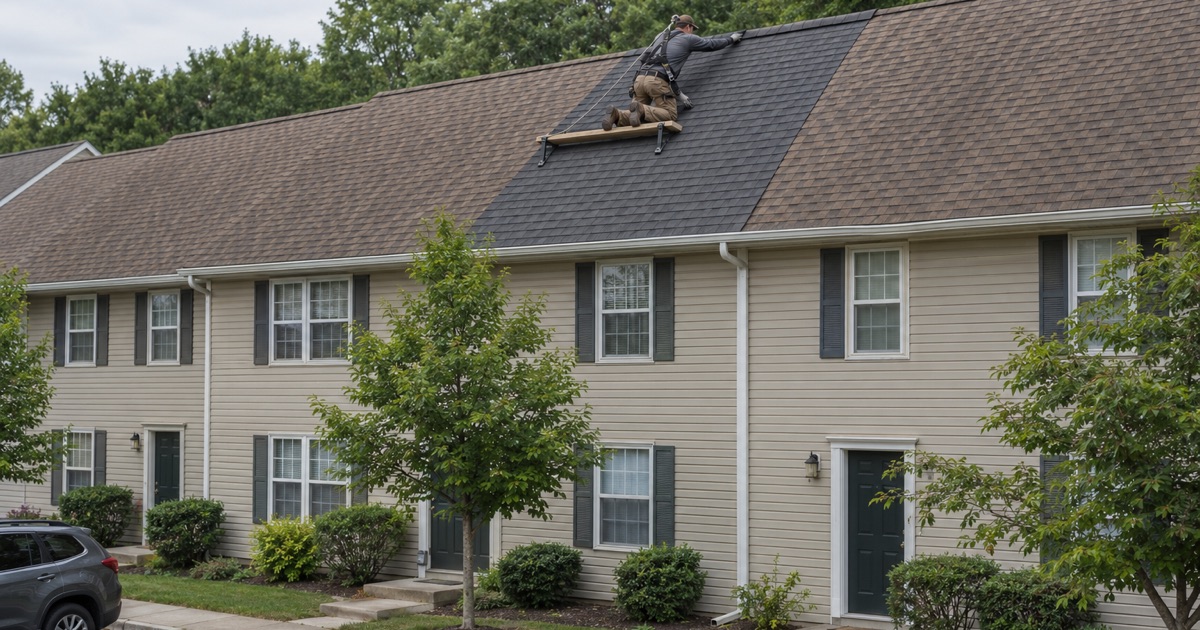
The 1980s were the borough’s biggest building decade by a wide margin. Census figures count 1,177 of Lincoln Park’s 4,050 housing units, or 29.1 percent, as built between 1980 and 1989, more than any other ten-year span. A large part of that build-out took the form of townhouses rather than freestanding homes.
A quarter of owner homes are attached
The same census tables count 803 owner-occupied single-family attached homes in Lincoln Park, which is 25.5 percent of all owner-occupied homes in the borough. Counting renters too, there are 875 attached units overall. In plain terms, roughly one owner in four lives under a roof that continues past their own property line.
A townhouse row is usually one long roof divided into units by party walls. From the street it reads as a single building, but the deed, the attic and the repair bill stop at the wall. That split between one roof and several owners is what shapes every decision on this page.
Why so many of these roofs are due now
A roof put on in the 1980s has had a long run, and many of those original coverings were already replaced once. That means a lot of attached roofs in Lincoln Park are now heading toward their second replacement, often with owners who were not there for the first one. Nobody on the row may remember how the last job met the neighbor’s shingles, or who paid for what.
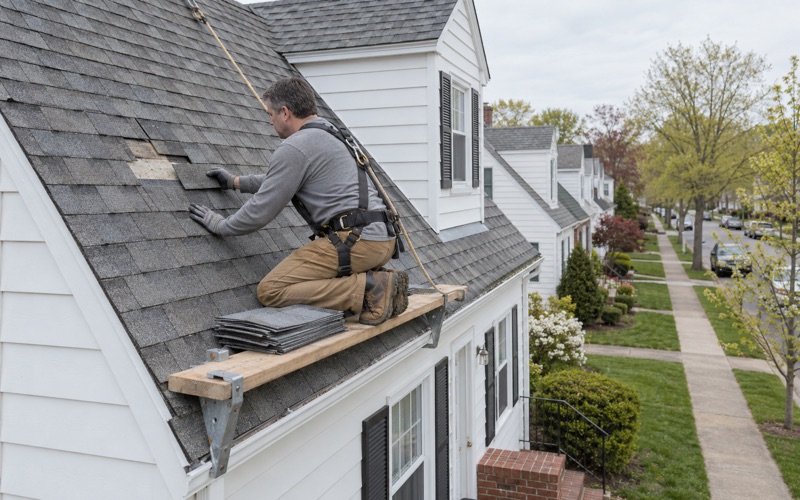
We treat that history as something to find out, not assume. On a tear-off we look at what the last crew did at the party wall, how the flashing was set and what the decking looks like once it is exposed. Any damaged decking is photographed and shown to the owner before it is replaced, at the per-sheet price written into the contract.
Looking for roofing closer to Fairview? See Roofing in Fairview.
Where Your Shingles Meet Your Neighbor’s at the Party Wall
The party wall line is the one spot on an attached roof that belongs to two people at once. Your shingles run up to it, your neighbor’s run away from it, and whatever ties the two together has to keep water out of both units. Most of the trouble we see on townhouse roofs traces back to this seam.
What happens at the wall line
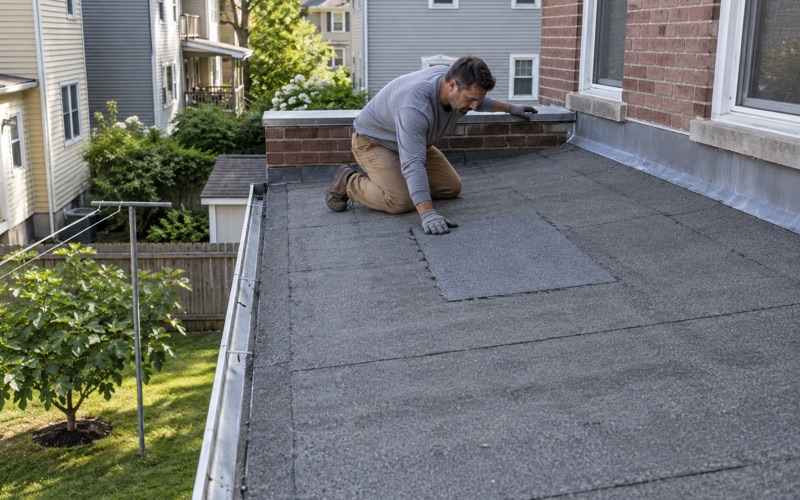
On a continuous roof, a re-roof of one unit ends at a cut line over the party wall. The new shingles have to be woven or lapped into the old ones next door without tearing up the neighbor’s roof, and the underlayment has to carry past the seam so water running sideways has nowhere to go. A sloppy tie-in here leaks into whichever unit sits lower on the slope.
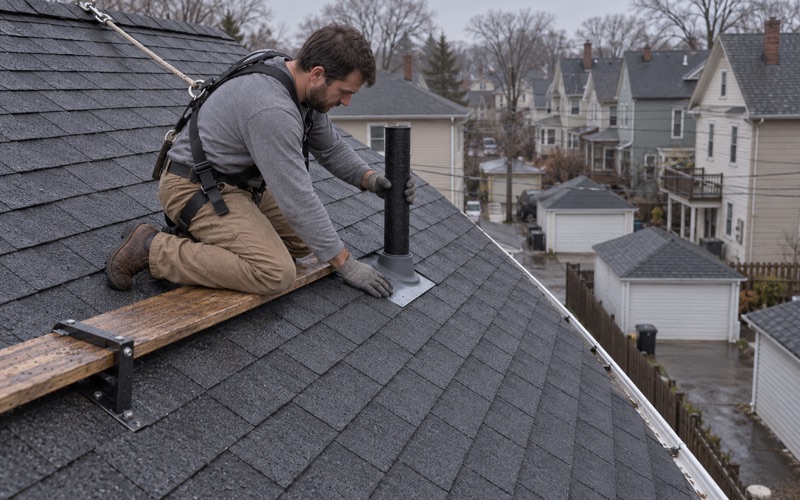
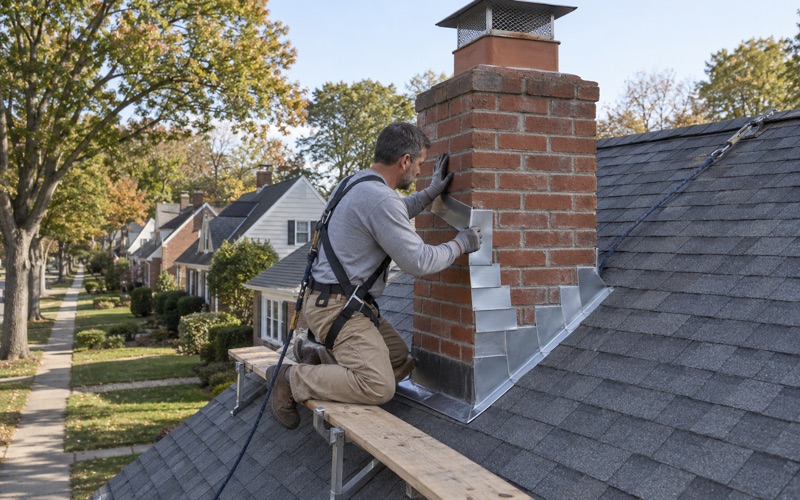
Where units step up or down, or where one roof meets a wall of the next unit, the joint needs real flashing: step flashing along the wall, counter flashing over it and a kick-out where the roof edge meets the siding. We replace step, counter and chimney flashing with the roof rather than tucking new shingles under old metal. On a shared wall, reused flashing is a problem you hand to the neighbor.
Ridges and fire separation
The ridge often runs straight across several units, and the ridge cap shingles and ridge vent have to line up from one end to the other. If one unit gets a ridge vent and the next does not, the attic air paths on both sides can change. We check intake at the soffit against exhaust at the ridge on every replacement, and on a row we look at how the neighboring attics are vented before cutting anything open.
Party walls in attached homes also serve as a fire separation between units, and the roof deck runs over the top of them. That is one reason a re-roof on an attached home is not treated like a detached house under New Jersey’s ordinary maintenance rule. We go over what paperwork your job needs before the contract is signed, so the schedule is not built on a guess.
What we put in writing for both sides
When only one unit is being done, we write the tie-in at the party wall as its own item. The owner next door is not our customer, but they will be living with the seam, so we explain where we will cut, how far onto their side we may need to lift shingles, and how the joint will be sealed. Agreeing on that before the crew shows up avoids most of the friction between neighbors.
Re-Roofing a Townhouse Row Together or One Unit at a Time
The biggest decision for most attached owners in Lincoln Park is whether to go alone or go as a row. Both are legitimate choices, and the answer depends on the age of each roof, the owners’ budgets and how much each one cares about the roof reading as one piece. We lay out both options without pushing either.
When the whole row goes together
Doing every unit at once means one continuous roof with no cut lines at the party walls. The shingles come from the same production run, the ridge runs unbroken, and ventilation can be planned across the full length of the building. Owners also share one setup, one dumpster location and one cleanup.
The tradeoff is coordination. Every owner needs to agree on material, color and timing, and every owner should get a written scope they can read for their own unit. Because our scopes list tear-off, decking, underlayment, flashing and ventilation separately, owners can see exactly what each unit is paying for even when the work is done as one job.
When one unit goes first
Sometimes one roof is leaking now and the others still have years left. In that case we re-roof the one unit and tie into the neighbors cleanly, leaving the party wall seam ready for the next owner’s job. A careful seam today makes the neighbor’s eventual re-roof easier and cheaper.
We are also honest when a single-unit job does not make sense. If the neighbor’s roof is failing right at the wall, patching one side can leave a leak that keeps coming back. In that case we would rather tell you before work starts than after.
Scheduling around the people next door
A roof crew on one unit is a roof crew on the whole building as far as the neighbors are concerned. We let adjoining owners know when we will arrive, which side the materials will be staged on and where we need access. At the end of each work day the yards, driveways and gutters are cleaned, including a magnet sweep for roofing nails on every side we worked near.
Contracts follow New Jersey’s home improvement rules, including the three-day cancellation notice. When several owners sign separately for a row job, each owner gets that notice on their own contract.
Matching Color, Ridge and Material on a Shared Roof
On a detached house, a slight shift in shingle color is a matter of taste. On a townhouse row, it is visible from the street as a stripe running up the building at the party wall. Matching matters more here than almost anywhere else we work.
Getting close on a partial row
Architectural shingles such as GAF Timberline HDZ, Owens Corning Duration and CertainTeed Landmark come in a wide range of colors, and lines change over the years. When one unit is replaced, we compare the neighbors’ shingles to current product in daylight and talk through how close the match will be. New shingles next to roofing that has weathered for years will never be identical, so we tell you what to expect up front.
If a perfect match is the priority, that is often the strongest argument for doing the row together. If budget is the priority, a close color in the same profile usually reads fine from the street once it settles in.
Keeping the ridge and edges consistent
Beyond color, the details that make a row look like one roof are the ridge cap, the drip edge at the eaves and rakes and the line of the starter course. We match the exposure and the ridge cap style so the roof line stays continuous across the party wall. Algae-resistant granules are worth discussing too, because streaking on one unit and not the next shows up quickly on a shared slope.
Where Lincoln Park sits
Lincoln Park is a Morris County borough at the easternmost point of the county, bordering Passaic and Essex counties along the Pompton and Passaic rivers. The county has bought out flood-prone homes near the Pompton River, but flooding is a river problem, not a roofing one. A new roof keeps rain out from above; it does nothing about rising water.
The borough’s Building Department at 34 Chapel Hill Road keeps a file on every property showing the permits that were taken, which can be useful when owners on a row want to know what was done to their roof in the past. If you are weighing a re-roof on an attached home in Lincoln Park, we are glad to come look at the roof, the attic and the party wall line before anyone commits to a plan.
- 20+ Years on North Jersey Roofs
- Itemized Written Scopes
- Attic-to-Ridge Leak Tracing