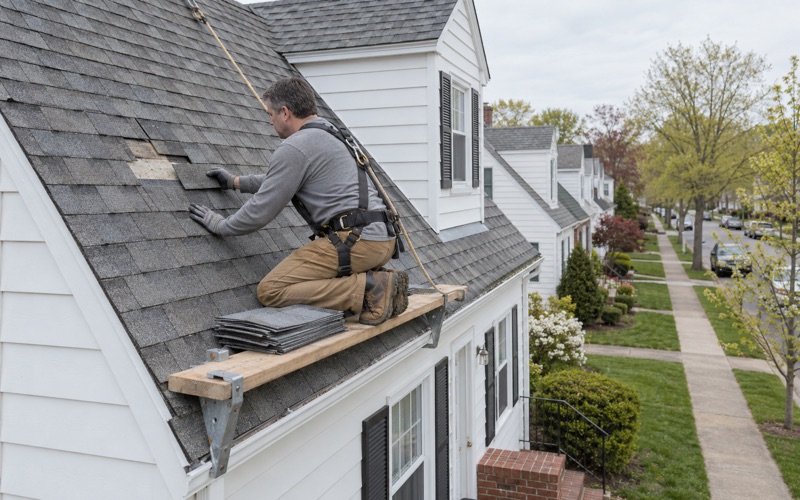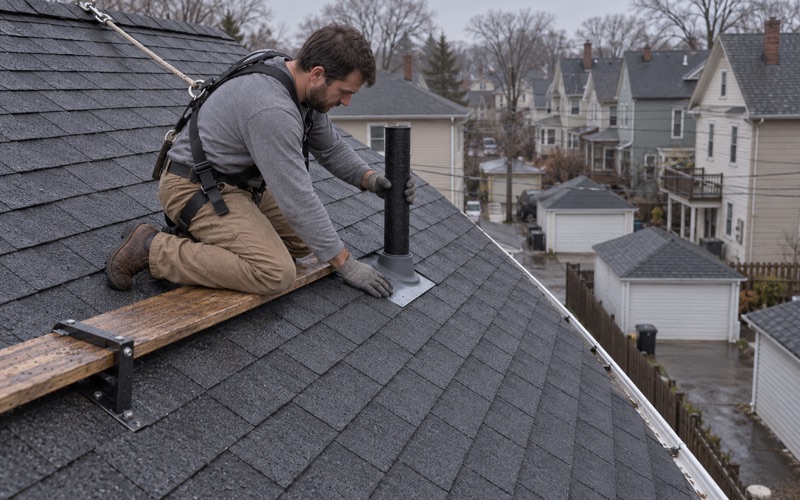
Clifton Elite Roofing has handled roofing in Little Ferry and the rest of Bergen County for more than 20 years, and the question we hear most often here is not which shingle to buy. It is how a roof repair on a house near the river will be counted. In a borough with mapped flood areas, the cost of fixing a roof can matter to more than the owner’s budget, so we write our numbers in a way that holds up when someone else reads them.
Every estimate we hand over breaks the job into tear-off, decking, underlayment, flashing and ventilation as separate lines. That habit started as a way to let owners compare two bids item by item, and in Little Ferry it does a second job: it shows exactly what the roofing portion of a project costs, which is the figure a floodplain review asks for.
We also start with the smaller answer. If a roof can be repaired, we say so plainly before replacement comes up at all, and on a leak call we go into the attic as well as onto the roof so the water is traced to where it actually enters. A repair that is scoped narrowly and priced honestly is usually the best outcome for a flood-zone house.
Roof Repairs on Hackensack River Floodplain Houses
Little Ferry is a borough in Bergen County with 1.477 square miles of land and 0.191 square miles of water, according to the 2024 Census Gazetteer. Flooding is the hazard the borough documents most, and it publishes a flood inundation map along with its flood insurance information. We want to be clear about our part in that picture: a roof is not flood protection, and floodwater is a foundation and interior problem that no shingle addresses.
Where the floodplain does touch our work is in the paperwork that follows a storm. A house in a flood area that loses shingles, flashing or a section of decking in a wind event still needs a roofer, and that roof repair can end up inside a larger review of how much is being spent on the building.
What changes about post-storm repairs here
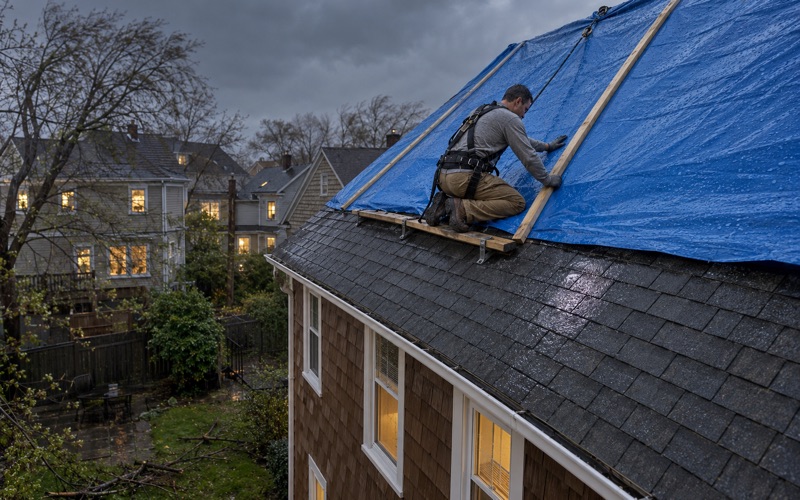
After a storm, our first step is the same as anywhere: we photograph the damage, write it up for the homeowner’s own claim and, when asked, meet the insurance adjuster on site. What differs in Little Ferry is how carefully we keep the scope tight. We separate what the storm actually broke from work an owner might want to add while the crew is up there, because the two can be counted differently.
Why the housing stock matters
The borough’s homes are mostly postwar. Census figures show about half of all housing units were built between 1960 and 1989, and roughly a quarter predate 1950. On roofs of that age we expect older layers, tired decking and flashing that has been patched more than once, so we price the decking contingency per sheet in the contract and photograph any damaged boards for the owner before they are replaced.
Looking for roofing closer to Glen Rock? See Roofing Services in Glen Rock.
How the 50 Percent Test Counts Roofing, and When the Whole Job Counts
Under the National Flood Insurance Program, a substantial improvement is any reconstruction, rehabilitation, addition or other improvement costing 50 percent or more of the structure’s market value before the work. Substantial damage is the same line applied to repairs: damage of any origin whose restoration would cost 50 percent or more of that value. FEMA’s desk reference on the subject, P-758, is the document floodplain officials use to apply both definitions.
Roofing, gutters and downspouts are in the total
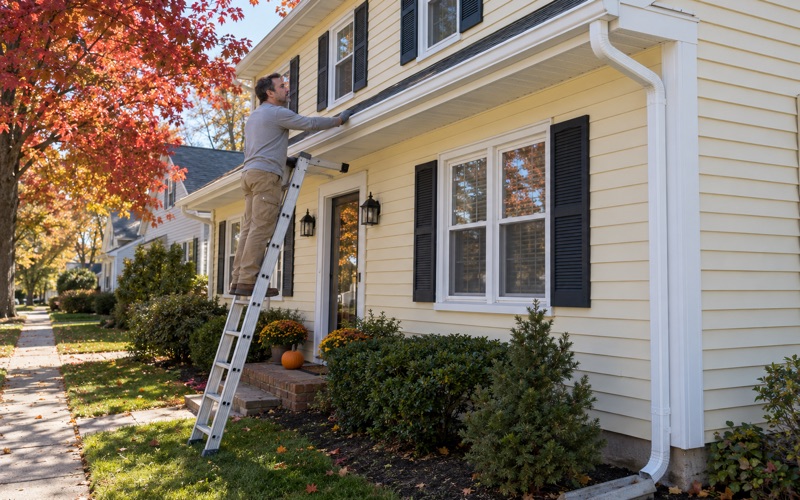
Section 4.4.1 of P-758 lists “roofing, gutters, and downspouts” among the costs that must be included when a substantial improvement or damage figure is calculated. Trusses, framing, and the contractor’s overhead and profit are on the same list. In plain terms, the roof is not a side item that falls outside the math, and neither is a new run of seamless aluminum gutters and leaders installed at the same time.
That is a large part of why our scopes are itemized. When the gutters, the flashing and the shingles each sit on their own line, an owner can see what each piece contributes to the figure being weighed. We do not decide whether a project crosses the line, and we never predict what a review will find; we make sure the numbers handed to the borough are clear.
Patching versus permit work
P-758 draws a useful distinction for communities that track improvements over time. Work that needs no permit, and its own example is patching a roof, is not counted. But if any part of a job requires a permit, all of the proposed work is counted, so replacing rafters and underlayment to repair roof damage pulls the re-shingling of an undamaged section into the same total.
Whether Little Ferry counts improvements cumulatively is a question for the borough, not for us. What we can do is tell an owner before work starts which parts of a repair are structural, such as sistering a cracked rafter or replacing a run of sheathing, and which are surface work, so nobody learns about a permit trigger halfway through the job.
How we keep the scope honest
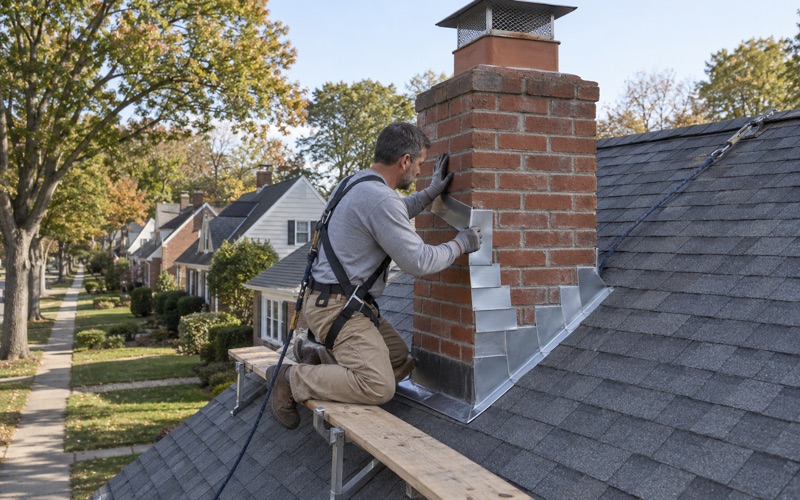
When storm damage touches only one slope, we price that slope on its own and list any optional work separately. Step, counter and chimney flashing on the affected area is replaced rather than reused under new shingles, and we explain why that line is there. If an overlay is not allowed because the roof already carries two layers, we explain the reason before the estimate rather than after.
One Office for Permits and the Flood Program
Little Ferry’s Building Department enforces the New Jersey State Uniform Construction Code, and its chief administrator is Construction Official Keith Dalton. The borough’s flood insurance and floodplain page lists him as “Construction Official & CRS Coordinator.” CRS is the Community Rating System, the FEMA program that rewards communities for floodplain management, and the borough page notes that the Meadowlands Commission and the borough each implement it within their own land use areas.
Why a shared desk matters for a roof
Because the same official oversees both construction permits and the flood program, a flood-zone house’s post-storm repair can be weighed in one office against the 50 percent line. For an owner, that means a permit filing for structural roof work is not reviewed in isolation from the house’s floodplain status. We find it helps to have the itemized scope ready before the conversation with the borough, not after.
Permit and inspection requests go through the borough’s online portal at sdlportal.com, and the department page links the state Department of Community Affairs permit application packet. Borough offices are open Monday through Friday, 8:30 a.m. to 4:30 p.m., closed on legal holidays.
What does and does not need a permit
Under N.J.A.C. 5:23-2.7, replacing the roof covering on a detached one- or two-family house is ordinary maintenance, and no permit is required for that alone. Roofs on buildings with three or more units, attached dwellings and commercial buildings are different; those go to the Building Department as permit or minor-work filings. Work on rafters or sheathing structure is where a residential repair can move from maintenance into permit territory.
The Meadowlands District in the background
Part of Little Ferry lies inside the Hackensack Meadowlands District, where the New Jersey Sports and Exposition Authority handles planning and zoning under N.J.A.C. 19:4. A straight re-roof needs no zoning approval on either side of that line. It becomes relevant only when roof work changes height or massing, such as a raised roof or rooftop equipment, and then the first step is confirming which authority zones the lot.
Two-Family and Apartment Roofs in a Renter-Majority Borough
Little Ferry is a renter-majority borough. Census estimates put 54.3% of occupied homes as rented, with 20.8% of housing units in two-unit buildings and 40.7% in buildings of three or more units. That shapes who calls us: the person making the roof decision is often an owner-landlord or a building owner, not the household living under the roof.
Two-unit houses with an owner who may live elsewhere
When the owner does not live in the building, we put the photographs, the itemized scope and any decking findings in writing so they can be reviewed from a distance. Contracts follow New Jersey’s home improvement rules, including the three-day cancellation notice, and the scope lists each component separately so an owner comparing bids for a rental property can do it line by line.
At the end of each work day, the yard, driveway and gutters are cleaned, including a magnet sweep for roofing nails. On a rental with shared walks and parking, that matters to the people who still need to use them while the work is underway.
Garden-apartment and mid-size buildings
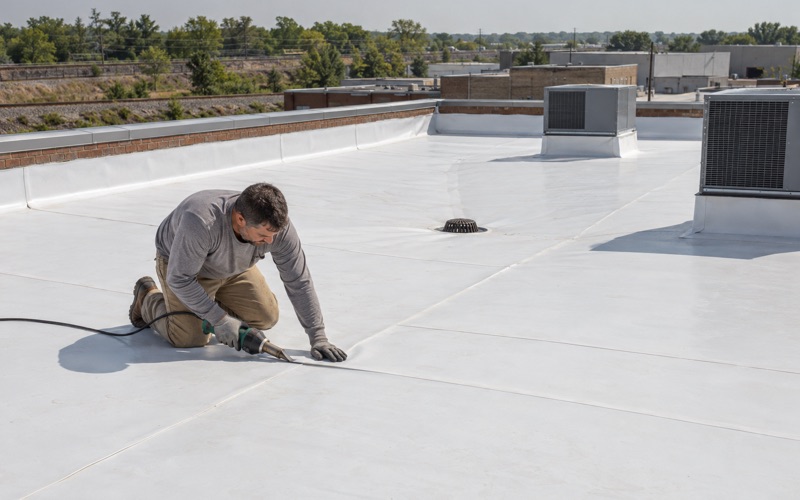
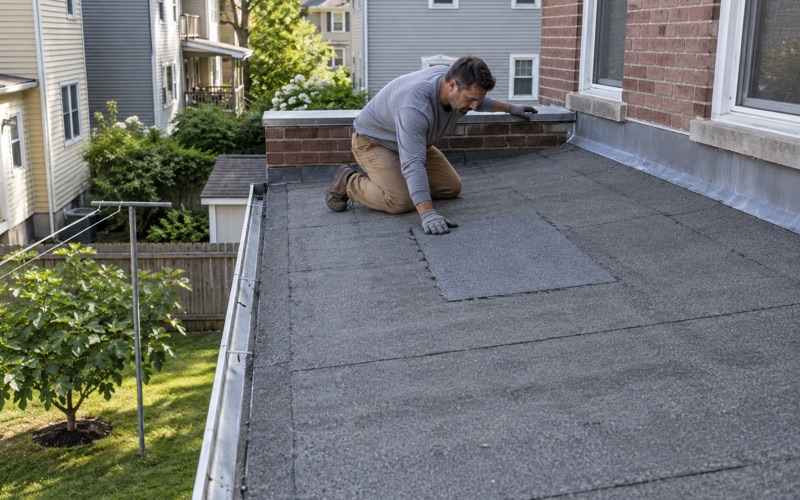
Buildings with ten to forty-nine units hold about 922 of the borough’s housing units. Blocks of that size are commonly built with low-slope roofs, though roof types were not surveyed, so we confirm the system on site before quoting. On low-slope roofs we work with EPDM rubber, TPO and modified bitumen, and because these buildings carry three or more units, the roof work is a filing at the Building Department rather than ordinary maintenance.
Ventilation and flashing on older multi-unit roofs
On any replacement, we check that intake at the soffit is balanced against exhaust at the ridge, measured as net free area rather than guessed. Older two-family houses often have a ridge vent added years after the fact with no soffit intake to feed it, and correcting that is part of the scope we write, not an extra we suggest later. Where solar panels are mounted, their removal and reinstallation is put into the schedule from the start.
- 20+ Years on North Jersey Roofs
- Itemized Written Scopes
- Attic-to-Ridge Leak Tracing