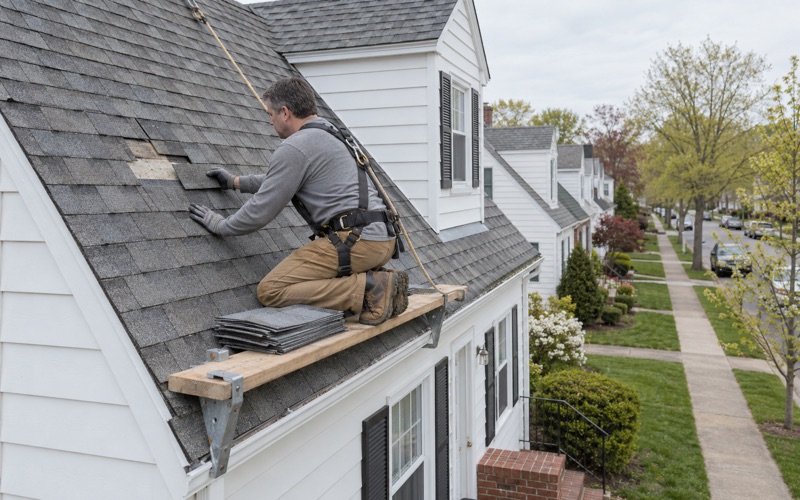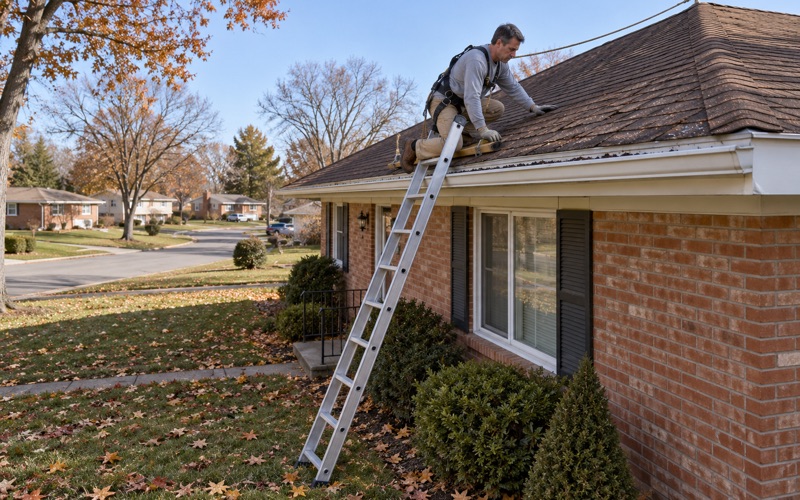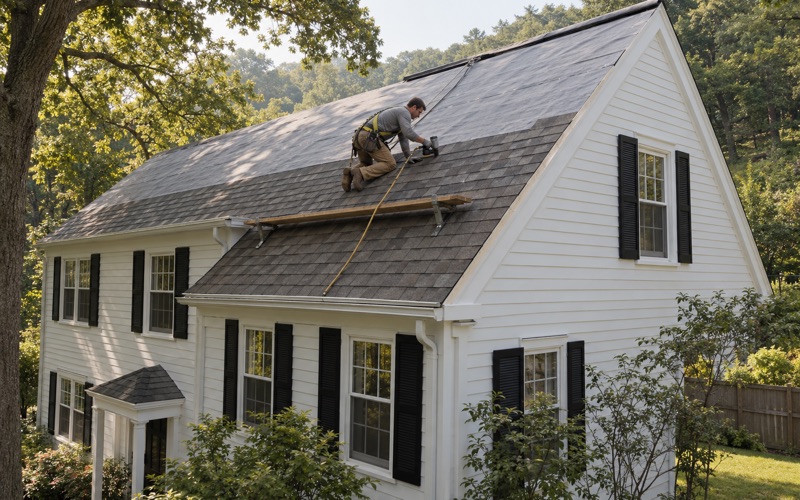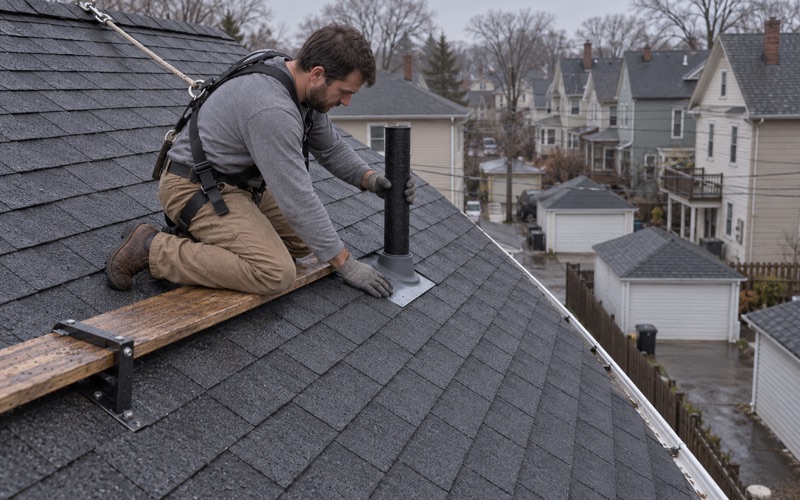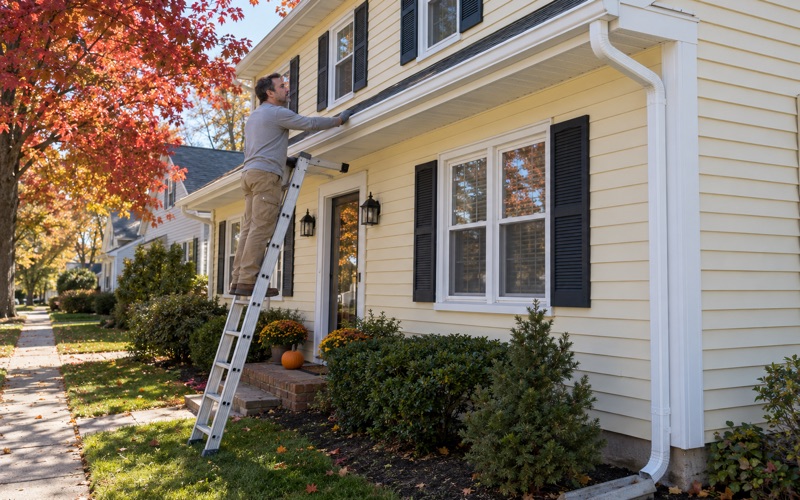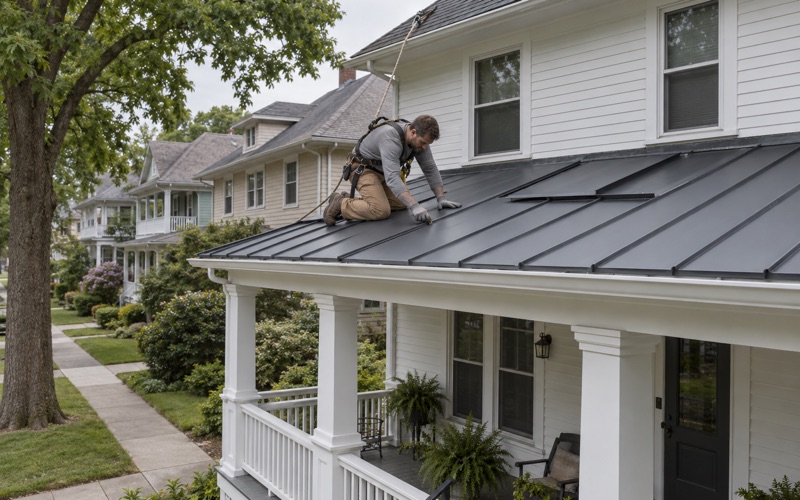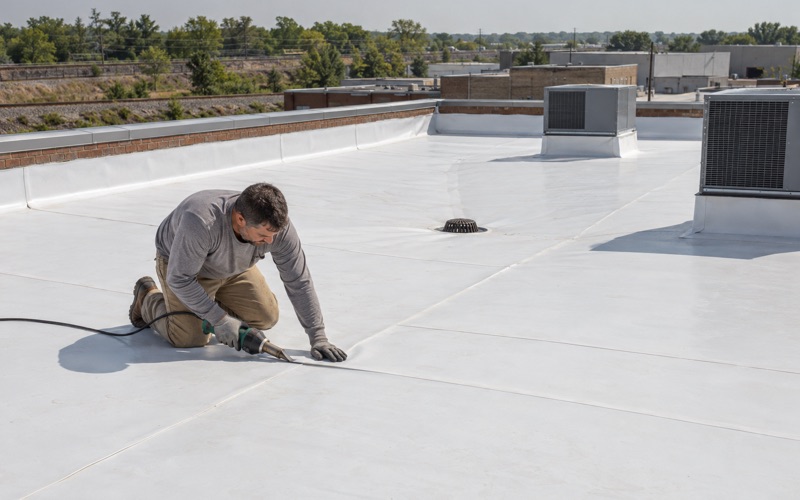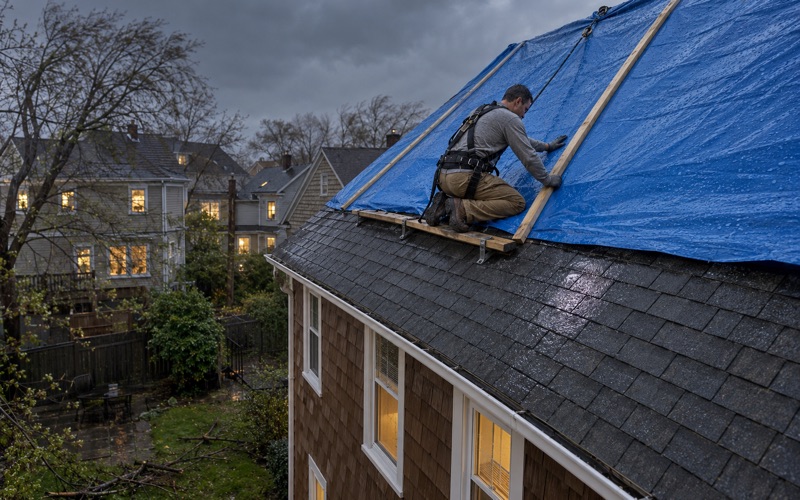
Clifton Elite Roofing has handled roofing in Pompton Lakes and the rest of northern New Jersey for more than 20 years, and the work here comes with a detail most roofers never plan for. Many houses in this borough have a slender pipe climbing the outside wall from an active vapor mitigation system, and that pipe often ends near the roof edge. We treat it as part of the roof plan from the first visit, not as something to discover with a tear-off crew already on the ladder.
Our estimates start with a straight answer about whether the roof can be repaired at all. If a replacement makes sense, the written scope breaks out tear-off, decking, underlayment, flashing and ventilation on separate lines, so you can hold our number next to anyone else’s and see exactly where the two differ.
When there is a leak, we go into the attic as well as onto the shingles. Water rarely drips straight down from where it enters, and pricing a repair before we know the real entry point is how homeowners end up paying twice.
The Vapor Systems on Pompton Lakes Houses
The former DuPont Pompton Lakes Works, now associated with Chemours, operated from 1902 until it closed in April 1994. In the years since, U.S. EPA Region 2 and the New Jersey Department of Environmental Protection have overseen a cleanup that reaches into the surrounding neighborhoods. EPA identifies a residential area of about 425 homes as the vapor intrusion investigation area, and its site page, last updated February 17, 2026, states that approximately 337 vapor mitigation systems have been installed.
What the system on your house is
These are sub-slab depressurization systems, installed under a Vapor Interim Remedial Measure Work Plan that both agencies approved. A small fan draws soil gas from beneath the slab and pushes it outside through a pipe. For eligible properties, the program covered testing, design and installation, and it continues to provide inspection and maintenance once a system is in place.
That ongoing maintenance matters to anyone planning roof work. The system belongs to a program with its own maintainer, and that party should hear about a re-roof before a crew goes near the pipe. We do not install, move or certify these systems, and we will not adjust one ourselves.
Why a vent pipe runs past the roof edge
The general U.S. standard for this kind of depressurization system, as written for radon work, calls for the discharge to sit above the eave of the roof, well clear of windows and other openings. Ideally the exhaust ends high, near the ridge, so the gas disperses away from the living space. We expect many systems in Pompton Lakes follow that pattern, though not every one will, and no installation drawing for the borough was part of our research.
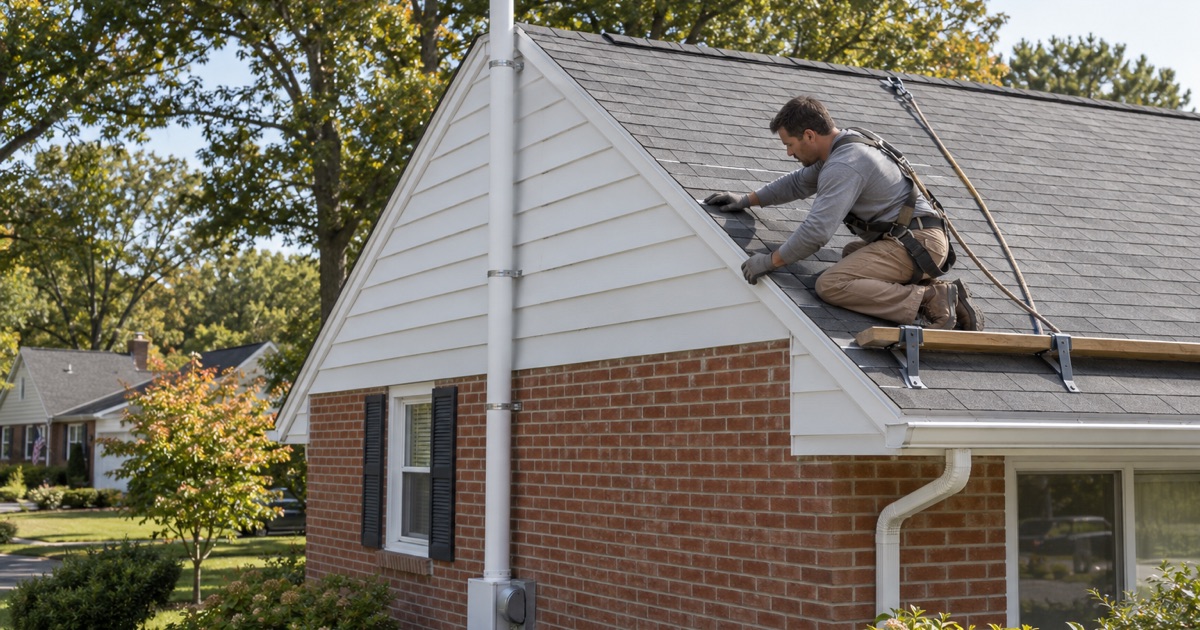
In practice, that means a pipe running up the siding, past the gutter line and sometimes alongside the roof itself. On some houses it clears the eave by a short run; on others it rises along a rake or near a dormer. Whatever the layout, it is an operating piece of equipment, and the roof has to be built around it rather than over it.
Looking for roofing closer to Oakland? See Oakland Roofing.
Re-Roofing Around a Working Mitigation System
We walk the exterior with you before we write the estimate, and we note where the vent pipe runs, where it is strapped to the house and where it ends. That one walk shapes the staging plan, the order of the tear-off and where the dumpster and ladders go. It also tells us whether the pipe is anywhere near a valley, a gutter run or a section of decking likely to need replacement.
Coordinating with the system’s maintainer
Because Chemours funds inspection and maintenance on eligible homes, we ask you to let the maintainer know the dates of the job before we start. If they want to look at the pipe, the fan or the clearances before or after the roof goes on, we build that into the schedule. Our role is to keep the roof work away from their equipment and to tell you right away if anything about the pipe looks out of the ordinary.
Flashing and keeping the discharge clear
Where a pipe passes close to the roof or through an overhang, the detail around it gets new flashing rather than a smear of sealant. Our crews keep the discharge open the whole time: no tarps draped over it, no bundles stacked against it and no debris chute aimed past it. The fan has to keep running while we work, so nothing we do should block the outlet even for an afternoon.
We also keep the gutter and fascia work honest around the pipe. If straps or brackets hold the pipe to a fascia board we are replacing, we stop, show you, and let the maintainer decide how it should be reattached rather than improvising a fix.
The rest of the replacement still gets full attention
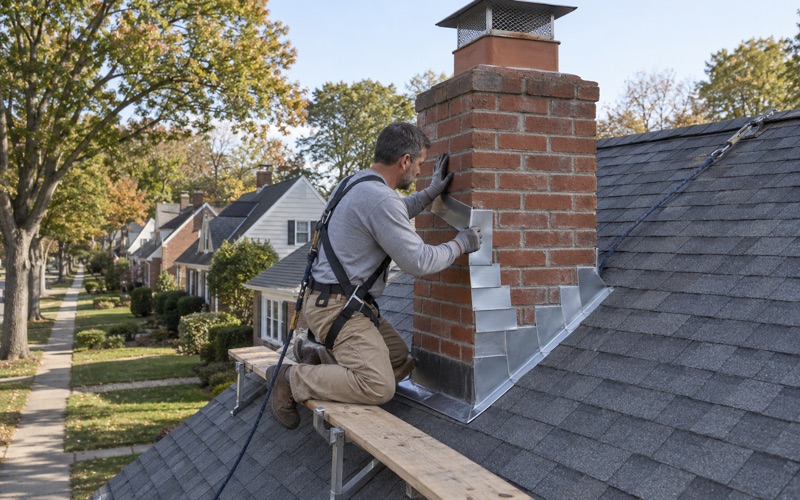
The vent pipe changes the plan but not the standard of the roof. We replace step, counter and chimney flashing with the new roof, check that soffit intake is balanced against ridge exhaust, and photograph any rotted decking for you before it comes out, at the per-sheet price written into the contract. At the end of every workday the yard, driveway and gutters are cleaned, and a magnet sweep picks up loose nails.
Mid-Century Roofs Between Three Rivers
Pompton Lakes was set off from Pompton Township as its own borough on February 26, 1895, and it covers 3.16 square miles, 0.27 of them water. The Ramapo, the Pequannock and the Wanaque all run through it, and the Pompton Lake dam stands on the Ramapo where an ironworks operated in the early 1700s. The southern reach of Ramapo Mountain State Forest extends into the north end of town.
A housing stock built mostly in the 1950s and 1960s
Census figures show 1,085 homes here were built in the 1950s, the single largest decade, and about 61.2 percent of the borough’s housing dates from 1940 through 1979. Most of it is one-unit detached houses, and a clear majority of occupied homes are owned by the people living in them. Roofs on houses of that age have usually been replaced at least once, which is why we always check how many layers are on the deck.
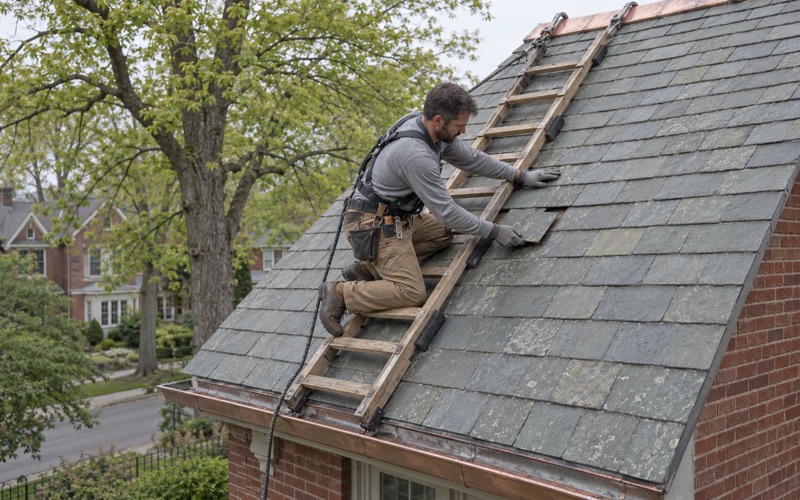
When a roof already carries two layers, or sits over slate or tile, a new layer cannot go on top, and we explain that before handing over a price. On older houses with painted trim and fascia, we follow lead-safe work practices whenever that trim is disturbed.
What the valley location does and does not mean for a roof
The borough sits where these rivers meet, and flooding has been common, most recently in 2011. A roof is not flood protection, and we will not pretend a new one changes what happens at the foundation. What we can do is make sure gutters and leaders carry roof water well away from the house, so the roof is not adding to a wet basement during a heavy rain.
Trees along the slope
Homes near the forest and along the river corridors often sit under mature trees, which drop debris into valleys and gutters and shade shingles long enough for algae to grow. We look at overhanging limbs during the estimate and suggest algae-resistant shingles where shade is heavy. If a tree near the street might need work, the borough’s Shade Tree Commission is the body to ask about its rules before anyone cuts.
Borough Hall, Paperwork and Ordinary Maintenance
The Building and Zoning Department at Borough Hall, 25 Lenox Avenue, is the borough’s Uniform Construction Code enforcing agency. It is open Monday through Friday from 8:30 a.m. to 4:30 p.m., and Sal Poli is listed as the Construction and Zoning Official. Any structural work on a house in Pompton Lakes runs through that office.
When a roof job is ordinary maintenance
Under the state code, replacing the roof covering on a detached one- or two-family house is treated as ordinary maintenance (N.J.A.C. 5:23-2.7). The picture changes when a job goes past the covering, such as rebuilding rafters, adding a dormer or reframing a section of the roof. Before work starts, we tell you which side of that line your job falls on, and if it involves structure, we point you to the Lenox Avenue office first.
Contracts, claims and two-family homes
Our contracts are written to New Jersey’s home improvement rules, including the three-business-day cancellation right on contracts over $500. If a storm damages your roof, we photograph and document it for your own claim, and we will meet the insurance adjuster on site if you ask us to. For a two-family house, we schedule with both floors in mind so the upstairs tenant knows when the crew arrives and where we need access.
If your house has solar panels as well as a mitigation pipe, both go into the schedule from the start. The panel removal and reinstall are planned alongside the roof, so neither surprises anyone on the first morning of the job.
- 20+ Years on North Jersey Roofs
- Itemized Written Scopes
- Attic-to-Ridge Leak Tracing