Clifton Elite Roofing has spent more than 20 years on roofing in Ridgefield and across this part of Bergen County, and most of what we are asked to look at here is a house with one or two families living under it. Before anyone talks about money, we tell you plainly whether the roof can be repaired, because a sound roof with one bad valley does not need to be replaced.
When replacement is the honest answer, the next question is how to pay for it. Some Ridgefield owners have an option most towns do not post on their own website: a borough rehabilitation loan that names roofs and gutters first among the repairs it covers. This page explains how that program fits a roof job, what to confirm with the borough before you count on it, and how we write an estimate that a loan coordinator can read.
Our scopes break the job into tear-off, decking, underlayment, flashing and ventilation as separate lines. That makes our number easy to set side by side with anyone else’s, and it gives a program office a clear picture of what the money is buying.
Ridgefield’s One- and Two-Family Houses, by the Numbers
The Census Bureau’s 2024 five-year estimates describe a borough built mostly at house scale. Of Ridgefield’s 4,117 housing units, 43.0 percent are detached houses and 29.4 percent sit in two-unit buildings, and 56.1 percent of all units were built before 1960. Ownership is close to an even split, with 2,075 owner households and 1,961 renter households.
What the two-unit share means on the roof
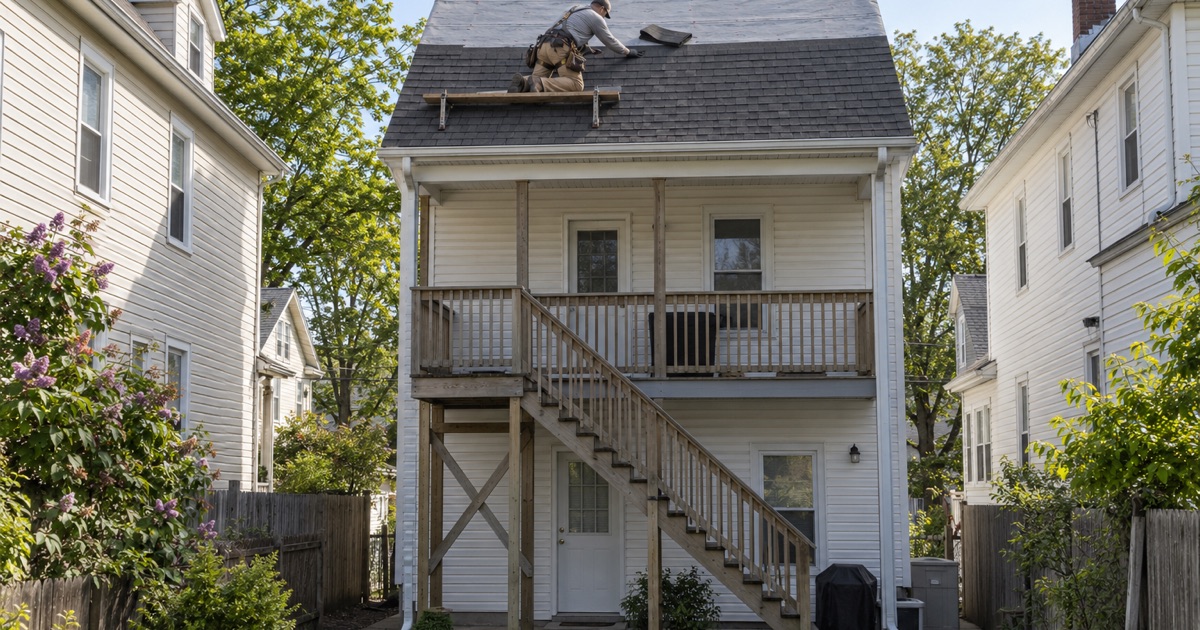
The two-family house is the main rental form in Ridgefield: 869 renter households live in two-unit buildings. In practice that means one roof often covers an owner’s unit and a tenant’s unit together, and the person paying for the roof is frequently also the landlord for the family upstairs or downstairs.
That changes how we plan the work, not how we build it. Shingles, underlayment and flashing go on the same way, but the schedule, the access points and the conversation have to account for two households instead of one.
What we look for on a pre-1960 house
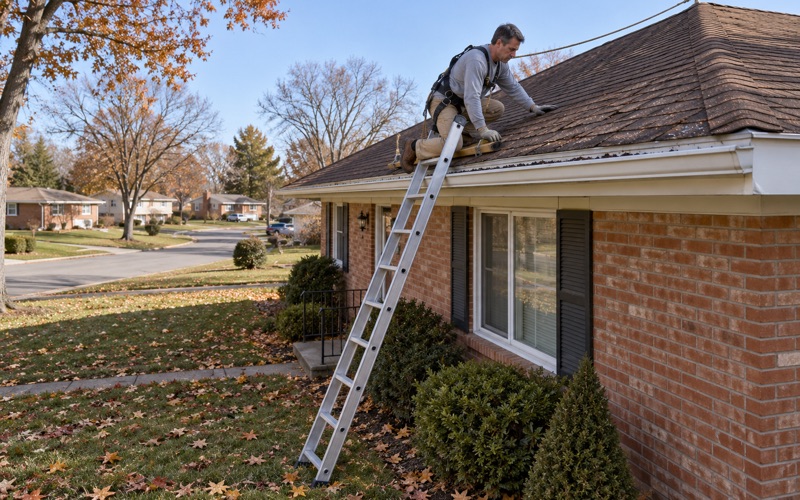
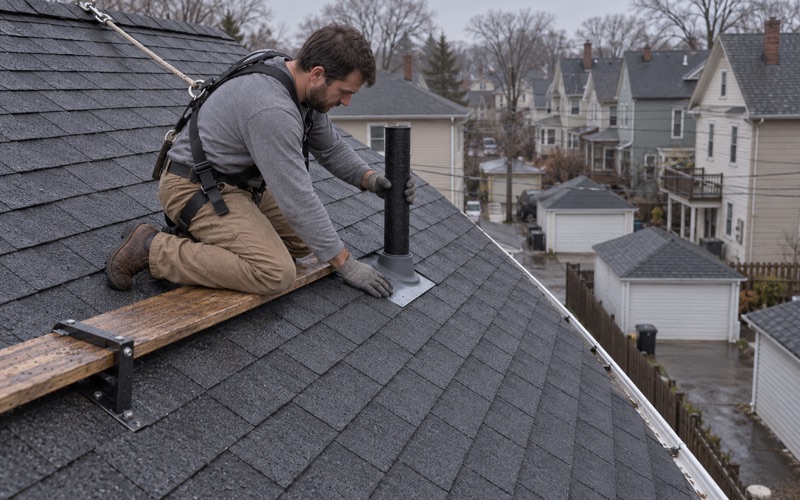
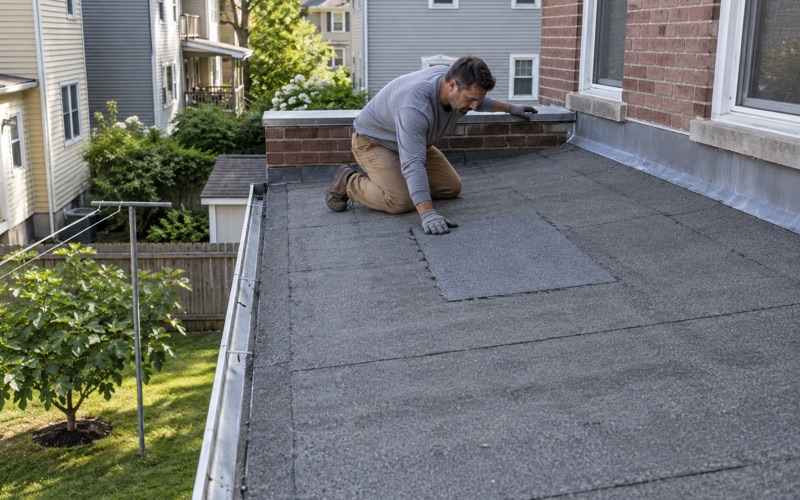
An older age profile is a reason to look carefully, not a verdict. On a leak call we go into the attic as well as onto the roof, so we can trace the water to where it actually enters before we put a price on anything. On houses of this era that is often a tired chimney flashing, an old pipe boot or a valley that has been patched more than once.
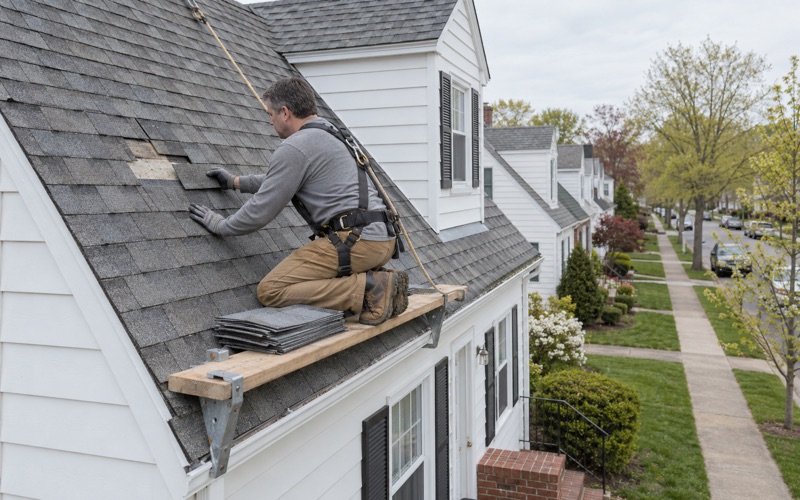
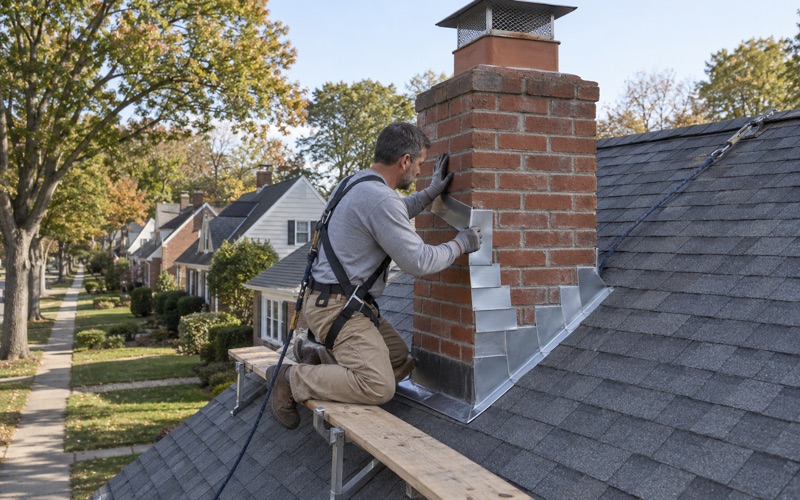
When we replace a roof, step, counter and chimney flashing come off with the old shingles and new metal goes in, rather than old flashing being tucked back under new shingles. We also check ventilation every time, balancing intake at the soffit against exhaust at the ridge, because an attic that cannot breathe shortens the life of the new roof.
Looking for roofing closer to Lincoln Park? See Lincoln Park Roofing.
The Borough’s Rehabilitation Loan and Where Roofs Fit on It
Ridgefield runs its own Housing Rehabilitation Program, and its posted pre-application describes a 20,000-dollar home improvement loan at 0 percent interest with no monthly payments. The loan is repaid only when the house is sold or title is transferred. The form lists roofs and gutters first among eligible repairs, ahead of heating, windows and doors, electrical work, kitchen and bath basics, painting or siding, insulation and minor structural problems.
Who the form says it is for
The pre-application is written for families who own their home. It prints household income limits, from 46,635 dollars for one person to 87,941 dollars for eight or more, with 66,622 dollars listed for a household of four. Total liens on the property must be under 75 percent of its value, and single-family, duplex and three-plus-unit homes are all listed.
The form we are working from is undated and prints the coordinator’s office at the Ridgefield Municipal Building, 604 Broad Avenue, at 201-943-5215 extension 381. That is why the first call belongs to the borough, not to us. Ask the coordinator whether the program is currently funded, whether the loan amount and income limits are still the ones printed, and what paperwork they need from a contractor.
How we fit a re-roof around the program
We cannot tell you whether you qualify, and we are not an approved program contractor. What we can do is give you a written scope that is easy for a program office to review. Because tear-off, decking, underlayment, flashing and ventilation each have their own line, a coordinator can see what the roof costs and what the gutters cost without guessing.
Decking is the one part of a re-roof nobody can see in advance. If we find damaged boards once the old roof is off, we photograph them and show you before replacing anything, at a per-sheet price already written into the contract. That keeps the final number predictable, which matters when a loan amount is fixed.
Every contract we write follows New Jersey’s home improvement rules, including the three-business-day cancellation notice on contracts over 500 dollars. If you are waiting on the borough’s answer, you can hold our estimate until you know where the money is coming from.
Two Households Under One Roof, and the Building Department
A roof over a Ridgefield two-family house affects two sets of people, and only one of them signed the contract. We schedule these jobs with both floors in mind, so the tenant knows what day the crew arrives, how long the noise lasts and where we will need access to the attic or a rear yard.
Keeping both households in the loop
We ask the owner up front how they want the tenant told, and we confirm the start day with enough notice for the household to plan around it. If the attic is reached through the upstairs unit, we arrange that access once rather than knocking on doors mid-job.
Cleanup happens at the end of every work day, not just on the last one. The yard, driveway and gutters are cleared and the ground is swept with a magnet for roofing nails, which matters when two families share one driveway and children walk through the yard.
Which jobs go through 700 Shaler Boulevard
Under New Jersey’s code, replacing the existing roof covering on a detached one- or two-family house is listed as ordinary maintenance. Attached houses, which are 9.2 percent of Ridgefield’s units, and buildings of three or more units fall outside that item, as does structural work. When a job does need a permit, it goes through the Building Department at 700 Shaler Boulevard, where Gregory K. Yfantis is the Construction Official.
The borough’s code also says the Construction Official issues no building permit until the Zoning Officer has issued a zoning permit. Whether that step reaches a given roof job is a question for the office itself, and we check before we set a start date rather than after.
The 8:00-10:00 a.m. inspection window
Ridgefield wants inspection requests in writing by email at least 24 hours ahead, listing the permit number, the owner’s name, the work-site address and the type of inspection. Building inspections run Monday through Friday from 8:00 to 10:00 a.m. and are typically done within three business days.
We build that window into the schedule so an inspection does not leave a deck open longer than it needs to be. The office keeps weekday hours from 8:00 a.m. to 4:00 p.m., with no financial transactions after 3:00 p.m., which is worth knowing if you plan to pay a fee in person.
From the 1793 Sandstone Church to Ridgefield Heights
Ridgefield takes its name from its terrain. The borough climbs from the edge of Overpeck Creek, Skeetkill Creek Marsh and the Meadowlands up to Ridgefield Heights on the Palisades ridge, with Morsemere and the older Ridgefield streets in between. Houses on the ridge and houses near the marsh are often from the same decades, and the roofs over them age in much the same way.
A roof record from 1997
The borough’s oldest landmark is the English Neighborhood Reformed Church at 1040 Edgewater Avenue, built in 1793 with walls and foundation of native brown sandstone. Its National Register nomination, listed in 1998, records a gable roof re-covered in 1997 with fiberglass shingles, aluminum gutters, and a spire that still needed work.
That is a useful reminder for homeowners. Even a building that has stood since the eighteenth century gets its roof covering replaced on a cycle, and the covering is a maintenance item rather than a permanent part of the structure. National Register listing by itself does not dictate what a private owner puts on a roof in New Jersey.
Choosing materials for Ridgefield houses
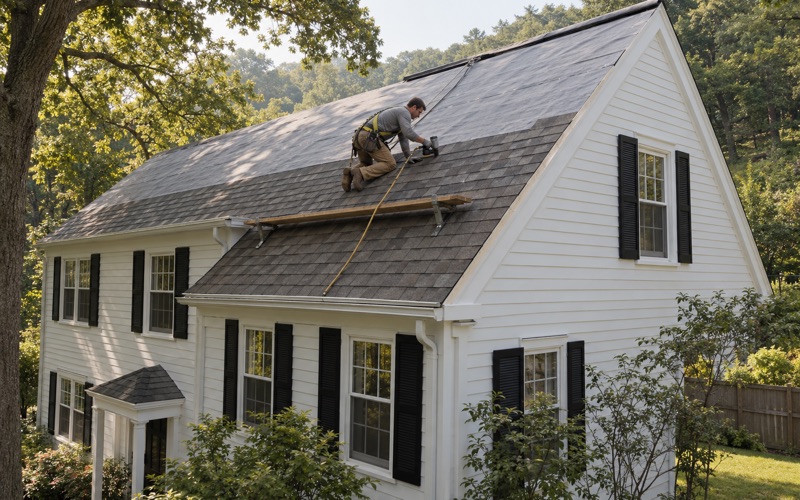
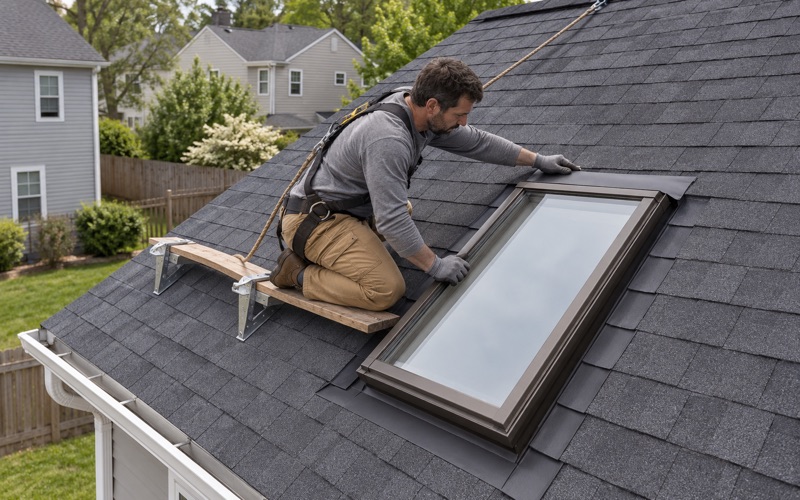
Most of what we install here is architectural laminated shingle, such as GAF Timberline HDZ, Owens Corning Duration or CertainTeed Landmark, over synthetic underlayment, with drip edge at the eaves and rakes and an ice and water barrier in valleys and around chimneys. Where wind exposure is a concern, shingles rated to ASTM D7158 Class H or ASTM D3161 Class F are an option worth pricing.
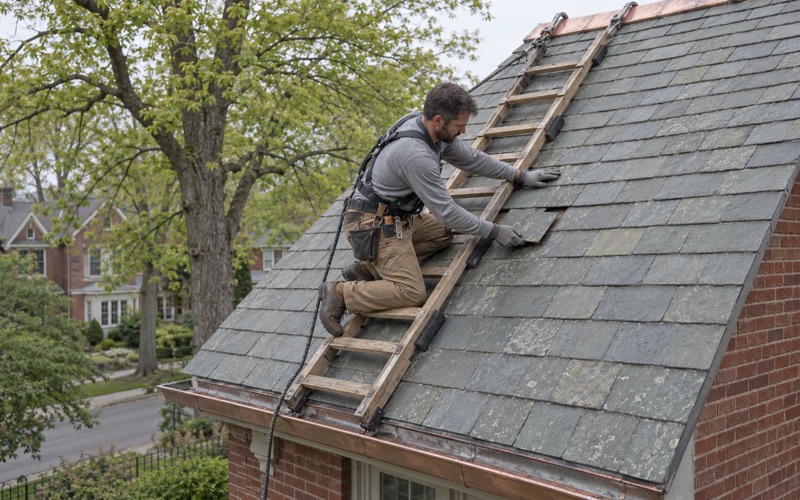
If an older house still carries sound slate, we repair it with matching slate, copper nails and slate hooks rather than tearing it off by default. When a roof already has two layers, or has slate or tile underneath, we explain before the estimate why an overlay is not an option, so the price you see reflects a full tear-off from the start.
When storms or solar panels are part of the job
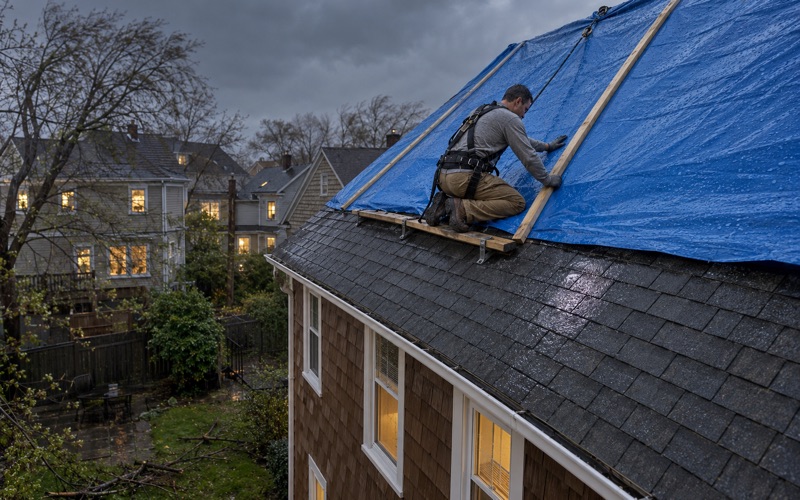
After a storm, we photograph the damage and write it up for your own claim, and we will meet the insurance adjuster on site if you ask. If your roof carries solar panels, we plan their removal and reinstall into the schedule from the beginning instead of discovering the problem on the first morning.
Whether your next step is a call to the borough’s coordinator or a straight answer on repair versus replacement, we start with an inspection from the attic up and a scope you can read line by line.
- 20+ Years on North Jersey Roofs
- Itemized Written Scopes
- Attic-to-Ridge Leak Tracing