Clifton Elite Roofing has handled roof repair in Clifton, NJ for more than 20 years, serving surrounding cities including Woodland Park, Wallington, Wood-Ridge, Rutherford and Totowa. We fix leaking shingles, failed flashing, worn pipe boots, storm damage, flat roof seams and broken slate, and we fix them at the source rather than covering the symptom with sealant.
Before we price a repair, we look at the problem from both sides of the roof deck. On the older houses that make up much of Clifton, water often runs along a rafter or plank board for several feet before it shows on a ceiling, so a repair aimed at the stain instead of the entry point is money spent in the wrong place.
You also get a straight answer on whether the roof is worth repairing at all. Most roofs with a localized problem are, and we will tell you so. When the whole field is failing, we explain why another patch is unlikely to hold before replacement ever comes up.
Residential Roof Repair
Shingle Repair and Replacement
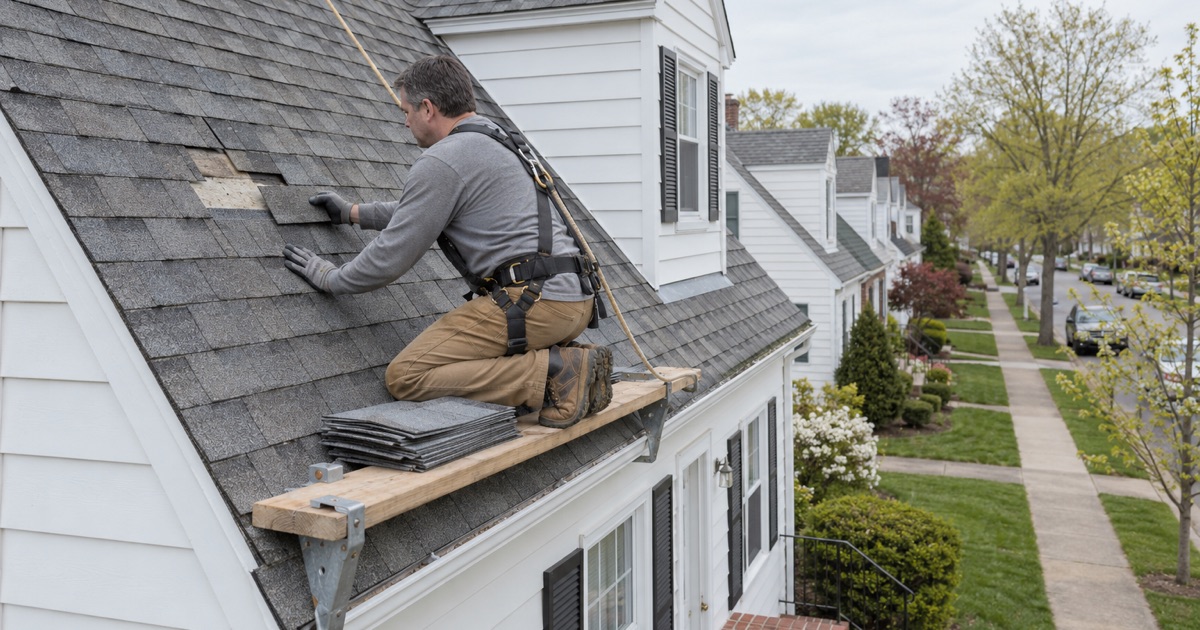
Cracked, creased and missing shingles leave the underlayment and nail holes exposed to the next rain. We lift the surrounding courses carefully, replace damaged pieces with a matching architectural or 3-tab product, and re-nail and hand-seal the tabs so the repair lies flat and resists wind as well as the original roof did.
Where storm damage has broken the seal strips on shingles that still look intact, we check a wider area than the obvious tear. A shingle that lifts in a gust and settles back down can let water in for years without ever going missing.
Pipe Boot and Roof Vent Repair
Rubber pipe boots around plumbing vents crack and shrink long before the shingles around them wear out, and they are one of the most common leak sources we find. We replace failed boots with long-life or lead flashing boots and check roof vents and exhaust caps for loose fasteners and dried-out sealant.
Box vents, turbine vents and bath fan caps get the same attention, because a cracked housing or a missing screw lets wind-driven rain past the shingles. Where an old vent has been sealed over with layers of roofing cement, we remove the buildup so the replacement flashing can lie flat on the shingles beneath it.
Chimney and Wall Flashing Repair
Flashing is the metal that turns water where the roof meets a chimney, wall, dormer or skylight. We rebuild step flashing course by course, cut counter flashing into the mortar joint or a reglet, and add a cricket behind wide chimneys so water does not pond against the brick and work its way inside.
Where a sidewall meets the eave, we add kick-out flashing to direct water into the gutter. A missing kick-out is a frequent cause of rotted siding and sheathing at the bottom of a wall.
Flat Roof and Low-Slope Repair
EPDM and Rubber Roof Repair
Rubber roofs fail at their seams, around drains and where the membrane has been punctured or pulled loose. We clean and prime the membrane, patch with compatible EPDM tape and cover strips, and reseal flashing at curbs and walls, so the repair bonds to the existing roof instead of peeling away with the first freeze.
TPO and Modified Bitumen Repair
TPO seams are heat-welded, so a lasting repair means welding new material to a cleaned surface rather than smearing caulk over the split. On SBS and APP modified bitumen, we cut out blistered or cracked sections and torch or adhere new cap sheet with properly lapped edges.
Before any of that, we probe the area around the damage for wet insulation underneath. A membrane patched over soaked insulation board keeps the moisture trapped against the deck, so the wet section is cut out and replaced first rather than sealed in.
Drains, Scuppers and Ponding Water
Water that sits on a flat roof for days speeds up every kind of membrane failure. We clear and reflash drains and scuppers, check that the edge metal is not trapping water, and tell you plainly when ponding comes from the roof’s slope itself, which a repair cannot change.
Slate and Older Roof Repair
Replacing Broken Slate
Slate that is still hard and sound can outlast several asphalt roofs, so a cracked or slipped piece should be repaired rather than used as a reason to tear off. We match the slate’s size, color and thickness, using sources such as Pennsylvania Black or Buckingham slate, and fasten the new piece with copper nails, slate hooks or a bib where it cannot be face-nailed.
This follows the approach set out in NPS Preservation Brief 29, which favors repairing a sound slate roof over replacing it. Roofers who walk on slate without care or patch it with asphalt shingles and roofing cement often do more damage than the original problem.
We also look at the copper or lead-coated copper flashing in the valleys and around chimneys, because on many slate roofs the metal wears out decades before the stone. Replacing failed flashing is often the repair that actually stops the leak.
Prewar Board Decking and Patched Roofs
Many houses in Clifton and the surrounding towns were built before 1940, with plank decking and decades of earlier repairs layered on top. We check whether the boards can still hold fasteners, replace split or rotted planks, and remove old patches made with tar or caulk before the new work goes down.
Older roofs also tend to have flashing that was reused through two or three re-roofs, rusted through or bent to fit something it was never shaped for. Where we find that, we tell you and price new metal as a separate line, so you can decide whether to fix it now or plan it with the next roof.
Repairs on Painted Trim on Older Homes
Roof edge repairs often disturb fascia, soffit and trim that were painted before 1978, when lead paint was still in use. On those houses we follow the EPA lead-safe work practices for containment and cleanup, so a gutter-line repair does not leave paint chips and dust in the yard.
Commercial Roof Repair
Low-Slope Repairs on Small Commercial Buildings
Storefronts, offices and mixed-use buildings along the commercial corridors in and around Clifton usually sit under low-slope membrane roofs with rooftop units, parapets and through-wall scuppers. We repair membrane seams, curb flashing around HVAC equipment and parapet coping, and document the condition of the rest of the roof so an owner can budget for what comes next.
Leak Calls on Mixed-Use and Multifamily Roofs
On a building with tenants or a business operating below, the first priority is stopping water from reaching the space while the source is found. We coordinate access with the owner or manager, make a temporary repair where needed, and then return for the permanent fix. Roof work on these buildings is not ordinary maintenance under New Jersey’s rules, so we tell you when the construction office has to be involved.
Our Step-by-Step Roof Repair Process
Step 1: Inspect From the Attic and the Roof
We check the attic for stains, wet sheathing, daylight and condensation, then walk or examine the roof above the same spot. Comparing the two is what locates the actual entry point, and it is also how we catch ventilation or plumbing problems that look like roof leaks.
Step 2: Photograph and Explain the Problem
You get photos of what we found and a plain explanation of whether the issue is a repair, a series of repairs or a sign the roof is near the end of its life. If an overlay or patch is not appropriate, we say why before giving you a price.
Step 3: Written Repair Scope and Price
The repair is written up with the specific materials, the area involved and the price, so you know what is being fixed. Any home improvement contract over $500 in New Jersey also carries the written three-business-day cancellation notice, and ours follows that rule.
Step 4: Repair, Clean Up and Recheck
The crew completes the repair with fall protection appropriate to the pitch, clears debris from the roof and gutters, and runs a magnet over the work area for loose nails. On leak repairs we recheck the attic after the next significant rain to confirm the water has stopped.
- 20+ Years on North Jersey Roofs
- Itemized Written Scopes
- Attic-to-Ridge Leak Tracing