Clifton Elite Roofing handles slate roof repair in Clifton, NJ, serving surrounding cities including Woodland Park, Wallington, Wood-Ridge, Rutherford and Totowa. Many of the prewar houses, churches and older buildings in this part of North Jersey still carry their original slate, and in more than 20 years we have seen too many sound slate roofs torn off when they only needed repair.
Good slate can outlast several asphalt roofs, and what usually fails first is everything around it: the nails that hold each piece, the flashing in the valleys and at the chimneys, and the repairs other roofers made with tar and the wrong materials. We fix those parts with matching slate, copper nails, slate hooks and proper metal, and give you a straight answer about how much life the stone itself has left.
Our approach follows the guidance in the National Park Service’s Preservation Brief 29 on slate roofs, which favors repairing a sound slate roof in kind over replacing it with a different material.
Common Slate Roof Repairs
Replacing Broken and Cracked Slates
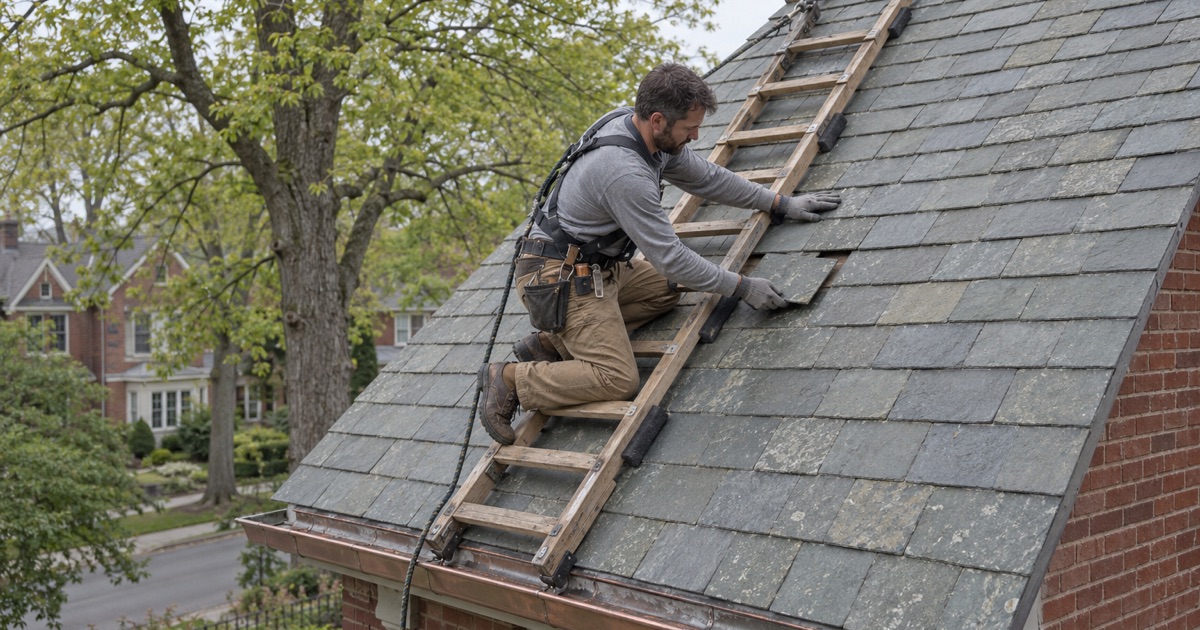
Slates crack from falling branches, ice, foot traffic and age. We remove the broken piece by cutting its nails with a slate ripper, slide in a matching slate, and secure it with a copper nail under a bib or with a slate hook, so the repair holds without leaving a nail exposed to water.
Removing a broken slate the right way does not disturb the sound pieces around it. Prying and hammering from the surface, by contrast, often cracks two more slates for every one replaced.
Slipped Slates and Nail Failure
When slates slide down the roof, the cause is usually the original nails rusting through rather than the stone failing. Older slate roofs were often fastened with iron nails that corrode long before the slate wears out. We refasten slipped pieces with copper nails or hooks and check the surrounding area for more nails near failure.
If nail failure is widespread across a slope, we explain the option of stripping and relaying that section on new copper nails, reusing the sound slate, which gives the roof decades more service without replacing the stone.
Hooks, Bibs and Copper Nails
Slate hooks are nailed to the deck between the slates of the course below, and the new slate rests on the hook. A bib is a small piece of copper slipped under a face-nailed slate to cover the nail hole. Each method has its place, and we choose based on the slate’s size, the roof’s pitch and where the repair sits.
Flashing on Slate Roofs
Valleys and Chimneys
On many slate roofs, the metal in the valleys and around the chimneys wears out decades before the slate. Thin, rusted or cracked valley metal and failing chimney flashing are among the most common causes of leaks on slate roofs. We rebuild them in copper or lead-coated copper, which match the long life of the stone.
Replacing valley metal means carefully removing the slates along each side, installing new metal, and relaying the original slate. Done properly, the roof looks unchanged and the leak is gone.
Ridges, Hips and Snow Guards
Ridges and hips on slate roofs are capped with slate or metal, and both can loosen or crack. We reset loose ridge slates and repair or replace metal ridge caps. Slate sheds snow in sheets, so we also repair and install snow guards in staggered rows above entrances and gutters.
Avoiding the Damage Slate Roofs Suffer
Tar Patches and Asphalt Shingle Repairs
Roofing cement smeared over cracked slate, asphalt shingles slipped into gaps, and metal patches nailed through the face all trap water and make proper repair harder later. We remove these old patches and replace them with matching slate, which restores both the roof’s performance and its appearance.
Working on Slate Without Breaking It
We never walk directly on a slate roof. Hook ladders, roof brackets and padded staging spread our weight so the slate around the repair is not cracked in the process. It is slower, and it is the difference between a repair and a new problem.
Slate on North Jersey Houses
Matching Slate Color and Size
Slate roofs in this region use stone such as Pennsylvania Black, Buckingham and Vermont slates in grays, greens and purples, sometimes in patterned blends. We match the color, thickness and size of your existing slate using new quarried stone or salvaged pieces, so repairs blend into the roof.
Graduated and Textural Slate Roofs
Some older roofs use graduated slate, with the largest pieces at the eaves and the smallest at the ridge, or textural slate with thick, irregular pieces and uneven edges, often seen on Tudor-style houses. Repairs on these roofs need matching slate for that course and position, not a generic replacement.
Historic Districts
In towns with local historic districts, roof work visible from the street can require a certificate of appropriateness, and guidelines typically favor repairing slate and replacing it in kind. Matching repairs usually satisfy those rules, and we check the local requirements before starting work.
When Slate Needs Replacing
Signs the Slate Itself Is Failing
Slate that flakes, delaminates, turns soft or crumbles when handled has reached the end of its life, and patching it one piece at a time stops making sense. New Jersey’s re-roofing rules do not allow a new layer over slate, so replacement means a full tear-off.
Replacement Options
When replacement is necessary, options include new natural slate, synthetic slate such as DaVinci composite, and slate-look designer shingles. We explain the weight, appearance, cost and lifespan of each, so the replacement suits both the house and your plans.
- 20+ Years on North Jersey Roofs
- Itemized Written Scopes
- Attic-to-Ridge Leak Tracing