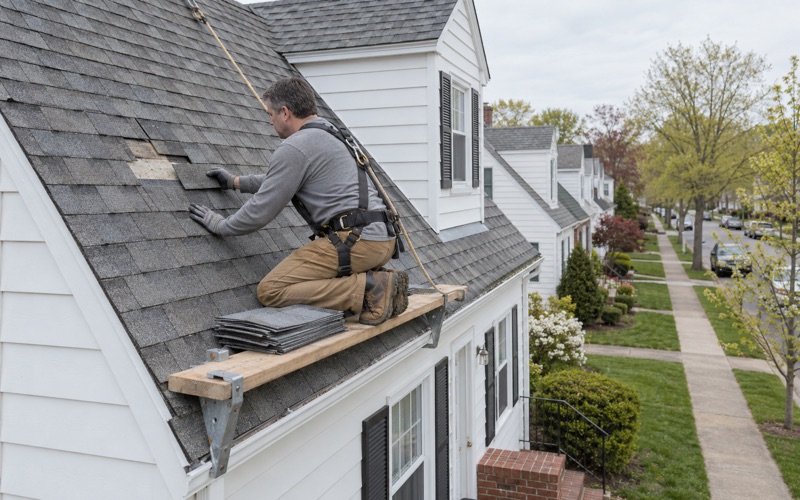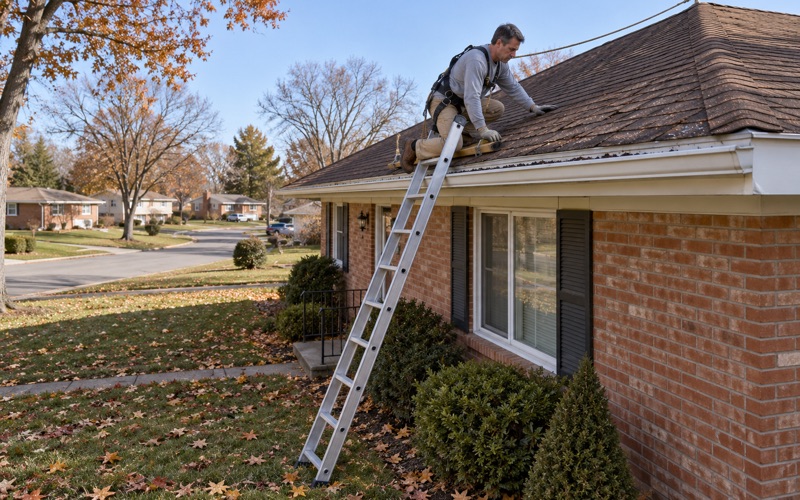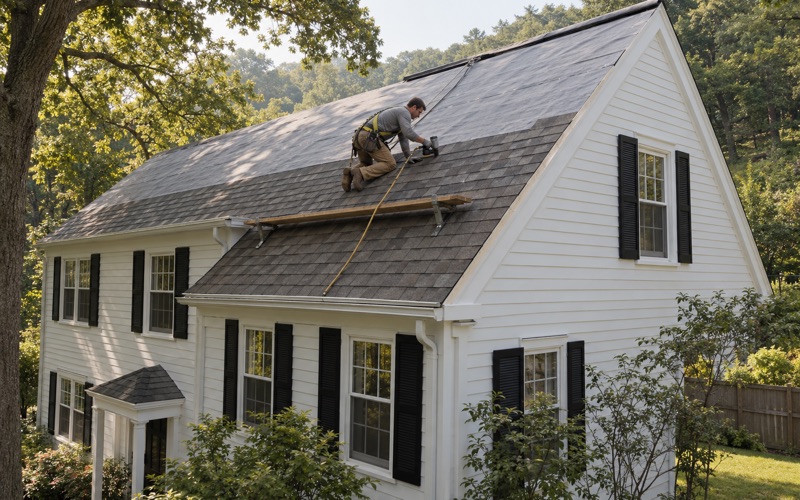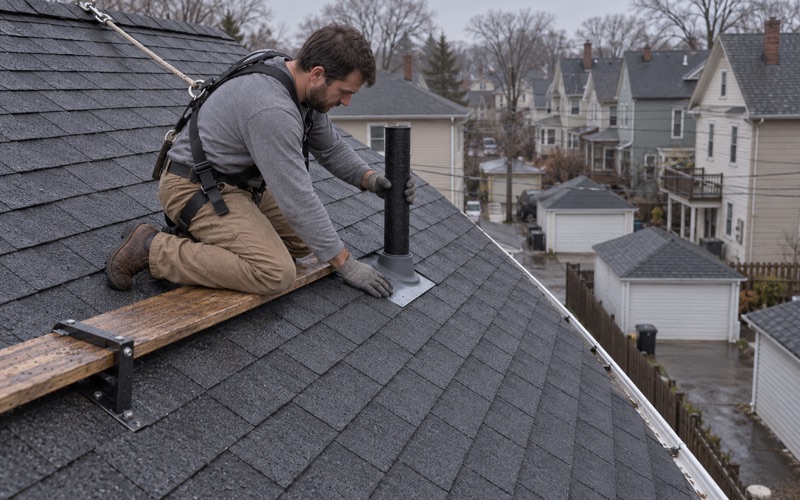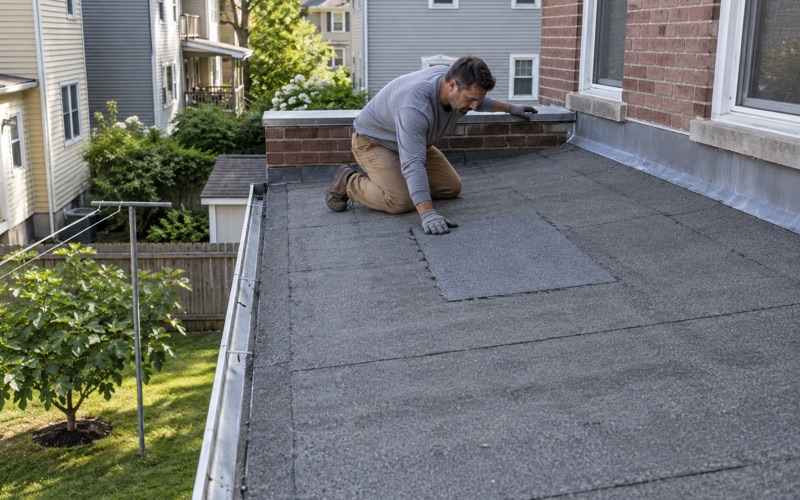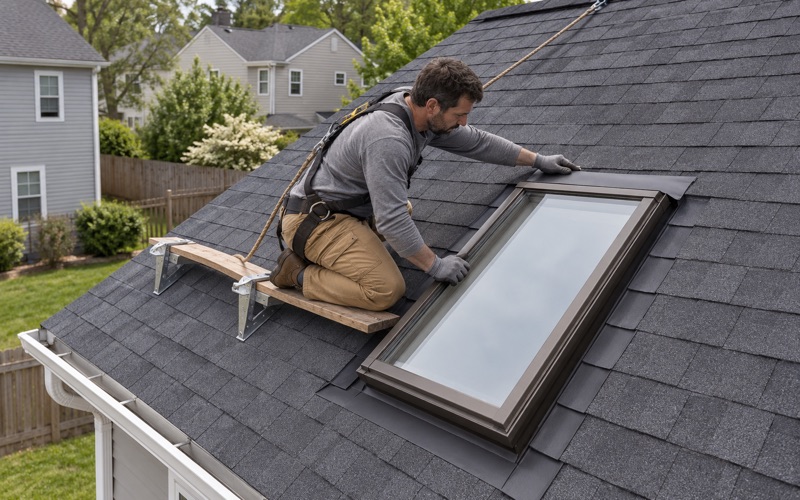
Clifton Elite Roofing brings more than 20 years of hands-on work to roofing in Wanaque, and every job here starts the same way: we find out what is actually wrong before anyone mentions a price. A leak call means a look from inside the attic as well as across the shingles, because water that stains a bedroom ceiling often entered several feet uphill at a pipe boot, a valley or a chimney. Once the entry point is found, you get a plain answer on whether the roof can be repaired, and replacement only comes up when a repair would be money spent twice.
When a new roof is the right call, our written scope prices tear-off, decking, underlayment, flashing and ventilation on separate lines. That lets you set our number beside any other bid and see exactly where the two differ. Every contract is drawn up under New Jersey’s home improvement rules, including the three-day cancellation notice.
On a lot of Wanaque properties, though, the first conversation is not about shingles. It is about the oak or maple leaning over them, and in this borough that tree has its own paperwork.
Trees over Wanaque roofs need a borough permit
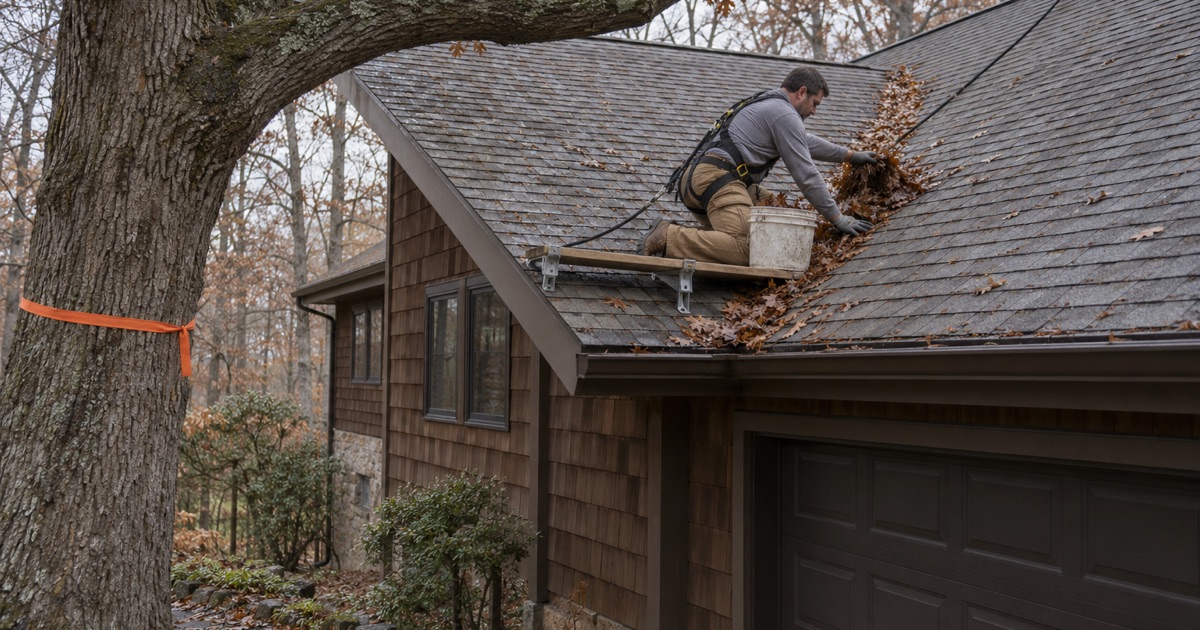
Wanaque regulates tree removal on private property, and that changes the order in which a roof project happens. If a limb hangs across the ridge or a trunk leans toward the house, taking it down is a matter for the borough’s Zoning Officer, with an inspector checking the site before anything is cut. We do not remove trees and we do not file for the tree permit, but we plan the roof schedule around it so the tree work and the roof work never collide.
The borough’s tree removal application
The form is titled Application for Removal of Trees Other Than for New Construction, Major Subdivision, Industrial or Commercial, and it falls under Ordinance #16-90-96, Chapter 104 of the borough code. It asks for the name, address and license number of whoever is doing the removal, along with a copy of that license. The applicant also states the reason for removal and how many trees are involved.
A survey or a sketch of the lot has to accompany the application, with each tree marked on it. The tree itself gets marked on the ground as well, with ribbon, rope or an ‘x’, so the inspector knows exactly which trees are coming down. The permit fee printed on the form is $10.00.
What the Zoning Officer can require
Approval rests with the Zoning Officer, and the form states that the Zoning Officer at his discretion may require the replacement of said tree(s). It also says plainly that all stumps must be ground. Homeowners sometimes assume a tree that threatens the house can simply be dropped the same week, and in Wanaque that is not how the process reads.
For anyone weighing a new roof under a big canopy, it helps to know that a replacement tree may be part of the approval. Where it goes, and how tall it will grow, is worth thinking about before the new shingles are on.
How we sequence the two jobs
When we inspect a roof with a tree problem, we photograph the contact points: scuffed granules where branches drag, gutters packed with leaf litter, moss on the shaded slope. You get those photographs to take to your tree company and to the Zoning Officer if they help explain why the work is needed. Our start date is then set after the tree is down and the stump is ground, so a crew is never working under a limb that is scheduled to come off.
Looking for roofing closer to Roselle Park? See Roofing in Roselle Park.
Lakes, the reservoir and the Highlands slopes
Wanaque is lake country. The borough holds 8.07 square miles of land and 1.26 square miles of water, and its named localities include Lake Inez, Lake Washington, Meadow Brook Lake, Ramapo Lake and Stephens Lake. It sits inside the Highlands preservation area, and the Wanaque Reservoir, impounded by the Raymond Dam, lies partly within its borders and partly in Ringwood.
Why that matters to a roof
Houses tucked into wooded slopes near water stay shaded and damp longer than a roof in an open suburban grid. The north-facing planes on those lots tend to hold moss and algae, and valleys collect needles and leaves that dam water against the shingles. On replacements in these settings we lean toward shingles with algae-resistant granules and open valleys lined with valley metal, which shed debris better than a closed-cut valley.
The water supply here is regional, too. The reservoir feeds Newark, Paterson, Passaic and our own home base of Clifton, among other cities, which is a fair reminder that the hills around it shed a great deal of rain.
What the Raymond Dam station records
The NOAA cooperative station at the Raymond Dam lists 1991-2020 normals of 48.20 inches of precipitation a year, an annual mean temperature of 51.7 degrees, and 120.8 days a year with a low at or below 32 degrees. That is a long freezing season for a roof to sit through. It is why we look hard at attic insulation and airflow on every visit, since warm air leaking into a cold attic is what melts snow on the upper roof and refreezes it at the eaves.
Underlayment and ventilation choices
On our replacements we typically lay a self-adhering ice and water barrier meeting ASTM D1970 along the eaves and in the valleys, with a synthetic underlayment under ASTM D8257 across the field. New Jersey’s ice barrier bulletin applies only in Sussex County, so in Wanaque this is our own practice rather than a code mandate. Ventilation is checked on every replacement, with soffit intake balanced against a ridge vent so the attic actually breathes.
Haskell’s prewar houses and the 2000s builds
Wanaque’s housing is split almost evenly between very old and quite new. Census estimates count 973 homes built before 1940, about 21.9 percent of the borough’s 4,450 units, and 955 built between 2000 and 2019. Haskell, which has its own ZIP Code and sits along the Wanaque River near Back Beach Park, holds a good share of the older stock.
Older roofs in Haskell and Midvale
A prewar house often carries board sheathing instead of plywood, and sometimes two layers of shingles already. When a roof has two layers, or there is slate or tile underneath, New Jersey’s rehabilitation subcode calls for a full tear-off, and we explain that before the estimate rather than after. Any decking that turns out to be rotted once the old roof is off is photographed and shown to you before it is replaced, at a per-sheet price already written into the contract.
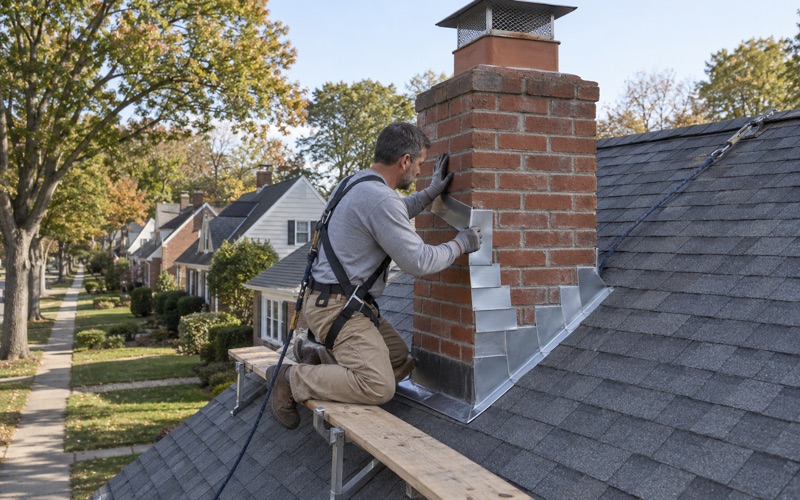
These houses also tend to have brick chimneys and dormers that rely on step and counter flashing. We replace that flashing with the roof instead of bending old metal back under new shingles. On homes built before 1978, work that disturbs painted trim or fascia follows the EPA’s lead-safe RRP rule.
Newer construction on the hillsides
The homes built since 2000 are reaching the age where their first roof starts to show wear, especially on wooded lots. Many were built with architectural shingles and ridge vents, but we still measure the net free area at the soffits, because a ridge vent without enough intake below it pulls air from the wrong places. A first replacement is the cheapest time to correct that.
Two-family homes and larger buildings
About 568 of Wanaque’s homes are in two-unit buildings, and when we work on one we schedule with both floors in mind. The upstairs tenant hears from us about arrival times and where we need access, so nobody is surprised by ladders at the back door. In the borough’s larger condominium buildings, the roof is usually a common element handled by the association, so an owner there should start with the board before calling any roofer.
Building & Zoning at 579 Ringwood Avenue
The borough offices are at 579 Ringwood Avenue, and Building & Zoning lists Michael Hafner as Construction Official and Fire Subcode Official, with Vinny Bruno as Building Subcode Official. The posted construction permit packet is the state’s standard UCC application, form F100. The page carries separate borough forms for fences, sheds and tree removal, but no roofing-specific guidance.
When a permit is part of the job
Replacing the roof covering on a detached one- or two-family house is treated as ordinary maintenance under N.J.A.C. 5:23-2.7, so a straightforward shingle replacement on that kind of home is not a permit job. Work that goes beyond the covering, such as structural framing repairs, is a different matter. When a project crosses that line, we tell you before work starts and the application goes to the construction office here.
Storm damage and your claim
After a windstorm, we photograph what we find, from lifted tabs to cracked flashing, and write it up so you have a clear record for your own insurance claim. If you ask, our crew will meet the adjuster on site and walk the roof with them. The claim itself stays between you and your insurer.
How the work days run
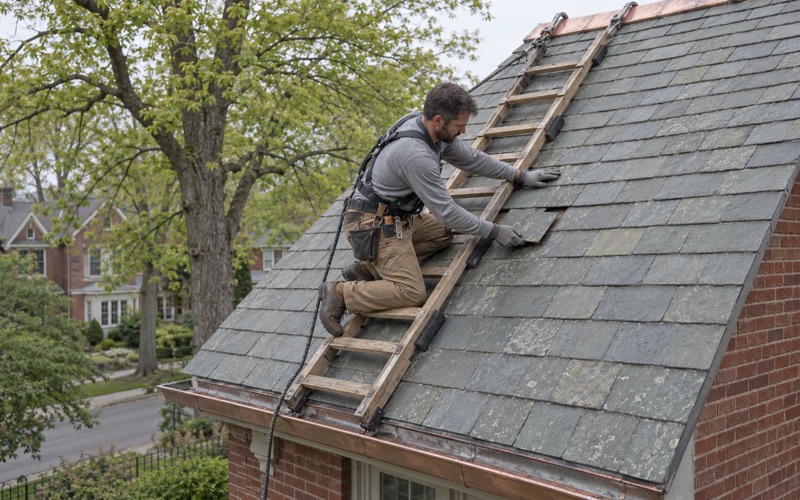
At the end of every work day we clean the yard, the driveway and the gutters, and we run a magnet sweep for roofing nails. If your roof carries solar panels, the removal and reinstall are written into the schedule from the start, not discovered when the crew arrives. Where an older home still has a sound slate roof, we repair it with matching slate, copper nails and slate hooks rather than tearing it off by default.
- 20+ Years on North Jersey Roofs
- Itemized Written Scopes
- Attic-to-Ridge Leak Tracing