Clifton Elite Roofing has handled roofing in Wood-Ridge and the surrounding part of Bergen County for more than 20 years, and the first thing we ask a caller here is how old the house is. In this borough that one answer sorts a roof into one of two very different jobs, with different questions, a different scope and different paperwork.
Whatever the age, the visit starts the same way. A leak call means we look in the attic as well as on the roof, so the water is traced to the spot where it actually enters before anything is priced. You also get a plain answer on whether a repair will hold before anyone mentions a replacement.
When a new roof is the right call, our written scope breaks tear-off, decking, underlayment, flashing and ventilation into separate lines. That lets you set our estimate next to anyone else’s and compare the two item by item instead of guessing at a single total.
From B-29 Engine Plant to Wesmont Station Townhomes
Much of the newer housing in Wood-Ridge stands on ground that once held the Wright Aeronautical plant, the Curtiss-Wright factory that built B-29 engines during World War II. The building was dug into a hillside under a 32-acre roof, with ten concrete engine-test sheds on the property. A 2005 plan for the site called for 266 single-family homes, 90 townhomes and 381 apartments on a 67-acre first phase, along with a rail stop.
That stop, Wesmont station, opened in May 2016, and the neighborhood around it took the Wesmont Station name. The result shows up plainly in census counts: 876 of the borough’s 3,976 housing units, or 22.0 percent, were built in 2010 or later. One-unit attached homes, the townhome type, make up 12.4 percent of the stock.
What a first-cycle roof usually needs
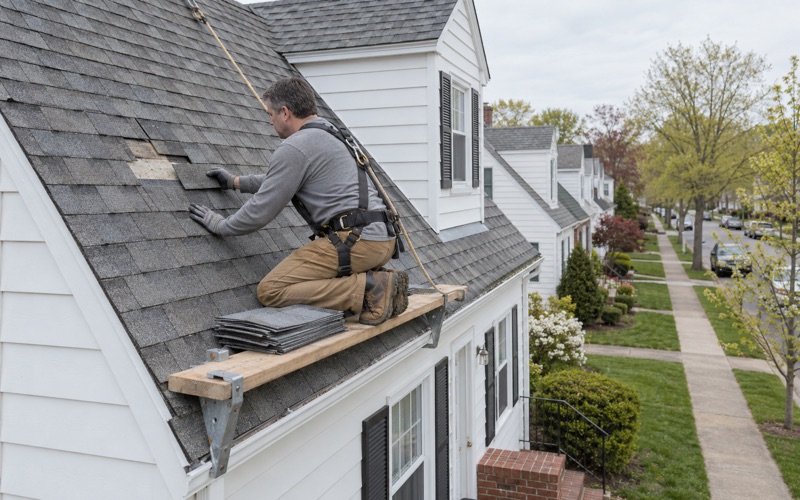
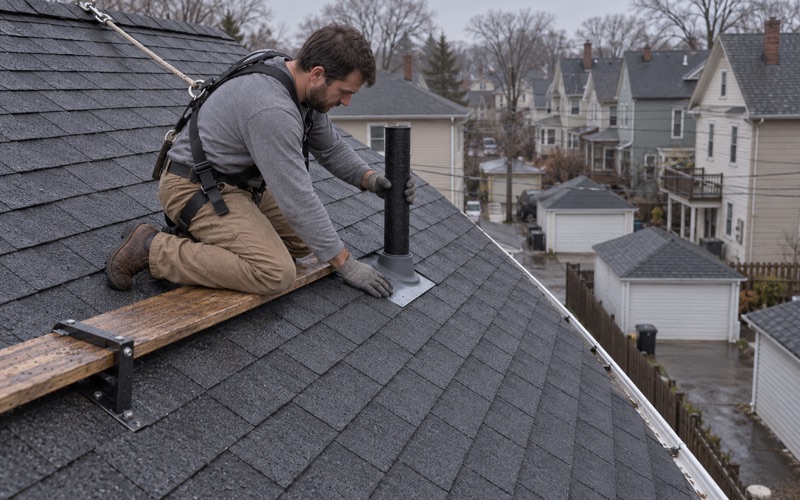
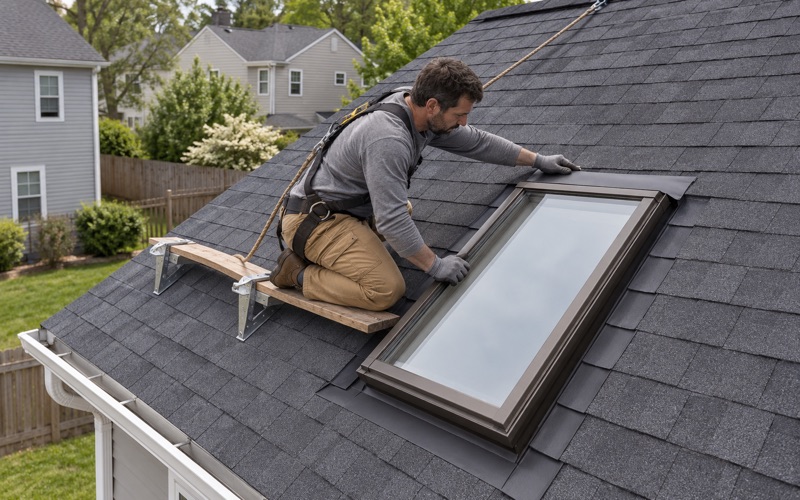
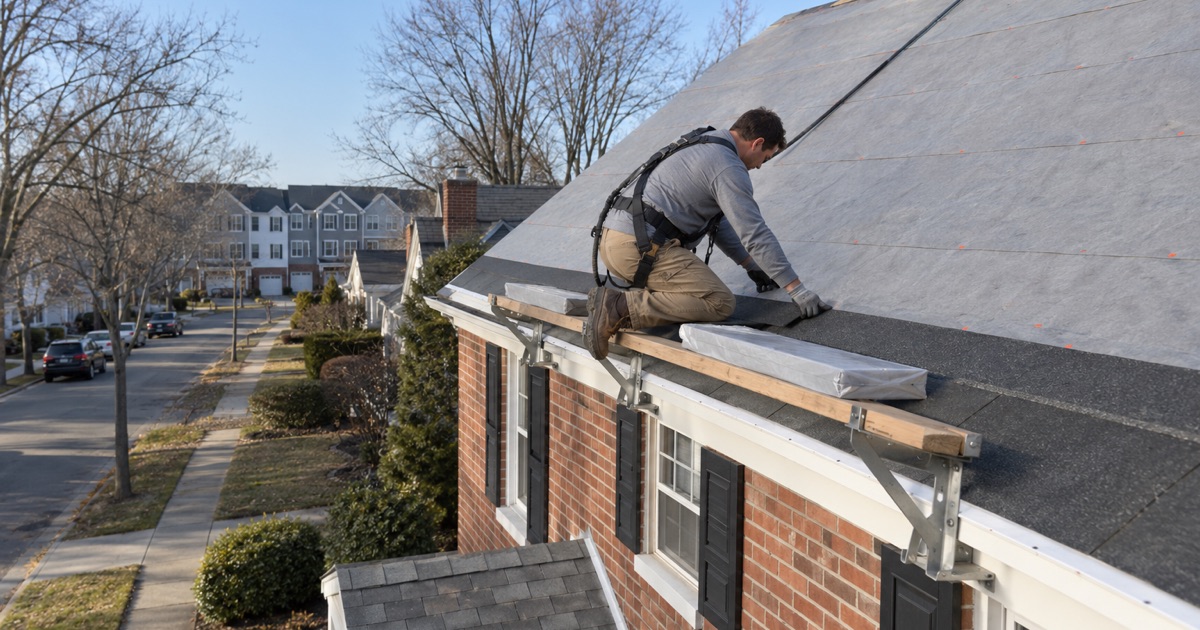
A roof put on in the 2010s is still on its original shingles, so the calls we get from these homes are rarely about a worn-out field. They tend to center on a single spot: a pipe boot that has cracked around the vent stack, a run of step flashing where a wall meets a lower roof, or a kick-out flashing that is missing at the bottom of a sidewall and letting water behind the siding.
Those are repair conversations, and we treat them that way. We find the entry point from the attic side, show you what we found, and quote the fix on its own. A young roof with one bad detail should not be priced as a replacement, and we will tell you so before anything else is discussed.
Storm damage on newer roofs
Wind can lift tabs and break the seal strip on architectural shingles of any age, and a townhome row exposes long, uninterrupted roof planes to it. After a storm we photograph the damage and write it up so you have a record for your own claim. If you ask, our crew will meet the insurance adjuster on site to walk the roof; the claim itself stays between you and your insurer.
When individual shingles need replacing on a newer roof, matching matters. We look for the same product line and color where it is still made, such as GAF Timberline HDZ, Owens Corning Duration or CertainTeed Landmark, and tell you plainly if an exact match is not available.
Looking for roofing closer to Rutherford? See Roofing in Rutherford.
Prewar and Postwar Houses on the Ridge
The other half of Wood-Ridge is far older. In the same census count, 20.2 percent of units date from 1939 or earlier and another 28.4 percent from 1940 to 1959, so 48.6 percent of the borough was built before 1960. One-unit detached houses account for 50.2 percent of all homes, and two-unit buildings for 4.5 percent.
A house from the 1920s through the 1950s on the ridge is often on its third or fourth roof, not its first. That history is the starting point for the estimate, because what sits under today’s shingles decides how the job has to be done.
Counting layers before quoting a tear-off
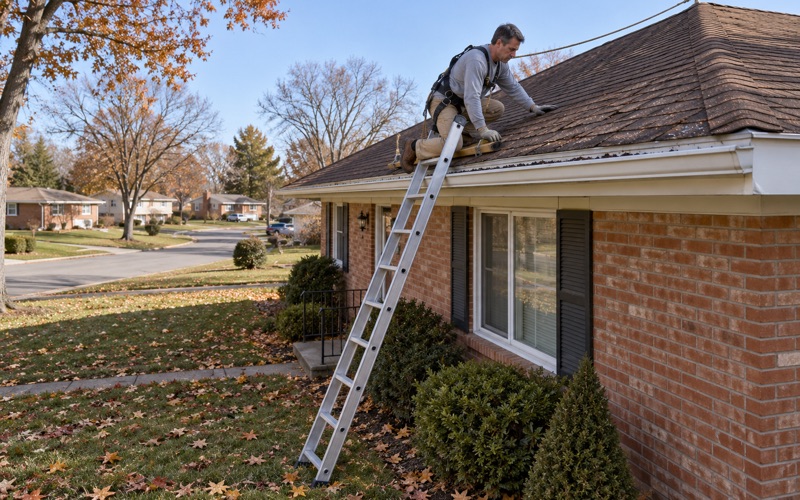
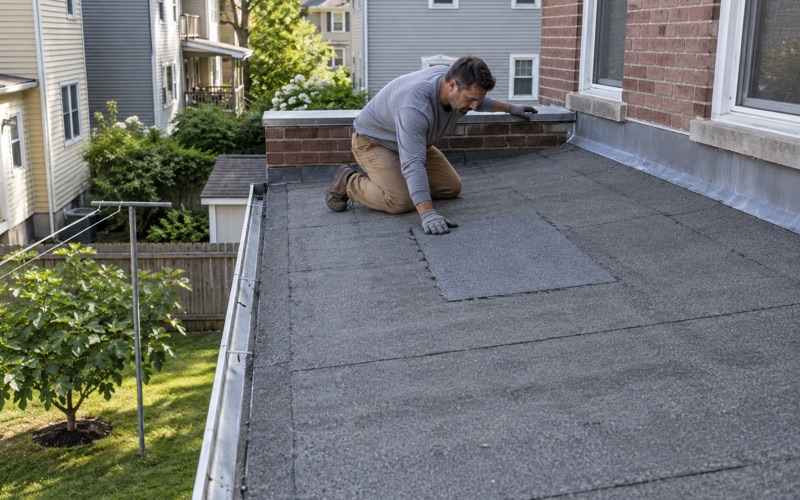
New Jersey’s rehabilitation subcode, N.J.A.C. 5:23-6, does not allow a new roof to go over one that already has two or more layers, or over slate, wood shake or tile. On an older house we check how many layers are up there before we write a number. If an overlay is off the table, we explain why before you see the estimate, so the full tear-off line does not come as a surprise.
Once the old roof is off, the decking is exposed for the first time in decades. Any boards or sheets that are soft or rotted get photographed and shown to you before they are replaced, at the per-sheet price already written into the contract.
Chimneys, valleys and ventilation
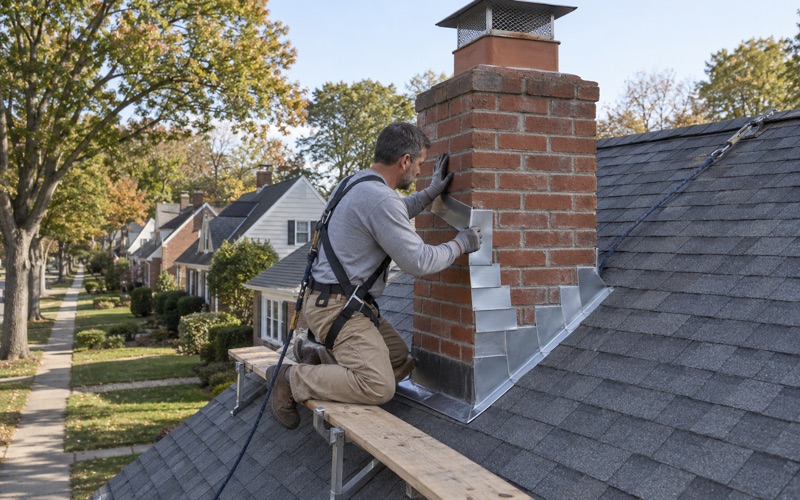
Older houses tend to carry masonry chimneys, and the chimney is where many of their leaks begin. We replace step flashing, counter flashing and chimney flashing with the roof rather than tucking the old metal under new shingles, and we add a cricket behind a wide chimney where water has been pooling. Valleys get new valley metal or a properly woven or cut closed valley, depending on the shingle.
Ventilation on these houses was often an afterthought, with a couple of gable louvers and little or no soffit intake. On every replacement we check the attic and balance intake at the soffit against exhaust at the ridge vent. On a pre-1978 house where painted trim or fascia will be disturbed, we follow the EPA lead-safe RRP rule for that work.
Slate that is still sound
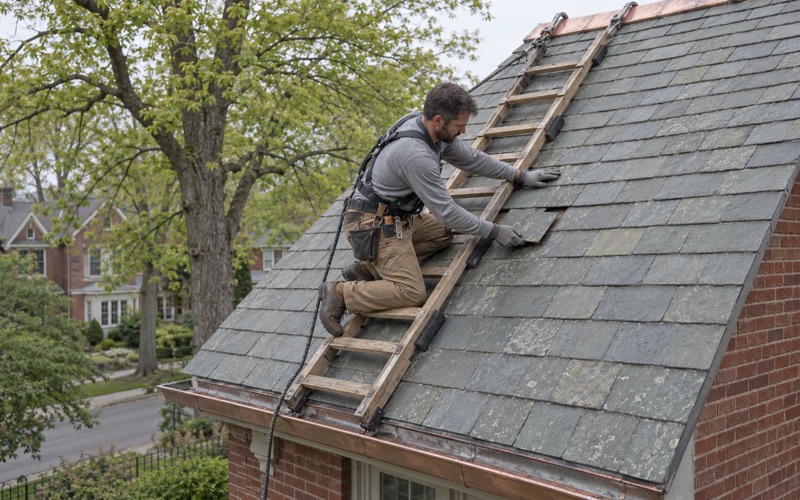
Some older Bergen County houses still wear slate. Where the slate itself is sound and the trouble is a few broken or slipped pieces, we repair it with matching slate, copper nails and slate hooks rather than tearing it off by default. Pennsylvania Black and Buckingham slate are the usual matches, and a sound slate roof repaired this way can keep going long after an asphalt replacement would have worn out.
Who Answers for a Townhome Roof Versus a House Roof
On a detached house the question of who decides is simple: the owner does. Wood-Ridge is 67.0 percent owner-occupied, and 49.6 percent of occupied units are owner-occupied detached houses. For those owners, the roof, the gutters and the schedule are theirs to settle with us.
An attached townhome is less straightforward. The roof over one unit is often a section of a single continuous roof shared with the neighbors, and community documents may assign responsibility for it to the owner, to an association, or split it in some other way. We have not reviewed the governing documents for any Wesmont Station community, so we will not tell you what yours says.
Settling responsibility before the work
Our practical advice is to pull your own deed, master deed or bylaws, or ask the management office, before you schedule anything beyond an emergency patch. Knowing who is responsible decides who signs the contract, whose insurance is involved and whether neighbors on either side need to be part of the plan.
When it is your call, we write the scope so it stops cleanly at your unit’s boundary. We note where your roof ties into the neighbor’s at the party wall, how the transition will be flashed, and what we will and will not touch on the adjoining sections.
Two-family houses and tenants
The borough’s two-unit houses bring a different kind of shared roof: one owner, two households. We schedule those jobs with both floors in mind, so the tenant upstairs knows when the crew arrives, which rooms may need attic access and how long the work will run. At the end of every work day the yard, the driveway and the gutters are cleaned, including a magnet sweep for roofing nails.
Attached Homes, Detached Homes and the Humboldt Street Office
The Borough of Wood-Ridge Construction Department works from the second floor of the Municipal Building at 85 Humboldt Street. Permits are issued from 9:00 a.m. to 3:00 p.m., inspections run Monday through Friday by calling 201-939-5188, and paper applications sit on a rack by the office door. No online portal is posted.
The department’s own page says building permits are required for most work and suggests calling to find out whether a given project needs one. That is exactly the call we make before a job starts, because the answer depends on what kind of home it is.
Why house type matters at the office
State rules under N.J.A.C. 5:23-2.7 treat roof covering work on detached one- and two-family dwellings as ordinary maintenance. An attached townhome is not a detached dwelling, so its roof falls outside that provision, and we check with the Construction Department on how that particular job should be filed. On a detached house on the ridge, we confirm the treatment with the office the same way rather than assuming.
The rehabilitation subcode’s limits on overlays apply regardless of house type, which is why the layer count we take on older homes goes into the paperwork as well as the price.
Contracts and the three-day window
Our contracts are written to New Jersey’s home improvement rules. That includes the notice of your right to cancel within three business days on a home improvement contract over $500 under N.J.S.A. 56:8-151, printed on the contract rather than mentioned in passing.
If a replacement qualifies as a capital improvement, ask us about Form ST-8, the Certificate of Exempt Capital Improvement, at signing. It affects how sales tax is handled on the job, and it is easier to sort out before work begins than after.
Planning around the neighborhood
Wood-Ridge sits on higher ground, at about 167 feet, next to the lowlands that hold Teterboro Airport, and the borough is a member town of the Teterboro Aircraft Noise Abatement Advisory Committee. The airport does not change how a shingle roof goes on, since this work is done from ladders and hoists. What does need planning is anything mounted on the roof: if your house carries solar panels, we put the panel removal and reinstall into the schedule from the start rather than discovering them on the day.
The borough’s older landmarks hint at how long some roofs here have been looked after. The Brinkerhoff House on Hackensack Avenue, listed on the National Register of Historic Places in 1984, now holds the public library. Many houses on the ridge have already carried several roofs of their own, and the next one deserves a scope you can read line by line.
- 20+ Years on North Jersey Roofs
- Itemized Written Scopes
- Attic-to-Ridge Leak Tracing